When you click on links to various merchants on this site and make a purchase, this can result in this site earning a commission. Affiliate programs and affiliations include, but are not limited to, the eBay Partner Network.
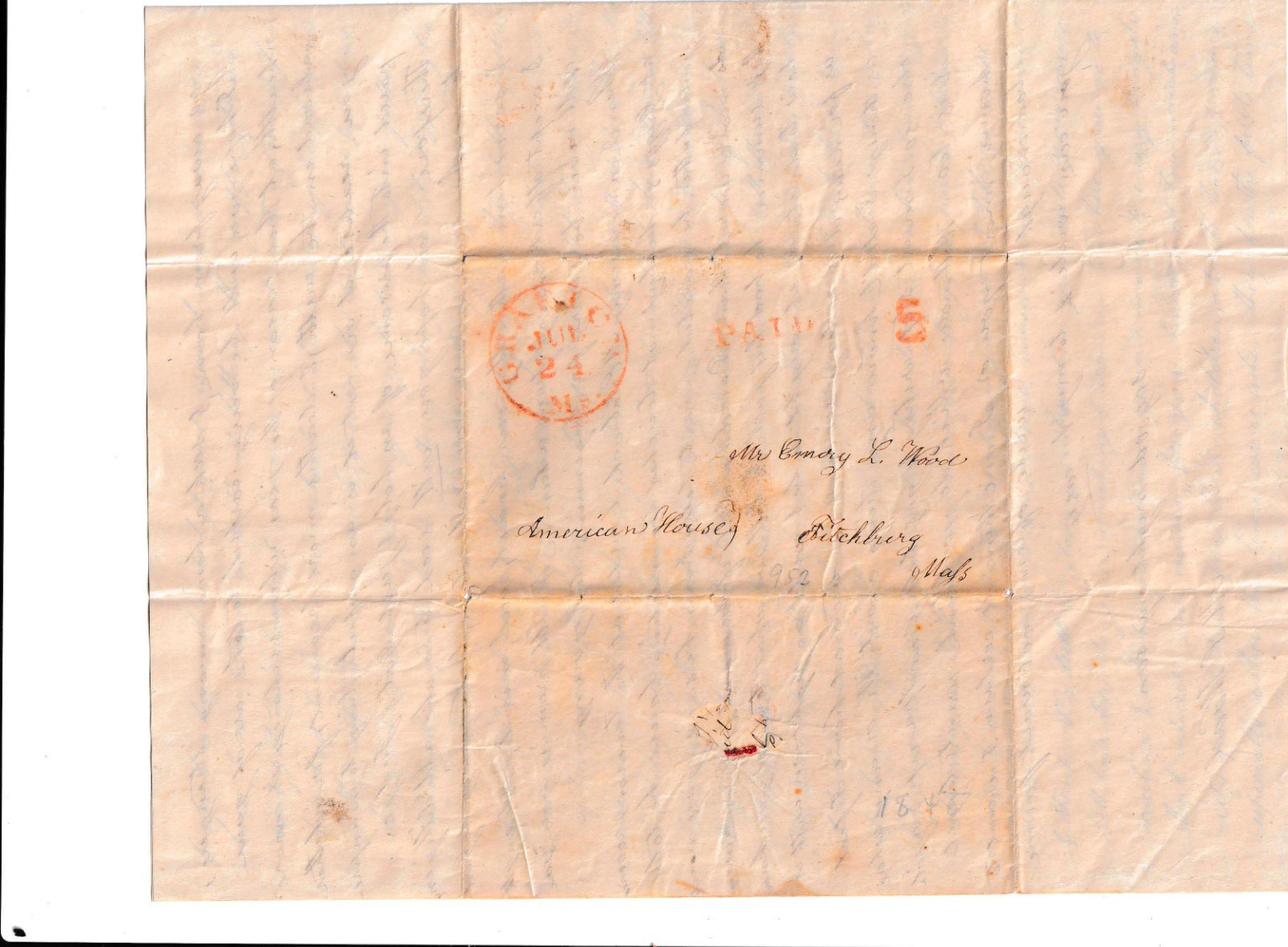
Original three-page stampless folded letter written at Grafton, New Hampshire, on July 23, 1848, and postmarked Grafton on July 24. Addressed to Mr. Enos G. Wood at the American House in Fitchburg, Massachusetts.
The outer panel bears an attractive red GRAFTON N.H. circular postmark, red PAID marking and five-cent rate notation. This represents the contemporary prepaid letter rate for a journey of less than 300 miles.
The lengthy letter was apparently written by the recipient’s mother, who signs as M. S. Wood. Its unusually detailed contents describe several family and community crises. These include a grandmother suffering from dysentery and inflammation of the stomach; an elderly grandfather being knocked down and run over by both wheels of a loaded wagon; a severe wound over his shin bone; a woman dying after a serious illness; and another man cutting his wrist and narrowly avoiding bleeding to death.
The writer also discusses domestic work, nursing family members, local movements and employment. A substantial passage gives maternal and religious advice to her son after he has left home, urging him to protect his health and “make sure your own salvation.”
An evocative piece of antebellum New England correspondence with postal-history, medical-history, religious-history, women’s-history, genealogical and local-history interest.
Please examine all photographs carefully. The transcription below has been lightly punctuated for readability; uncertain words are shown in brackets.
Transcription
Grafton, July 23, 1848
My Dear Son,
I doubt not you are out of patience with me for not answering your letter sooner, but if you could see how entirely my time has been taken up since I came here, you would not complain of me for delay.
I came up Monday night, after washing & ironing & baking, & when I got here I found Mother very sick indeed with dysentery & inflammation of the stomach, & she has not been able to sit up any since till today. She is considerable more comfortable & we hope she will get along now, though she is very weak yet.
I suppose your father told you how your Grandfather got hurt. It seems almost a miracle that he should fall so & have both wheels run over him, & not break any bones or hurt him worse, when we consider his age & the load. If it had passed over him any other way it seems that it must have been worse, although it is bad enough now.
The gash is about four inches long, right on the shin bone, & has left the bone rough. When I came it took 3 men & Aunt Martha & I an hour & a half to get him up & back, & he would halloo like a loon if you moved the toes the 16th of an inch. It was like taking his life away, it hurt him so, & that was the first time he was got off the bed.
Now we can get him up without hurting him very bad, but it is quite a job yet, though we have got him in a chair twice, & he gains as fast as we could reasonably expect.
When he was hurt we heard of it that afternoon, & I could not come, for I was not well, so Emily came & stayed till Monday morn & came home sick, so I came. I was to stay till she could come again, & she has been able to but just crawl round since, so here I am & can’t go without letting them suffer, for we can’t get anybody.
Mr. Dwight Hardy came for me to watch with his wife that night, but I did not go till Thursday night. She was very sick indeed, but lived till Tuesday, & then died.
Mr. Brigham Hardy cut his wrist, so they said he would bleed to death in 5 minutes if he had not had presence of mind enough to cord it till the doctor came.
Mr. Burnap is getting along nicely. Isaac Congdon has got home. I don’t know why—have not asked your father, & he is gone up to Grandfather Wood’s.
Grandmother was down here day before yesterday. She sent her love to you. When I wrote you she was glad to hear you had got so good a place, & [fared] as well, & so was I, though I hope you won’t like so well you won’t want to come back when your time is out.
Next time you write you must tell how they do your washing & ironing, & where you go to meeting, & what acquaintances you have made, & everything else that interests you some, for you know not how much anxiety parents have for their children at all times, & more especially when the time comes when they for the first time go away from home & seek a home among strangers.
I hope you will be very careful to take care of your health at this season of the year, when sickness is more abroad in the earth & deaths more frequent, for whether you realize it or not, it is an awful thing to go unprepared into the presence of a holy & just God & Judge.
When I came away Mr. [Caton/Cotton] boarded at the tavern & roomed at Griggs’s. He had not touched the meeting house. He told your father he wanted you to help him. He said you would do more work than David Hardy, & if he went to go away this summer, he had but just to tell you what to do & you knew how to do it as it ought to be.
As for news, it is so long since I have been at home I feel as though I didn’t know anything about W— or anywhere else, so I must stop writing & go & help Grandpa up.
Well now, what do you think—want to get home most, you or I? One thing is certain: I won’t [be] bad enough [to] write often & not wait for me. You can write 2 to my 1 easy.
So good night, my son.
M. S. Wood