When you click on links to various merchants on this site and make a purchase, this can result in this site earning a commission. Affiliate programs and affiliations include, but are not limited to, the eBay Partner Network.
This is a particularly interesting mid-19th-century maritime manuscript because the vessel named at the top of the letter appears to correspond with the American schooner Alexander Mitchell documented in contemporary records connected with Atlantic commerce, Liberia, and suspected illegal slave-trading activity off West Africa.
The letter itself is a personal family communication and does not discuss slavery directly. Its historical importance lies in the fact that the writer can now be independently documented as a ship captain, and the recipient can be independently placed in the same Salem household with him.
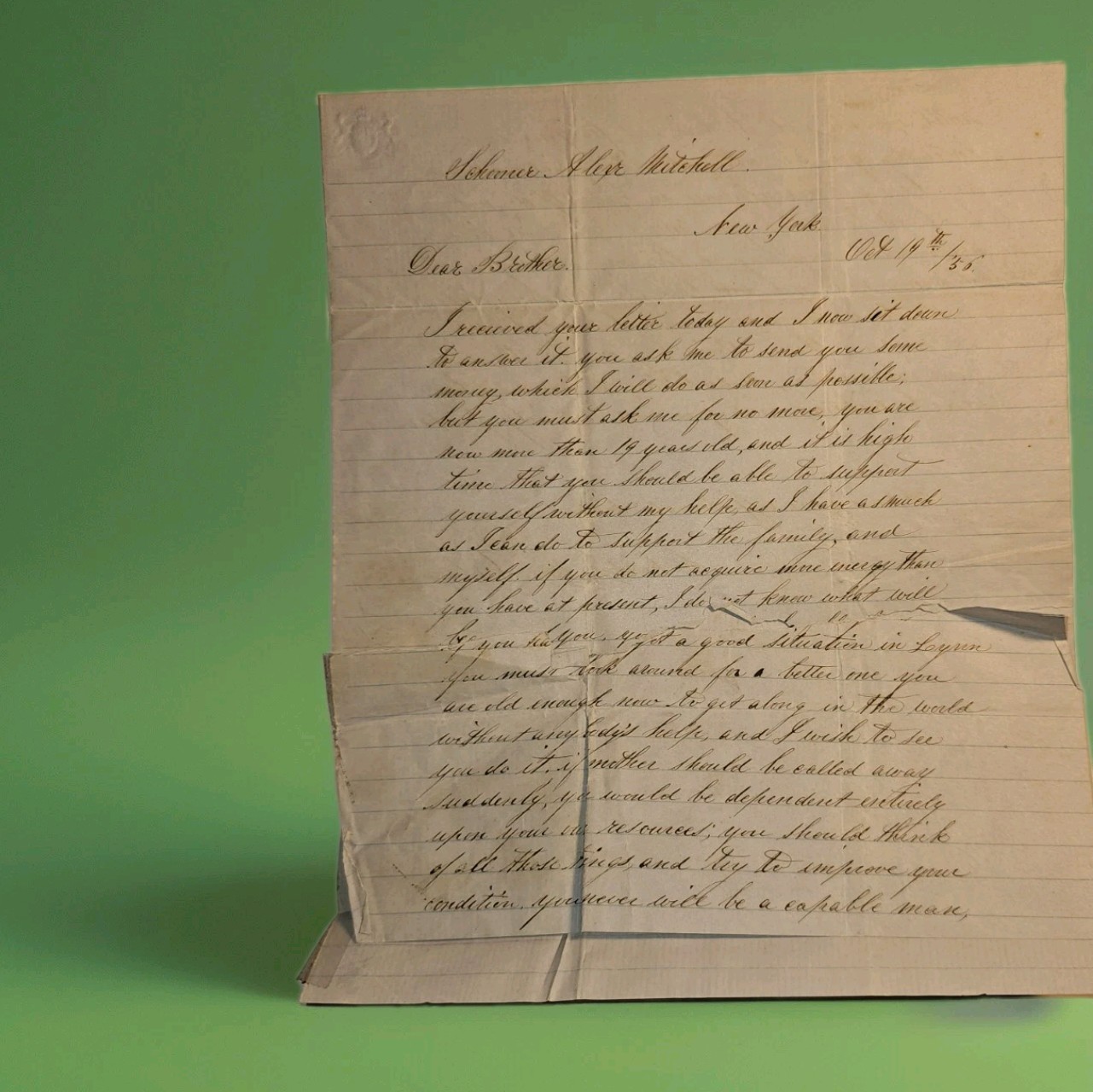
Manuscript Heading
Schooner Alex Mitchell
New York
Oct 19th /56
Charles then writes:
Dear Brother,
I received your letter today and I now sit down
to answer it. you ask me to send you some
money, which I will do as soon as possible;
but you must ask me for no more, you are
now more than 19 years old, and it is high
time that you should be able to support
yourself without my help...
He tells James that if he has not secured a good situation in Lynn, he should look for a better one. Charles urges him to become independent, noting that if their mother were suddenly “called away,” James would have to rely entirely on his own resources.
The second page becomes an unusually direct statement of personal responsibility:
“you are altogether too quiet, and easy,
you have got no confidence in yourself; do not
be afraid to speak your mind...”
Charles concludes with:
“Strive to get along through your own exertions, be ambitious, be prudent, be wise, be virtuous, and you will certainly prosper.”
Signed:
From your affectionate brother,
Charles H. Nelson
The integral address panel is directed to:
Mr. James F. Nelson
Salem
Mass.
Charles H. Nelson
The writer can now be independently identified in the 1864 Salem Directory, which records:
“Nelson Charles H., captain, boards 21 Beckford”
This is highly significant because it confirms that Charles H. Nelson was not merely a passenger or casual traveler. He was a professional ship captain.
That makes the 1856 heading:
“Schooner Alex Mitchell / New York”
far more meaningful.
Although the present evidence does not yet prove that Charles was captain of the Alex Mitchell specifically in 1856, his later documented occupation strongly supports the interpretation that his association with the schooner was professional and maritime.
James F. Nelson
The recipient is James F. Nelson, not James H. Nelson.
This identification is strongly corroborated by the same 1864 Salem Directory, which lists:
“Nelson James F., boards 21 Beckford”
Charles H. Nelson and James F. Nelson are therefore documented at the same address in Salem, eight years after this letter was written.
This is powerful independent confirmation of the brotherly relationship represented in the manuscript.
The letter states that James was more than nineteen years old in October 1856 and was apparently connected with employment in Lynn, Massachusetts.
The family structure is further suggested by another resident at the same address:
“Nelson Samuel F., shoemaker, house 21 Beckford”
Samuel appears to have been the householder at 21 Beckford while Charles and James boarded there. He was almost certainly a close family relation, though his exact relationship should be confirmed through census or vital records before making a definitive claim.
The Schooner Alexander Mitchell
Contemporary commercial notices identify an Alexander Mitchell as a:
- three-masted schooner
- approximately 173 registered tons
- advertised as capable of carrying about 180 tons or 1,200 barrels
- built in Philadelphia
- coppered and copper-fastened
- equipped with passenger accommodations
- fitted with a large cabin and house on deck
- marketed as “ready and fit for any voyage”
An early sale advertisement offered the nearly new vessel for sale, freight or charter through:
J. & N. Briggs, 40 South Street
A February 2, 1854 notice concerning a change of ownership described the vessel as:
“schooner Alexander Mitchell, (three-masted,) 173 tons, built in Philadelphia, five years old”
and valued it at approximately $6,500.
These details establish a substantial Atlantic merchant schooner built around 1849.
Liberia and the Illegal Slave Trade
The most historically important material associated with the vessel appears in contemporary British consular correspondence.
In a letter dated September 10, 1855, J. G. C. L. Newnham, British consul at Monrovia, reported that on August 19 an American vessel named the Alexander Mitchell had arrived at Monrovia from New York.
He described the vessel as suspicious and stated that:
its owner had been engaged in the slave trade
Later reports attributed to Newnham further alleged that the Alexander Mitchell had participated in a slaving expedition near Cape Palmas and the Bights, with contemporary accounts claiming that hundreds of Africans had been taken aboard.
This reporting was later reproduced in anti-slavery literature issued by the Religious Society of Friends in Pennsylvania, New Jersey, Delaware and surrounding states.
The present manuscript is especially compelling because, only about a year later, Charles H. Nelson writes from:
“Schooner Alex Mitchell / New York”
The combination of:
- vessel name
- New York connection
- 1850s chronology
- Atlantic trading pattern
- Charles H. Nelson’s independently documented career as a captain
creates a strong circumstantial case that the schooner in this letter may be the same vessel appearing in the West African reports.
However, the identification should still be described as probable rather than absolutely proven unless further registry, ownership, crew, or customs records link Charles H. Nelson directly to the specific Alexander Mitchell involved in those voyages.
Other Maritime Activity
Contemporary reporting also records a schooner Alex. Mitchell operating between New York and Puerto Rico.
One maritime disaster notice reports that the schooner, while bound from New York to Puerto Rico, was struck off the New Jersey Highlands by the brig S. Thurston.
The collision badly damaged the schooner, reportedly cutting her down close to the water’s edge and damaging spars and rigging, forcing her to return to New York.
This fits the broader pattern of an Atlantic and Caribbean merchant vessel operating out of New York.
Historical Importance
This letter combines several important collecting areas:
American maritime history, ship captains, antebellum shipping, Salem and Lynn Massachusetts history, New York commerce, Liberia, Atlantic trade, anti-slavery history, illegal slave-trade research, family correspondence, and manuscript Americana.
Its significance is increased by the fact that the writer is independently documented as a captain, and the recipient is independently documented living with him in Salem.
The manuscript itself does not mention slavery, and Charles H. Nelson’s personal involvement in any slave-trading activity has not been established. The importance lies in his direct connection to the schooner and the strong possibility that this is the same Alexander Mitchell documented in contemporary West African slave-trade reporting.
Condition
Please review all photographs carefully.
The letter has several significant tears and other condition problems, including:
- multiple tears through the sheet
- splitting along old fold lines
- paper losses
- old repairs or reinforcement
- edge wear
- creasing
- toning
- scattered staining
- a hole/loss on the outer address sheet
- remnants of the original sealing wax
Despite the condition, the most important portions remain intact and legible, including:
- “Schooner Alex Mitchell”
- New York dateline
- October 19, 1856 date
- substantial body of the letter
- Charles H. Nelson signature
- James F. Nelson address panel
A historically important maritime manuscript with substantial research potential.