When you click on links to various merchants on this site and make a purchase, this can result in this site earning a commission. Affiliate programs and affiliations include, but are not limited to, the eBay Partner Network.
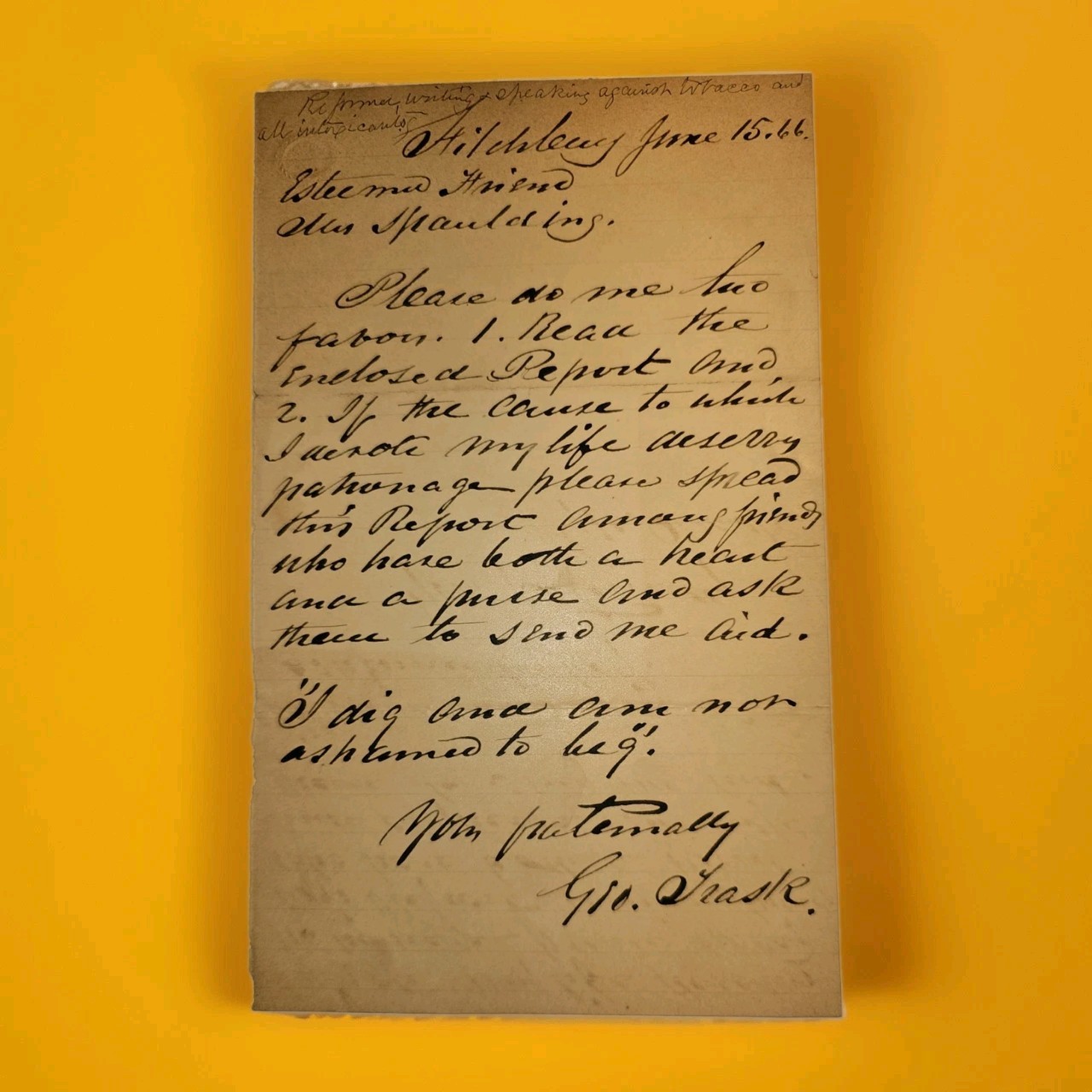
Written from Fitchburg, Massachusetts, June 15, 1866, the letter is addressed to “Mr. Spaulding” and concerns Trask’s reform work, fundraising, and distribution of one of his reports.
This is an unusually strong content letter in which Trask directly states that he has devoted his life to the cause and asks his correspondent to circulate his report among sympathetic supporters.
Transcription
Fitchburg June 15. 66.
Esteemed Friend
Mr Spaulding.
Please do me two
favors. 1. Read the
enclosed Report and
2. If the cause to which
I devote my life deserves
patronage — please spread
this Report among friends
who have both a heart
and a purse and ask
them to send me aid.
“I dig and am not
ashamed to beg.”
Yours fraternally
Geo. Trask.
A later handwritten notation at the top identifies him as a:
“Reformer, writing & speaking against Tobacco and all intoxicants.”
The piece is accompanied by an old biographical clipping describing Trask’s career and his anti-tobacco activities.
Historical Significance
The letter is especially desirable because it is not simply a signature or routine clerical note. It directly addresses the reform movement to which Trask devoted much of his adult life.
His appeal for supporters with “both a heart and a purse” gives a vivid glimpse into how 19th-century reform campaigns were financed and circulated through networks of sympathetic clergy, lecturers, publishers, and private donors.
The memorable line:
“I dig and am not ashamed to beg.”
appears to be a humorous inversion of Luke 16:3, which reads in part, “I cannot dig; to beg I am ashamed.” Trask turns the phrase into a declaration that he is willing both to labor and to solicit funds for his cause.
Biography of George Trask
George Trask was born in Beverly, Massachusetts, on August 15, 1798. He graduated from Bowdoin College in 1826 and from Andover Theological Seminary in 1829. He was ordained in 1830 and served Congregational pastorates in Massachusetts, including Framingham, Warren, and Fitchburg.
By the middle of the 19th century, Trask increasingly devoted himself to social reform, particularly temperance and opposition to tobacco use.
He became one of the most persistent and recognizable American anti-tobacco campaigners of his generation. Trask traveled widely, delivered lectures throughout the United States, distributed reports and pamphlets, and authored numerous anti-tobacco tracts.
His work belonged to the broader evangelical reform culture of 19th-century America, in which religious figures frequently became active in movements involving temperance, abolition, moral reform, education, and public health.
Trask continued his reform work from Fitchburg until his death there on January 25, 1875.
The Recipient
The letter is addressed simply to “Mr. Spaulding.” The recipient was likely someone within Trask’s New England religious, reform, or philanthropic network, although the precise identification cannot be established from the letter alone.
Condition
Original 1866 manuscript letter on period paper.
Expected age toning, folds, edge wear, and minor handling consistent with a document more than 150 years old. Ink remains bold and highly legible. The signature “Geo. Trask” is clear and attractive.
An old biographical clipping relating to Trask accompanies the piece.
Please examine photographs carefully, as they form an important part of the condition description.
A Strong 19th-Century American Reform Item
An appealing piece for collectors of:
Temperance history, anti-tobacco history, American social reform, Congregationalism, Massachusetts history, religious manuscripts, public health history, abolition-era reform culture, and 19th-century autograph letters.
The combination of Trask’s autograph, explicit reform content, fundraising appeal, and highly quotable “I dig and am not ashamed to beg” line makes this substantially more interesting than a routine ministerial letter.