When you click on links to various merchants on this site and make a purchase, this can result in this site earning a commission. Affiliate programs and affiliations include, but are not limited to, the eBay Partner Network.
1871: CANANDAIGUA Lake; ROBERT BROWNING; INDIAN eloquence; JUPITER; Chicago fireAPPLETONS’ JOURNAL
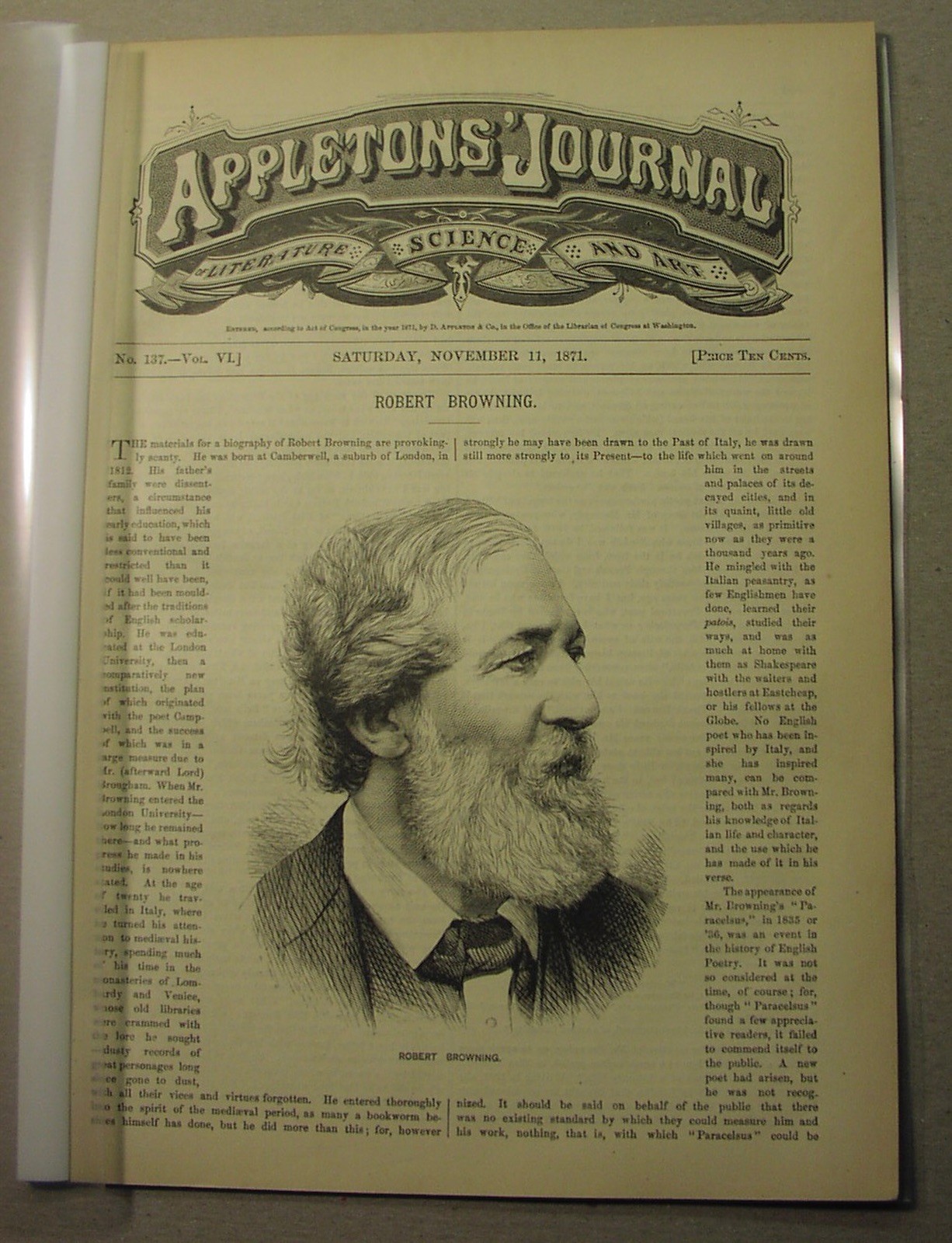
Nov. 11, 1871Robert Browning
CANANDAIGUA LAKE
Indian eloquence
Jupiter, the planet
poem on the Chicago FireThis is an issue of the illustrated weekly publication, Appletons’ Journal, which was printed 155 years ago! It is 28 pages long, and measures 8 x 11 inches in size. The paper came from a bound volume and has some typical minor disbinding marks at the spine, but is otherwise in excellent and very attractive condition. It will be shipped in a clear report binder, to help keep it safe from deterioration in the future.The cover story is on “ROBERT BROWNING,” with a nice portrait and over three pages of text on the legendary poet.* * * * * * * *
The highlight of the issue is over four pages devoted to CANANDAIGUA LAKE in New York’s Finger Lakes region. This features four lovely woodcut engravings by Paul Dixon, which are captioned:* Canandaigua Lake.
* A Nook Near the Foot of Canandaigua Lake.
* Point on the Lake, Northward.
* Head of Canandaigua Lake.The article describes the Lake’s history, geology, and surroundings in some detail, with a flowery language saying, in part:“On either side lies the village Canandaigua, its name aptly borrowed from the quiet, green water resting at its feet. It is in the western half of the New-York Lake District—a wealthy village, as its lake is wealthy in quiet beauty; an old village, too, though somewhat younger than the lake, and like the latter, above all, in the marked half-sleepiness of its general appearance . . .
“In early years at Canandaigua, says the record, the forests afforded a plenty of venison, and the lake and small streams a plenty of fish. The hills on either side of the lake abounded with deer, which were easily driven into the water and caught. Some hunters would kill from eighty to a hundred in a single season, and the Indians generally brought venison to the village to barter for flour or bread. In all the earliest years, the Cayugas, Oneidas, Onondagas, and Senecas, received their annuities at the village, which made it the place of the annual gathering of those nations, and the centre of the Indian trade. To this day, it is said, the Senecas visit the native hills on the lake-shore, and there perform the religious rites of their fathers in their fathers’ temples. . . .
“It reaches scarce sixteen miles from south to north, and is nowhere broader than a mile or two, and the jutting points and deep coves frequently shut out most of its little length It never looks large, only beautiful . . . it is a much-travelled highway for both passengers and freight, and, besides its two little steamboats, bears on its bosom scows and smaller craft innumerable, vehicles of business and pleasure, which ply to and fro from the head to the foot, or to the various points. These mimic capes, called in lake dialect "points," are very numerous, and especially inviting. They generally present two lines of beach, paved with fiat, smooth slates, narrow at first, and widening till they join in sometimes a sharp tongue, stretching out till it loses itself in the shallow ripple, sometimes a bold outward curve, just off whose pebbly edge you may bathe, if you will, in four hundred feet of water. Often the beach lies black and naked, with scarce a tree or shrub along its whole stony stretch; and, again, the trees, laden with vines, lean out to meet the lake and hide the narrow margin between. . . .
“One of the most prominent of the points is ‘Black,’ about halfway up the lake, on the west shore. It takes its name from the color of its bare, flatpebbled beach, and is distinguished for miles by a single tree standing on the very vertex of the narrow tongue which stretches out far from shore, and sinks by degrees beneath the surface.
“Climbing a short distance up the hill behind this point, and facing the southeast, that is, across and up the lake, we look upon the scene presented in the first of the accompanying engravings, which exhibits fairly the varied aspect of the shores. . . .
“Just in sight appears the low point, with its smntinel-tree; to the left, across the lake, precipitous rock is flanked by gradual wooded slope; while, watching in the background, the hill Genundewah lifts its cheerless and barren summit to the sky. This latter was a hill of note in the days of the aborigines, and a tradition of mystery clings to it, backed by material evidences which convince the most incredulous. . . .
“A scene, which most would be apt to overlook . . . is portrayed in the second engraving. Not from the steamboat's deck may it be discovered, but by closer scrutiny of the curving or jagged shlores, by hard tramping and climbing, it may be found—a thing of beauty, worth much search.
“Many such corners are known to the native boys and birds, but, to a passing traveeller, quite covered up, for the road is as difficult to Nature's secrets as to the hidden things of art. This is near the foot of the lake, and looks north easterly across it.
“On this side the hills are high as ever, but the range on the other side is just rising from the lowlands that lie around the outlet at the foot.
“Growing steadily in size and stature, they stretch out along the lake, lifting themselves as proudly above it at length . . . In the foreground the black cliffs rise, casting shadows which the fish love to hide in.
“Two miles above Black Point on the same side is Seneca Point, largest of all, and perhaps most resorted to, boasting an hotel as well as private cabins, and rich in great variety of steep cliff and fiat beach, of cool groves and rocky glens. . . .
“Go to the northward along the steep, narrow shore, streaked white with sulphur from many springs, and in a nook where a jutting rock cuts off the point from view, but where the impassive scrutiny of the Bare Hill still follows, you become an animated part of the scene the artist has chosen in the third view.
“Here the water is at its widest, and its stony bottom is hundreds of feet beneath the dark surface yonder, and keeps, doubtless, many a buried secret safe even from the mountain's eternal gaze. That stern, forofferding look of the dead summit, is almost the single variance from the lake's true spirit. . . .
“And, in truth, they are worth much looking at—these encircling hills. Here one rises, covered with thick forest, bright with glowing autumn colors, or dark with evergreen firs and cedars, and, stretching for a mile or two, gives place to another, whose sides are checked with squares of smooth-shaven grain-fields, telling of a year's work done, with now and then black acres amid the yellow, that speak another year's demand provided for. . . .
“The hills grow higher and more thickly wooded as we go up the lake, and begin to approach mountain stature. The scenery of the ‘head’”is given in our last illustration. The little hamlet Woodville lies here just where the hill-ranges meet and render up their charge, then stretch far away to the south to join the Alleghanies, bearing on their slopes, as they go, vineyards that offer fair, in this new Naples, to rival the clusters of Naples the old in the land of sunshine.
“Here in abundance are taken the voracious pickerel, which some experimenter upon Nature introduced years ago, to the destruction of the trout and white-fish, for which the lake was once somewhat famed.
“South Bristcl, to which belongs the hill on the right, presents its sunniest face to the lake; while just out of sight, beyond the border, it lies, a rough and difficult land, softened only wherever it draws near the edge, and its hard hills are charmed to smoothness by the fondling water.
“To the left is Middlesex . . . rough and steep-looking here, but rising and falling in gentler curves farther down, where Vine Valley lies at right angles to the shore.
“The vineyards of this valley are already famed, not only through the State, but in the markets of Boston and the South. Many varieties of grapes are here successfully cultivated, and a single grape-grower of the valley bore off almost every premium at the recent Western New-York State Fair.
“Only a few years ago this industry was not dreamed of here, but now the vineyards are the greatest source of revenue from the land, and soon all the hill-sides will be teeming with the grateful fruit of which one never tires.
“More and more every year is the lake sought by visitors, who come to make experiment of its virtue, to be inspired with the restfulness it bestows on all; many companies of children, young and old, to picnic in its groves and climb its glens; some to explore its springs with eyes of speculation, and to see prospective water-cures and infirmaries upon its shores, some for fishing and duck-shooting; some for dreaming, profitable or otherwise; but all, coming so variously, go away gladdened, according to their desert, by the beauty in store for all who have understanding thereof.
“The turtle-like septaria before mentioned are not the only objects of geological interest found in and about the lake; tile many ravines which cut through its hilly boundaries are rich in old corals of numerous sorts, and in the beautiful ‘stone-lilies,’ as they are called, half-plant, half-animal, planted animals, in fact, rooted to the rocky soil, and raking the water with their long arms for food. These latter are frequently discovered in layers several feet in diameter, and a few inches in thickness, and present forms of rare beauty and great interest.
“More important in an economic point of view are the innumerable springs of mineral waters, which, abundant through all the region around, especially crowd upon the borders of this lake. Some of them are already famous for healing properties—the Salisbury, for example, in Gorham, near the foot. Nor are these waters all that the hills spontaneously bring forth. Several burning springs, giving out carburetted hydrogen in large quantity, vary the natural phenomena. . . still another spring, on the west shore, deposits carbonate of lime in the form known as travertine or calcareous tufa.
“Thus much in the way of wonders has Nature done for the surroundings of this quiet water. . .”
Etc.* * * * * * * *
Another interesting piece is on “INDIAN ELOQUENCE.” This article is two and a half pages long, in small print, and describes the excellent speeches made by various Indian chiefs during the Colonial times and into the 1800s. It includes long quotes from Red Jacket of the Senecas, and Skanandoa of the Oneida nation. The article begins by saying it was inspired by a recent example of Indian oratory: “The American public was, undoubtedly, surprised by the simple and business-like addresses of the Western Indians who visited Washington a year ago to confer with our Government in relation to their own affairs. The speeches of Red Cloud and his companions, as translated, were manly and direct presentations of their views and wrongs . . .”* * * * * * * *
This is followed by nearly a page and a half on ‘THE PLANET JUPITER,” which begins: “No planet belonging to the solar system is more interesting or more fruitful in speculative theory than Jupiter. Important and wonderful discoveries are being made by astronomers in the constitution and habits of this planet, which seem to be a key to the still greater discoveries remaining for future students of the science of the stars. . . .”It concludes by saying: “Meantime, a deep interest is attached to every changing phase of this noblest creation of the planetary worlds, whether we watch its radiant glow among the stars in the soft evening light, or note its path as co-herald with the dawn, or, with its surrounding moons and variegated belts, make it a delightful object of telescopic study.”* * * * * * * *
Also of interest in this issue is a lengthy poem by Edward Renaud, lamenting the destruction wrought by the great CHICAGO FIRE OF 1871. It takes up more than a half-page of space, and one of its 9 verses says:Fallen is the queenly city!
Her palaces and towers,
Her pillared porticoes of pride
Sunk in a few short hours;
While all her mourning multitude—
Naked, unhoused, unfed—
Strive, through the depths of dumb despair,
Weeping, to find their on this publication: Appleton’s Journal was an illustrated weekly paper published in New York. Its parent company was D. Appleton & Co., Publishers, which at the time was one of America’s leading book publishers. The paper was founded in 1869, and achieved a widespread, but shortlived national popularity during the next six years. It carried some serial fiction, but most of its content was devoted to essays on Americana subjects, plus the arts and sciences. Following several changes in editors, however, it began suffering a decline in circulation. It subsequently switched to monthly publication after 1876, and went out of business in 1881.142 [p]_gsrx_vers_1736 (GS 9.9.5 (1736))