When you click on links to various merchants on this site and make a purchase, this can result in this site earning a commission. Affiliate programs and affiliations include, but are not limited to, the eBay Partner Network.
📜 ABOUT THIS PIECE OF HISTORY 📜
The July 10, 1880 issue of Harpers Weekly is one of the most politically and historically charged issues of the entire election year — the Democratic National Convention has just nominated Winfield Scott Hancock for President, completing the two-party presidential contest that would define the fall of 1880, and Harpers Weekly documents it with a full page of convention drama and a portrait of the candidate. Thomas Nast fires off a front-page cannon. The double-page centerfold delivers one of the most beautiful and historically resonant Independence Day illustrations in the entire Harpers Weekly archive. The American rifle team is heading to Ireland for an international match. And John Sutter — the man on whose land gold was discovered in 1848, setting off the California Gold Rush — appears in a quarter-page portrait that connects this July 1880 issue to one of the great turning points in American history. This is an exceptional issue.🎨 FULL FRONT PAGE — THOMAS NAST: \"BOOM!!! — SO NEAR, AND YET SO FAR\"
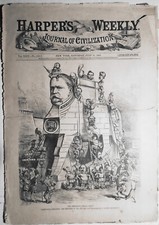
Thomas Nast opens the issue with one of his most pointed and historically specific cartoons of the entire election year — \"Boom!!! — So Near, and Yet So Far\" responding to the Democratic National Convention that had just nominated Winfield Scott Hancock of Pennsylvania as its presidential candidate. The Democratic convention at Cincinnati had been a dramatic affair — Tildens withdrawal, the scramble among competing candidates, and Hancocks emergence as the nominee — and Nasts \"Boom!!!\" captures the explosive energy of the moment while \"So Near, and Yet So Far\" signals his assessment of the Democrats presidential prospects. A fully displayable and historically precise front page for collectors of Nasts work, the 1880 presidential election, and Hancock history.🏛️ FULL PAGE — \"THE DEMOCRATIC CONVENTION AT CINCINNATI — THE BREAK FOR HANCOCK\"
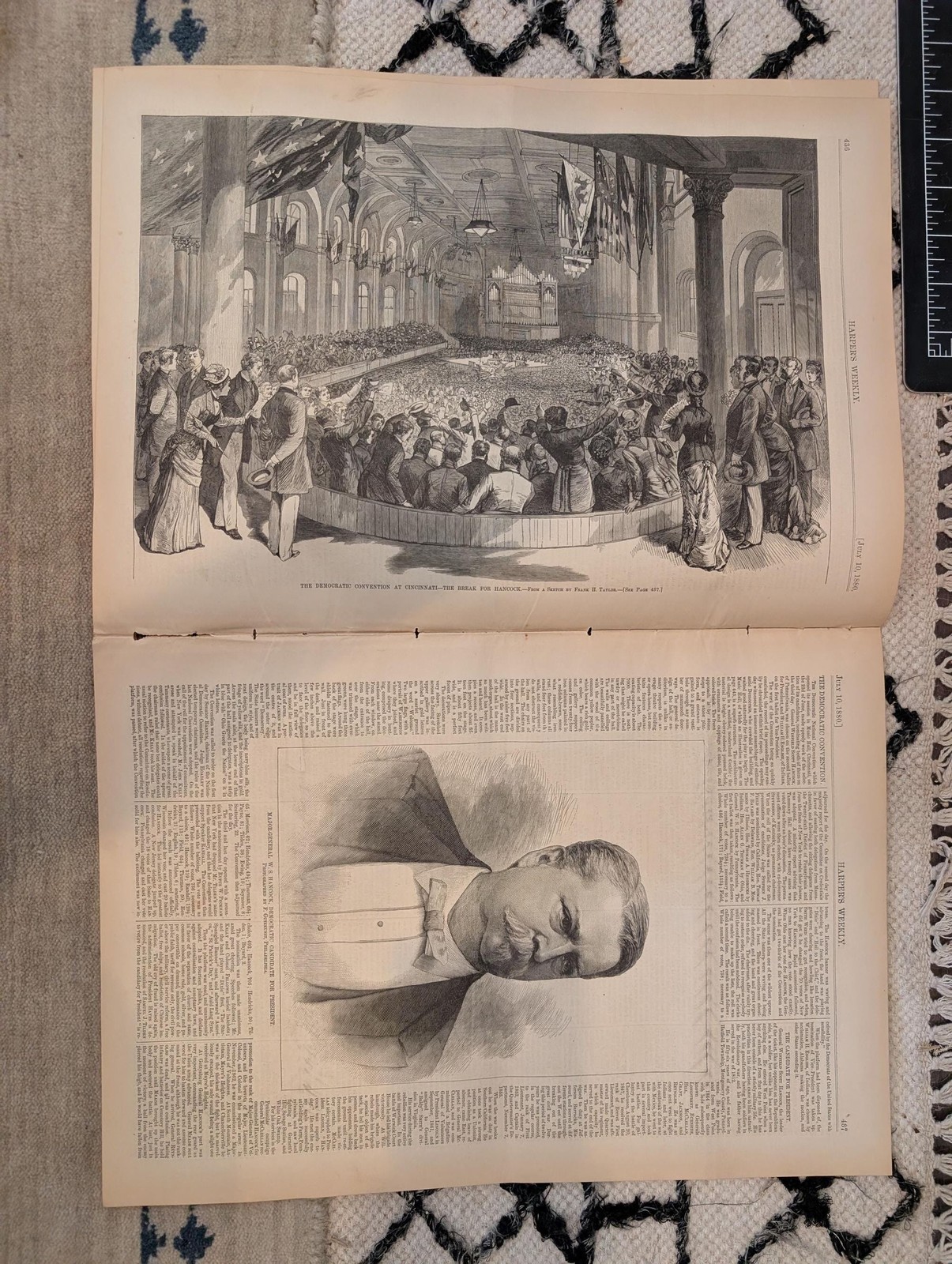
One of the most historically significant convention illustrations in the entire Harpers Weekly run for 1880 — a full-page documentary of the dramatic moment at the Cincinnati convention when the delegations broke toward Hancock and his nomination became inevitable. The Democratic National Convention of 1880 had been convened in Cincinnatis great Music Hall in late June, with Samuel Tildens lingering availability creating a cloud of uncertainty over the proceedings until his final withdrawal cleared the field. Hancock — the hero of Gettysburg, a genuine war hero whose military reputation was beyond reproach and whose political record was blessedly free of the controversies that had destroyed other candidates — emerged as the nominee on the second ballot in a surge that this full-page illustration captures at its moment of maximum drama. For collectors of Democratic Party history, the 1880 presidential election, and the history of American political conventions, this full page is an essential primary source document.🎖️ HALF PAGE PORTRAIT — \"MAJOR GENERAL W.S. HANCOCK — DEMOCRATIC CANDIDATE FOR PRESIDENT\"
A significant and historically important half-page portrait of Winfield Scott Hancock — the newly nominated Democratic candidate for President and one of the most genuinely distinguished soldiers ever to seek the American presidency. Hancock had commanded the II Corps of the Army of the Potomac with extraordinary skill through the Peninsula Campaign, Antietam, Fredericksburg, Chancellorsville, and most memorably at Gettysburg, where his defense of Cemetery Ridge on the second day and his command of the Union center on the third — the day of Picketts Charge — had made him the hero of the battle and one of the most celebrated soldiers in America. His political record as a military governor in Louisiana and Texas during Reconstruction had won him the admiration of Southern Democrats without alienating too many Northern ones — making him, on paper, the strongest Democratic candidate since before the Civil War.
Hancock would lose to Garfield in November by the narrowest popular vote margin in American presidential history — fewer than 2,000 votes out of nearly nine million cast. This portrait captures him at the moment of his nomination — the soldier-statesman about to enter the most consequential months of his public life. An essential piece for collectors of Hancock history, Democratic Party history, and the 1880 presidential election.🇺🇸 DOUBLE-PAGE CENTERFOLD — \"THE FIRST PUBLIC READING OF THE DECLARATION OF INDEPENDENCE — THE MEMBERS OF CONGRESS LEAVING INDEPENDENCE HALL\"
The visual crown jewel of this issue — and one of the most beautiful and historically resonant Independence Day illustrations in the entire Harpers Weekly archive. This magnificent double-page centerfold depicts the scene outside Independence Hall in Philadelphia on July 8, 1776 — the members of the Continental Congress emerging from the building where they had just voted for independence, into the summer air of a city and a world that would never be the same. Published just days after Independence Day 1880 — the 104th anniversary of that moment — this centerfold connects the Gilded Age present to its founding act with a visual grandeur and emotional depth that only the double-page format could achieve.
The scene depicted — the delegates filing out of Independence Hall, the crowd gathered in the street, the summer sky over a Philadelphia that was then the largest city in America — is a reconstruction of one of the supreme moments in human history, rendered with the historical imagination and pictorial skill that Harpers Weekly brought to its finest commemorative illustrations. For collectors of American Revolutionary history, Independence Day history, Philadelphia history, and the history of the Declaration of Independence, this double-page centerfold is an irreplaceable and fully displayable primary source document of lasting beauty and importance.🎯 SMALL PORTRAITS — \"THE DOLLYMOUNT INTERNATIONAL RIFLE MATCH — THE AMERICAN TEAM\"
A fascinating and historically specific suite of small portraits documenting the American team heading to Dollymount — the great rifle range outside Dublin, Ireland — for the International Rifle Match, one of the premier long-range shooting competitions in the world. The Dollymount matches pitted the finest military and civilian rifle shots of Britain, Ireland, and America against each other in a competition that was followed with intense national pride on all sides. The American team depicted here were among the finest marksmen in the country — products of the National Rifle Association, founded in 1871 specifically to improve American marksmanship after the perceived deficiencies revealed by the Civil War, and of the great Creedmoor Range on Long Island where American shooting had been honed to international standard. A wonderful piece for collectors of rifle shooting history, NRA history, and the history of international sport.🏛️ HALF PAGE — \"THE CINCINNATI MUSIC HALL, WHERE THE DEMOCRATIC CONVENTION WAS HELD\"
A handsome half-page illustration of Cincinnati Music Hall — the magnificent High Victorian Gothic concert hall and exhibition venue that had hosted the Democratic National Convention, and that remains to this day one of the finest examples of 19th-century American civic architecture. Cincinnati Music Hall was just three years old when the convention convened within its walls in 1880 — its great rose window and soaring brick facades still fresh, its acoustics already celebrated as among the finest in the country. This half-page illustration documents it at the moment of its greatest political significance, the hall where Hancocks nomination had just been sealed. A fine piece for collectors of Cincinnati history, American architectural history, and the history of the Democratic Party.👤 QUARTER PAGE — PORTRAIT OF GENERAL JOHN A. SUTTER
One of the most historically evocative quarter-page portraits in the entire Harpers Weekly run — General John Augustus Sutter, the Swiss-born California pioneer on whose sawmill at Coloma, on the American River, gold was discovered by James Marshall on January 24, 1848, setting off the California Gold Rush that transformed the American West, accelerated California statehood, and brought hundreds of thousands of fortune-seekers pouring across the continent and around Cape Horn. Sutter himself had been ruined by the Gold Rush — his land overrun, his cattle slaughtered, his workers deserting, his property claims disputed and ultimately denied — and had spent the decades since in futile legal attempts to recover compensation from the federal government. He died in June 1880, just weeks before this portrait appeared, one of the great tragic ironies of American history — the man whose land had generated the greatest gold rush in history, dying impoverished and uncompensated. A deeply poignant and historically essential portrait for collectors of California history, Gold Rush history, and the history of the American West.🔍 CONDITION & TRANSPARENCY 🔍
Completeness: Complete 16-page issue.
Authenticity: Guaranteed original printing from July 10, 1880 — not a reproduction.
Condition Report: Presents well for its 145-year age with natural toning to the newsprint consistent with paper of this era. The Thomas Nast front page, the Democratic convention full page, the Hancock portrait, the Declaration of Independence double-page centerfold, the American rifle team portraits, the Cincinnati Music Hall half page, and the Sutter portrait are all clear and displayable. I have photographed every page — please review all images carefully and dont hesitate to ask for additional close-ups of any area before purchasing.📦 SHIPPING & PRESERVATION 📦
Housed in an acid-free archival folder with Mylar overlay to protect the 145-year-old newsprint
Flat-shipped with heavy-duty reinforcement to ensure safe arrival of the centerfold
Fully tracked for your peace of mindIn July 1880 the Democrats had just nominated their candidate, the American rifle team was sailing for Ireland, John Sutter had just died having never been compensated for the gold found on his land, and the members of the Continental Congress were walking out of Independence Hall on the centerfold. Harpers Weekly held the whole sweep of American history in sixteen pages.🏷️ TAGS
1880 Democratic Convention Cincinnati Hancock, Winfield Hancock Democratic Nominee, Declaration of Independence Centerfold, First Reading Declaration Independence, Dollymount International Rifle Match, American Rifle Team 1880, General John Sutter Gold Rush, Cincinnati Music Hall Democratic Convention, Thomas Nast Boom So Near, Hancock Presidential Portrait 1880, Gold Rush History Sutter Death, 1880 Presidential Election Democratic, Independence Hall Philadelphia History, Antique Newspaper 1880, Harpers Weekly 1880, Gilded Age Presidential Election History