When you click on links to various merchants on this site and make a purchase, this can result in this site earning a commission. Affiliate programs and affiliations include, but are not limited to, the eBay Partner Network.
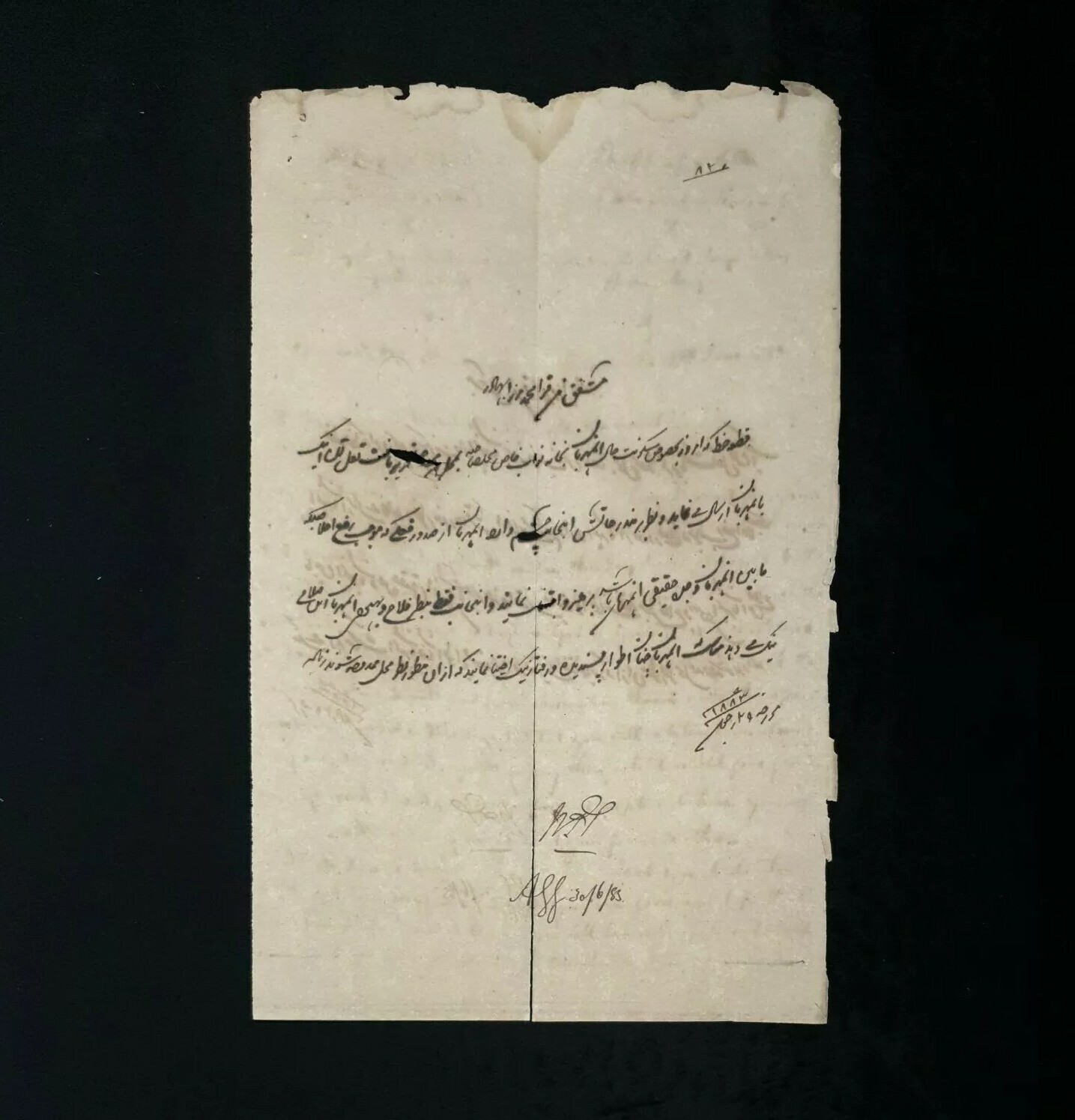
For your consideration, an important Awadh royal-household administrative manuscript dated Calcutta, 2930 June 1883, concerning Prince Qara Muhammad Mirza Bahadur, alias Burray Mirza, grandson of the deposed King Wajid Ali Shah and of Khas Mahal Sahiba (Alam Ara Begum). The principal leaf carries the vernacular communication in Persianate court script, with a contemporary English office draft on the reverse identifying the recipient as Qara Muhammad Mirza alias Burry Mirza and explaining that a copy of a separate letter addressed to Khas Mahal was being forwarded to him concerning his residence in her household. A separate official subject slip summarizes the same matter, confirming that the prince was being instructed to behave properly and adopt a conciliatory tone toward his grandmother.
The document records a revealing episode within the exiled court of Wajid Ali Shah at Matiyaburj, where the former royal family continued to maintain complex domestic, ceremonial, and political structures under British supervision. Khas Mahal, Wajid Ali Shahs senior wife, had long maintained a semi-independent household of her own, and by 1883 her grandsons residence with her had evidently produced sufficient tension to require formal intervention. The English draft specifically warns Burray Mirza to abstain from conduct that might lead to a rupture with his grandmother and urges him, for his own good, to behave properly and adopt a conciliatory manner toward her.
The administrative context points to the office of Lieutenant-Colonel William Francis Prideaux, then serving within the British political establishment responsible for the affairs of the ex-King of Oudh. The lower English endorsement bears initials plausibly reading W.F.P. with an office date of 30 June 1883, consistent with Prideauxs role, although the initials are best described as probable rather than conclusively authenticated without direct signature comparison. The bilingual format, English draft, and accompanying registry abstract together preserve the workings of colonial administration as it mediated not merely political matters but the internal family relations of the displaced Awadh dynasty.
The papers survive in original working condition, with age toning, brittleness, edge losses, fold wear, and handling consistent with an actively processed nineteenth-century office file. Their significance lies in the convergence of Awadh royal genealogy, the household of Khas Mahal, the final years of Wajid Ali Shahs exiled court, and direct British administrative intervention in a private dynastic dispute. Rather than a royal autograph of Wajid Ali Shah, the group is more accurately understood as a rare and unusually revealing colonial-Awadh household file, documenting how the British political establishment penetrated the domestic governance of one of Indias most prominent deposed royal families.