When you click on links to various merchants on this site and make a purchase, this can result in this site earning a commission. Affiliate programs and affiliations include, but are not limited to, the eBay Partner Network.
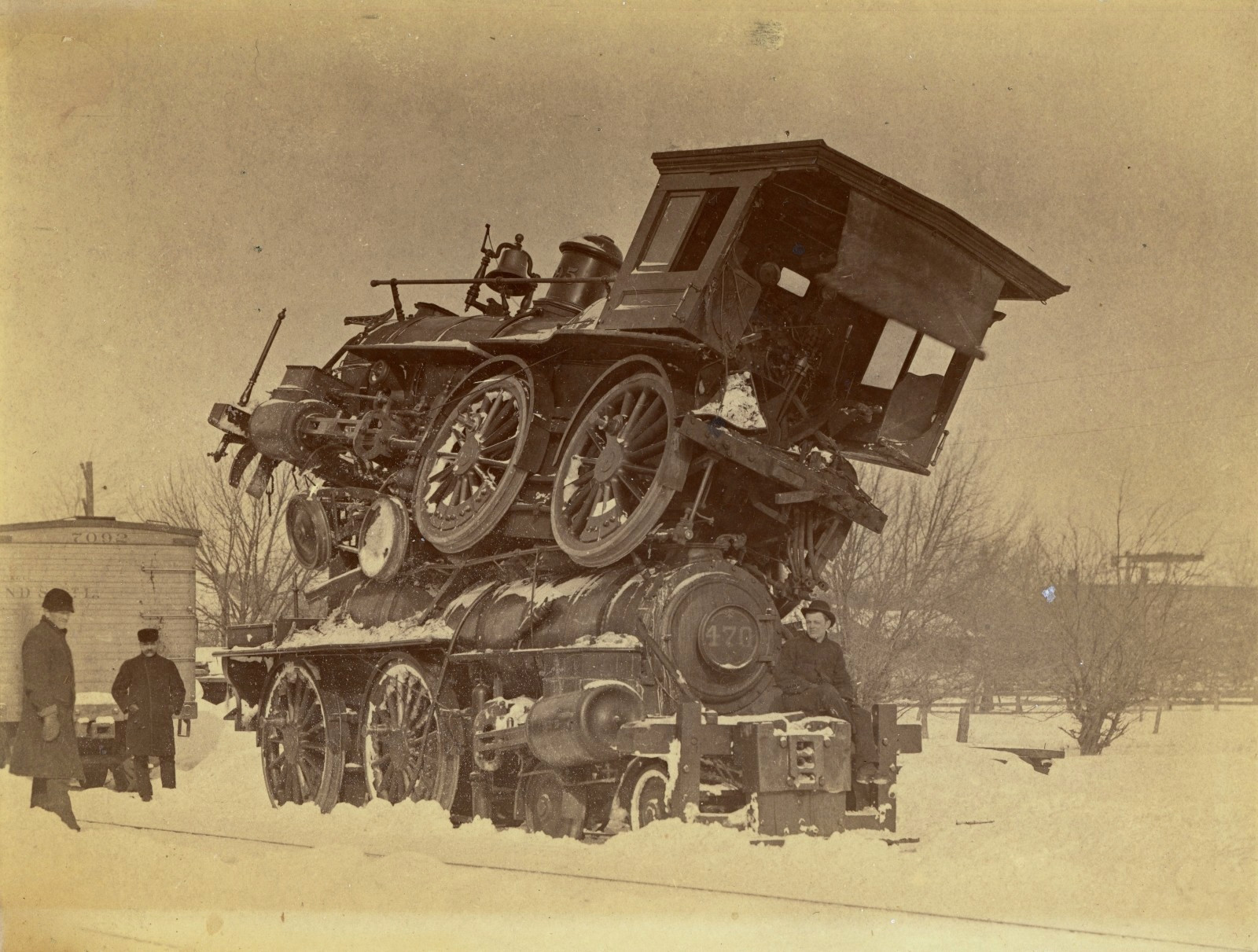
THECELEBRATED 1885 BATAVIA “PIGGYBACK” LOCOMOTIVE WRECK — ORIGINAL P. B.HOUSEKNECHT ALBUMEN PHOTOGRAPH OF NEW YORK CENTRAL ENGINES NO. 295 ATOP NO. 470
PhotographerStudio: Philos Beecher Houseknecht (1858–1930), P. B. HouseknechtPhotographic Studio, Batavia, New York.
StudioImprint: “P. B. Houseknecht, Leading Photographer of Batavia, N.Y., 106Main St., Opp. Opera House.”
Title orSubject: The “Piggyback” Wreck: New York Central & Hudson RiverRailroad Locomotive No. 295 Resting Atop Locomotive No. 470 Following aSnowplow Collision.
Place andDate: Batavia, Genesee County, New York; February 1885. The collisionoccurred east of Batavia on February 18, 1885; the photograph was apparentlytaken after the coupled wreckage had been hauled into the Batavia railroadyard.
Format:Original albumen photograph mounted on the photographer’s card.
Dimensions:Photograph approximately 5 15/16 × 7 13/16 inches; original mount approximately7 3/4 × 10 inches.
Description:A remarkable original nineteenth-century railroad-disaster photograph showingtwo New York Central & Hudson River Railroad steam locomotives locked inthe spectacular “piggyback” configuration created by the Batavia snowplowcollision of February 18, 1885. Locomotive No. 470 remains upright on therails, its circular number plate clearly visible, while the badly damagedlocomotive No. 295 rests almost bodily across its boiler and cab. The upperengine’s driving wheels, exposed running gear, shattered pilot, tilted cab, anddisplaced mechanical components form an extraordinary sculptural mass above thelower locomotive. Three railroad employees or onlookers stand in thesurrounding snow, providing scale and emphasizing the immense weight andimprobable position of the machinery. Snow clings to the locomotives and trackbed, while railroad buildings, utility poles, and leafless trees appear in thebackground. The photograph is especially compelling for its clarity, unusualcomposition, identifiable locomotive number, and documentation of one of thebest-known “piggyback” wrecks in American railroad history.
Biographical& Historical Notes: Philos B. Houseknecht was an established commercialphotographer in Batavia by the early 1880s. The Batavia Directory for1883–1884 lists “Houseknecht Philos B., photographer” at 106 Main Street, thesame address appearing in his studio imprint, and records his residence at thatlocation.
The wreckoccurred during a severe blizzard on the Canandaigua-to-Niagara Falls branch ofthe New York Central & Hudson River Railroad, commonly known as the “PeanutLine.” During the evening of February 17, a westbound train comprising threelocomotives and two baggage cars became immobilized in deep snow east ofBatavia. After the train backed up to make another attempt against a drift, thetrucks beneath one of the cars derailed, leaving the entire consist stranded.Its few passengers and several crew members subsequently walked into Batavia.
Shortlybefore 8:00 the following morning, a wedge snowplow propelled by twolocomotives departed Batavia to clear the line and assist the stalled train.The rescue crew reportedly believed that the stranded consist was approximatelyone mile farther east than its actual position. Traveling through deep snowwith severely restricted visibility, the plow train struck the standinglocomotives at an estimated speed of approximately forty miles per hour. Theplow slid beneath the leading engines of the stalled train, lifting locomotiveNo. 295 completely over the plow and depositing it atop locomotive No. 470.Locomotive No. 296 was driven partway up the snowplow, while No. 336 began toclimb behind it. Despite the violence of the collision, the crews jumped clear;only Engineer Walling, struck by debris, and Engineer Acker, who was bruised,were reported injured. There was no loss of life.
Importantly,the celebrated photograph does not appear to show the wreck at the originalcollision site. Contemporary and later accounts state that locomotive No. 470remained on the rails and was pulled into Batavia with No. 295 still restingupon it. The coupled engines were placed on a switch near Swan Street, wherethey remained for several days as a local attraction while railroad workersdevised a method of separating them. The locomotives were eventually loweredand separated using an excavated pit, repaired, and returned to service. Alater historical account similarly records that the wrecked locomotives werebrought to the Batavia yard, where the accompanying photograph was made.
Houseknecht’simage became the defining visual record of the accident. It was repeatedlyreproduced in railroad publications, newspapers, calendars, commercial novelties,and an episode or feature associated with Ripley’s Believe It or Not.Its dramatic appearance also led to later misattributions, with versionsclaiming that the wreck occurred on other railroads or at other locations.Historical research by P. J. Erbley, the pen name of Paul Worboys,reconstructed the Batavia event and distinguished it from a separate 1920snowplow wreck near Ionia on the same branch.
Condition:The photograph exhibits overall warm toning and fading, scattered light soilingand spotting, minor surface wear, and a few small abrasions or areas ofemulsion disturbance. The image remains substantially complete, clearlylegible, and visually impressive, with strong detail throughout the locomotivesand foreground figures. The original mount is fragile and considerablydistressed, with extensive edge chipping and losses, tears and cracks, worn androunded corners, discoloration, soiling, and substantial peeling and loss ofthe mount’s surface paper, particularly along the upper and lower margins. Awater stain and additional soiling are present on the verso. The mount shouldbe handled only with rigid support. Please consult all photographs for acomplete assessment of condition.
References:
- The Daily News, Batavia, New York, February 19, 1885; contemporary account transcribed in P. J. Erbley’s “Slaying the Dragon.”
- Erbley, P. J. [Paul Worboys]. “Slaying the Dragon: Bringing an ‘Urban Legend’ to Its Knees.” The Crooked Lake Review, Winter 2006.
- Sheret, John G. “The ‘Peanut Line’ of the New York Central Railroad.” The Crooked Lake Review, Spring–Summer 2007.
- Batavia Directory, 1883–1884, p. 41. Central Library of Rochester and Monroe County, Miscellaneous Directories Collection.
- Ruth McEvoy Collection, Genesee County, New York.
- “Philos Beecher Houseknecht,” Elmwood Cemetery, Batavia, Genesee County, New York, cemetery and genealogical records.