When you click on links to various merchants on this site and make a purchase, this can result in this site earning a commission. Affiliate programs and affiliations include, but are not limited to, the eBay Partner Network.
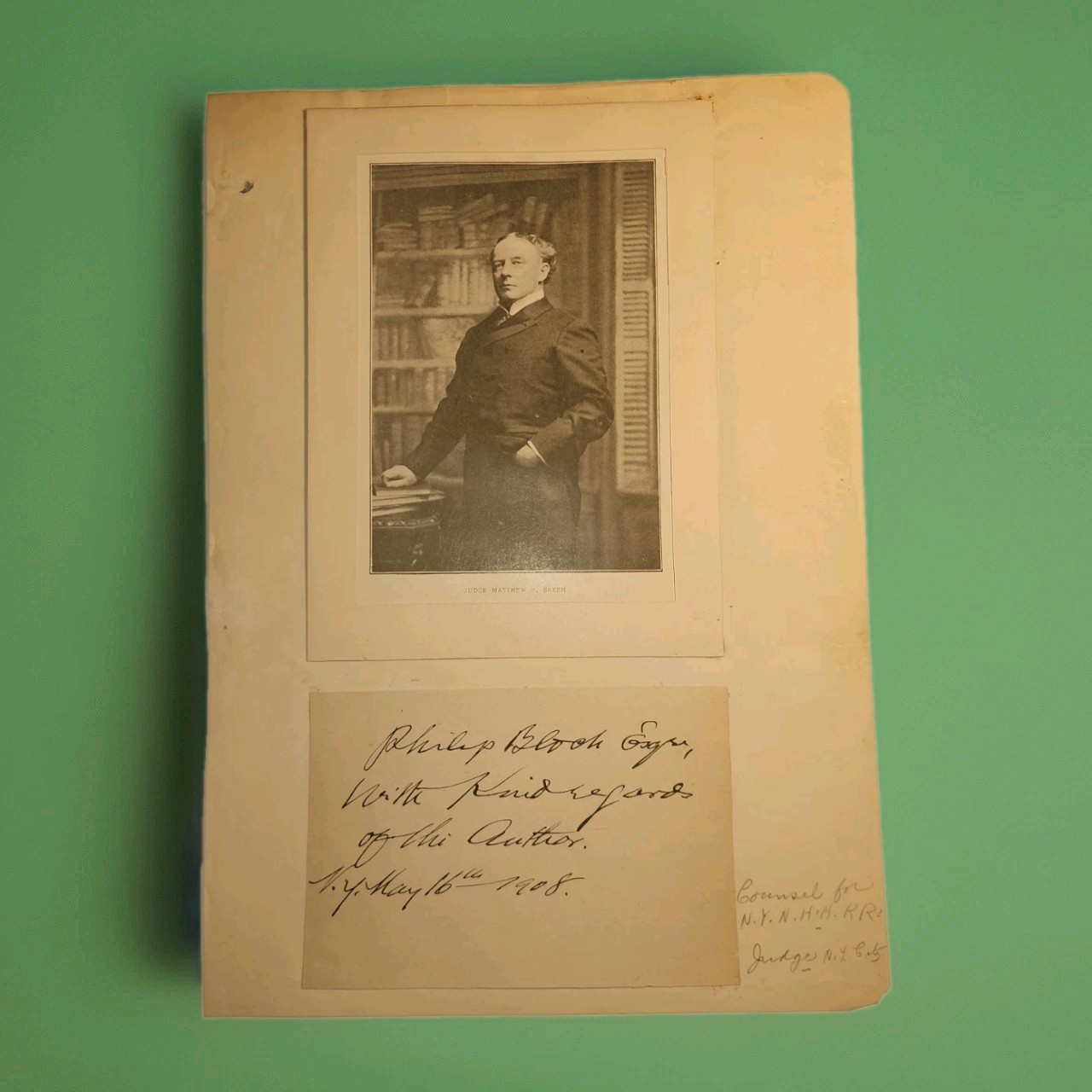
The piece consists of a printed halftone portrait captioned “Judge Matthew P. Breen” mounted above a separate handwritten presentation inscription. Both are affixed to an aged album or scrapbook leaf.
The inscription reads:
Philip Bloch Esq.,
With Kind regards
of the Author.
N.Y. May 16th 1908.
Although Breen did not write his name beneath the inscription, the phrase “of the Author,” its association with his identified portrait, and the presentation format strongly indicate that it was inscribed in Breen’s hand. The portrait was likely removed from or distributed in connection with his book and later mounted with the original presentation inscription.
Later pencil notes on the album leaf read approximately:
Counsel for
N.Y.N.H. & H. R.R.
Judge N.Y. City
These annotations appear to identify the occupations or associations of the two men. “Judge N.Y. City” clearly refers to Breen. The reference to counsel for the New York, New Haven & Hartford Railroad may refer to recipient Philip Bloch, although that connection has not been conclusively verified.
Matthew P. Breen Biography
Matthew Patrick Breen was born in County Clare, Ireland, on December 4, 1847, and immigrated to the United States as a child. He became a New York attorney and was active in education, Democratic politics, and municipal affairs. He served on a school board and later became a New York City magistrate.
Breen was also active in Irish-American historical circles and was a member of the American Irish Historical Society. Contemporary directories listed him as “Hon. Matthew P. Breen, a city magistrate” residing at 243 West 99th Street in New York City.
His best-known publication was Thirty Years of New York Politics Up-to-Date, privately published in New York in 1899. The substantial 843-page illustrated volume presents an insider’s history of New York politics during the Gilded Age. It discusses Tammany Hall, the Tweed Ring, political conventions, disputed elections, municipal corruption, party organization, and many of the politicians who controlled New York government during the late 19th century.
Because Breen personally witnessed and participated in the city’s political world, the book remains a useful contemporary source concerning the machinery, personalities, and controversies of Tammany-era New York.
Philip Bloch
The recipient was probably the Philip Bloch associated with New York City’s courts during the early 20th century. Contemporary newspaper reporting identifies a Philip Bloch as a clerk in the Tombs Police Court, while a published legal history lists a Philip Bloch as a court secretary. This places him within the same New York legal and municipal circle as Judge Breen.
The handwritten railroad notation may indicate that Bloch later served as counsel for the New York, New Haven & Hartford Railroad, but that attribution should be regarded as likely rather than conclusively established.
Historical Importance
This is an appealing New York political and legal association piece connecting Judge Breen with another member of the city’s court system. It is especially relevant to collectors of:
- Tammany Hall and New York political history
- Irish-American history
- New York City judges and attorneys
- Early municipal and police courts
- Authorial presentation inscriptions
- Gilded Age political literature
- New York railroad history
The dated 1908 inscription is particularly interesting because it was written nearly a decade after the publication of Breen’s major book and while he was serving as a New York City magistrate.
Condition
The portrait and inscription are mounted on an aged album or scrapbook leaf. The mount exhibits expected toning, scattered staining and soiling, edge wear, bumped corners, and minor losses or abrasions. The portrait has age-related toning and surface wear but remains clear. The inscription is bold and readily legible. Later pencil identification notes appear along the lower-right side of the mount.
Please examine all photographs carefully for dimensions, mounting method, completeness, and condition. Sold as an original historical presentation assemblage.