When you click on links to various merchants on this site and make a purchase, this can result in this site earning a commission. Affiliate programs and affiliations include, but are not limited to, the eBay Partner Network.
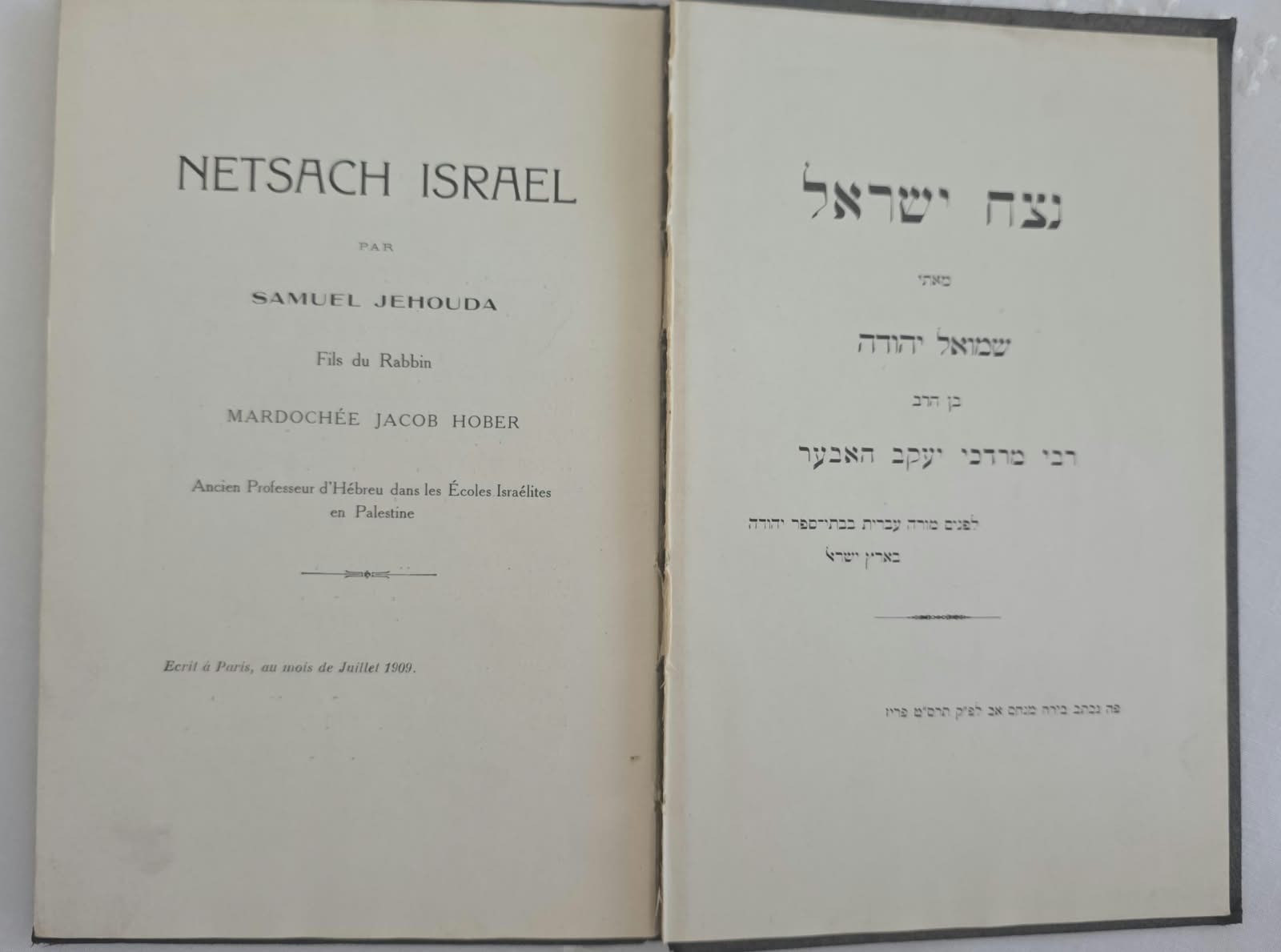
SAMUEL JEHOUDA HOBER — NETSACH ISRAEL (נצח ישראל)
Paris: Imprimerie Danzig, 1909
95 pages — Hebrew and French
An exceptionally uncommon and fascinating work of French Judaica and early Zionist intellectual history, published in Paris in 1909 by Samuel Jehouda Hober, a former teacher of Hebrew in Jewish schools in Palestine.
Hober identifies himself on the title page as the son of Rabbi Mordechai Jacob Hober. The work is written in both Hebrew and French and deals with Jewish national identity, Palestine, the Hebrew language, assimilation, and the future of the Jewish people during a formative period in the development of modern Zionism.
ZADOC KAHN AND FRENCH JEWISH HISTORY
A particularly interesting portion of the book concerns Zadoc Kahn (1839–1905), Chief Rabbi of France, one of the leading figures of French Jewry during the Dreyfus era.
Hober explains in his preface that following Kahn's death he composed two poems in his memory and produced an earlier memorial publication. He records distributing copies to prominent individuals and Jewish organizations, including 35 copies to the Fédération Sioniste de France and 20 copies to Chief Rabbi Joseph Lehmann.
The present work reproduces correspondence Hober received in connection with his earlier publication, including material from:
Abraham Eliyahu Harkavy (1835–1919), the distinguished Jewish historian, Orientalist, and scholar associated with the Imperial Public Library in St. Petersburg;
Rabbi Emmanuel Weill, a prominent French rabbi;
René Dreyfus, attorney at the Paris Court of Appeal;
the Fédération Sioniste de France, whose letter explicitly discusses the memory of Zadoc Kahn.
The result is an unusual primary source for the French-Jewish and Zionist intellectual milieu of Paris in the early twentieth century.
SCARCITY
This work appears to be very scarce.
Extensive searches have located institutional bibliographical records, including a copy catalogued at Harvard, but we have been unable to trace another copy currently offered in the antiquarian book trade or an identifiable sale record for this 1909 edition.
CONDITION
Complete, 95 pages.
Bound in an old, plain cloth binding, probably contemporary or relatively early. The cloth is worn and spotted/stained, with general age-related wear. The binding is utilitarian rather than decorative.
Internally the book is considerably better preserved, with the text generally clean and very readable. Please examine the photographs carefully for an accurate indication of condition.
Original 1909 publication — not a facsimile or modern reproduction.
A fascinating and apparently very scarce survival relating to French Jewry, Zadoc Kahn, early French Zionism, Palestine, Hebrew culture, Jewish nationalism, and the struggle against assimilation in the years immediately preceding the First World War.
DESCRIPTION FRANÇAISE
SAMUEL JEHOUDA HOBER — NETSACH ISRAEL (נצח ישראל)
Paris : Imprimerie Danzig, 1909
95 pages — hébreu et français
Ouvrage particulièrement peu commun et fascinant pour l'histoire du judaïsme français et du mouvement sioniste au début du XXe siècle, publié à Paris en 1909 par Samuel Jehouda Hober, ancien professeur d'hébreu dans les écoles juives de Palestine.
Hober se présente sur la page de titre comme le fils du rabbin Mardochée Jacob Hober. L'ouvrage, rédigé en hébreu et en français, aborde notamment la Palestine, la langue hébraïque, l'identité nationale juive, l'assimilation et l'avenir du peuple juif, à une époque particulièrement importante dans le développement du sionisme moderne.
ZADOC KAHN ET LE JUDAÏSME FRANÇAIS
Une partie particulièrement intéressante de l'ouvrage concerne Zadoc Kahn (1839–1905), Grand Rabbin de France, l'une des principales figures du judaïsme français à l'époque de l'affaire Dreyfus.
Hober explique dans sa préface qu'après la mort de Zadoc Kahn, il composa deux poèmes en sa mémoire et publia auparavant un ouvrage commémoratif. Il précise avoir distribué des exemplaires à plusieurs personnalités et organisations juives, notamment 35 exemplaires à la Fédération Sioniste de France et 20 exemplaires au Grand Rabbin Joseph Lehmann.
Netsach Israel reproduit également plusieurs correspondances reçues par Hober à la suite de cette publication, notamment des textes d'Abraham Eliyahu Harkavy, du rabbin Emmanuel Weill, de René Dreyfus, ainsi qu'une lettre de la Fédération Sioniste de France évoquant explicitement la mémoire de Zadoc Kahn.
L'ensemble constitue ainsi un témoignage particulièrement intéressant sur le milieu intellectuel juif et sioniste français au début du XXe siècle.
RARETÉ
Cet ouvrage semble être très rare dans le commerce.
Des recherches bibliographiques approfondies ont permis de retrouver des notices dans des collections institutionnelles, notamment à Harvard, mais je n'ai pu retrouver aucun autre exemplaire actuellement proposé dans le commerce du livre ancien, ni aucune vente aux enchères identifiable de cette édition de 1909.
ÉTAT
Exemplaire complet : 95 pages.
Reliure ancienne en toile simple, probablement contemporaine ou relativement ancienne. La toile présente des marques d'usure, des taches et salissures liées à l'âge. Il s'agit d'une reliure fonctionnelle plutôt que décorative.
L'intérieur est nettement mieux conservé ; le texte est généralement propre et parfaitement lisible.
Merci d'examiner attentivement toutes les photographies, qui font partie intégrante de la description de l'état.
Édition originale de 1909 — il ne s'agit ni d'un fac-similé ni d'une reproduction moderne.
Un document fascinant et apparemment très peu commun concernant le judaïsme français, Zadoc Kahn, les débuts du sionisme français, la Palestine, la culture hébraïque, l'identité nationale juive et la question de l'assimilation dans les années précédant immédiatement la Première Guerre mondiale.