When you click on links to various merchants on this site and make a purchase, this can result in this site earning a commission. Affiliate programs and affiliations include, but are not limited to, the eBay Partner Network.
THE BALLARD–HAMBRECHT LINCOLN ARCHIVEColin R. Ballard — The Military Genius of Abraham LincolnLondon: Oxford University Press / Humphrey Milford, 1926First EditionWith Ballard’s Multi-Page Autograph Manuscript Explaining the Origin of the BookPresented to Lincoln Collector George Philip HambrechtWith ALS, Presentation Correspondence, Invoice & 1943 Publication of the Manuscript
An extraordinary Lincoln association and manuscript archive built around the 1926 first edition of Brigadier-General Colin R. Ballard’s The Military Genius of Abraham Lincoln.
This copy was specially prepared for George Philip Hambrecht, an important early twentieth-century collector of Lincolniana.
Bound into the preliminary leaves is a substantial multi-page autograph manuscript by Ballard, signed and dated March 21, 1927, in which the British general explains in his own hand:
• how he first came to study the American Civil War
• his initial skepticism toward its military value
• the books and authors that changed his mind
• his transformation into an enthusiastic student of the conflict
• why he came to regard Lincoln as possessing exceptional military insight
• why he deliberately suppressed his personal admiration for Lincoln when writing the published book
The archive additionally contains Ballard’s autograph letter signed to Hambrecht, correspondence surrounding the presentation, the original invoice, Hambrecht’s private library label, later Abraham Lincoln Book Shop provenance, and the 1943 Lincoln Lore bulletin that specifically identifies this copy and publishes Ballard’s manuscript from it.
This is not simply a signed first edition.
It is the surviving documentary record of how Ballard conceived his interpretation of Lincoln, communicated it privately to a major Lincoln collector, and later saw that private statement enter the historical literature.
BALLARD’S AUTOGRAPH MANUSCRIPT
The central feature of the archive is Ballard’s handwritten statement, signed and dated:
March 21, 1927
It was written specifically for George Philip Hambrecht.
Ballard explains that the tone of his published military study may seem unusually restrained or “cold.”
He tells Hambrecht that he deliberately avoided dwelling on:
• Lincoln’s personality
• his warmth and humanity
• his wisdom
• his greatness as a statesman
because he wanted the book to stand as a disciplined military analysis rather than allow admiration for Lincoln the man to influence his judgment of Lincoln the strategist.
The manuscript therefore preserves an important statement of authorial intention not fully visible in the printed book.
HOW BALLARD DISCOVERED THE AMERICAN CIVIL WAR
Ballard then provides an autobiographical account of the origins of his interest in the conflict.
In 1911, while serving as lecturer in military history at the British Staff College, he was directed to undertake a serious study of the American Civil War.
His first reaction was skepticism.
Ballard’s military interests had centered on the campaigns of:
• Napoleon
• Wellington
• Moltke
and he initially doubted that a conflict fought to a large degree by nonprofessional armies could teach much to trained European officers.
His opinion changed as he read deeply in the subject.
Among the works he identifies are:
• John Codman Ropes
• Ulysses S. Grant’s Memoirs
• Battles and Leaders of the Civil War
He describes continuing his study:
“with all the enthusiasm of a convert.”
By 1912, he had come to believe that the American Civil War offered extraordinary lessons in modern command and strategy.
This is a remarkable first-person account of the intellectual development behind the published book.
LINCOLN AS MILITARY STRATEGIST
Ballard’s central argument was that Lincoln possessed a clearer understanding of grand strategy than many of the professional generals serving under him.
The published study emphasizes principles including:
• treating the enemy’s principal army, rather than its capital, as the true military objective
• maintaining pressure simultaneously across multiple theaters
• integrating naval power into national strategy
• destroying the enemy’s capacity to continue the war rather than merely occupying territory
Ballard’s manuscript explains how a British professional soldier arrived at that judgment.
The argument retained enough historical interest that the American edition was still being discussed decades later; The New Yorker summarized Ballard’s thesis in 1952 as an argument that Lincoln understood the proper function of high command and the strategic importance of destroying the enemy army rather than merely seizing territory.
THE MANUSCRIPT WAS PUBLISHED FROM THIS COPY
The significance of the manuscript is independently documented.
On February 22, 1943, the Lincoln National Life Foundation published an article in its Lincoln Lore bulletin discussing Lincoln as commander-in-chief.
That publication specifically identifies:
• George P. Hambrecht as owner of the copy
• Ballard’s handwritten statements on its preliminary leaves
• the manuscript date of March 21, 1927
• the fact that the statements were addressed to Hambrecht
The article then reproduces Ballard’s autobiographical account.
The original 1943 bulletin is preserved with this archive.
That gives the material an unusually complete history:
1927 — Ballard writes the manuscript for Hambrecht
1927 — correspondence and invoice document the presentation
1943 — Lincoln Lore publishes the manuscript from Hambrecht’s copy
Today — the book, manuscript, correspondence, invoice, and published article remain together
GEORGE PHILIP HAMBRECHT
The recipient was George Philip Hambrecht (1871–1943), an author and devoted collector of Lincolniana.
His own Abraham Lincoln: His Spirit Lives was published in 1926 in an edition limited to 300 copies.
The archive identifies Hambrecht as the owner of a Lincoln library of approximately 1,500 volumes and describes it as the sixth-largest Lincoln collection.
That makes the presentation particularly appropriate:
a British general’s reinterpretation of Lincoln as strategist, accompanied by the author’s personal account of how he reached that conclusion, presented to a major American collector devoted specifically to Lincoln.
A TRUE ASSOCIATION COPY
The importance of an association copy lies in the relationship between author, recipient, and subject.
Here that relationship is unusually direct.
Ballard wrote a book reassessing Lincoln’s military leadership.
Hambrecht assembled a major private Lincoln library.
Ballard then provided Hambrecht with an extended manuscript explaining:
• why he wrote the book
• how his opinion of the Civil War changed
• what influenced him
• what he believed about Lincoln
• and what he deliberately left out of the published text
This is precisely the kind of meaningful relationship that distinguishes a genuine association copy from an ordinary presentation inscription.
COMPLETE PRESENTATION CORRESPONDENCE
The archive preserves the documentary trail surrounding the copy.
Included are:
• Ballard autograph letter signed, March 21, 1927
• typed correspondence from B. F. Stevens & Brown, Ltd.
• correspondence involving Brentano’s
• original invoice
• material documenting the preparation, shipment, and presentation of the volume
Most association copies preserve only the finished book.
This one preserves much of the process by which the association copy was created.
ARCHIVE CONTENTS
The complete archive comprises:
1. The Book
Colin R. Ballard, The Military Genius of Abraham Lincoln: An Essay. London: Oxford University Press / Humphrey Milford, 1926. First edition. 246 pages with folding maps.
2. Ballard Autograph Manuscript
Substantial multi-page manuscript by Ballard, signed and dated March 21, 1927, bound into the volume and addressed to George Philip Hambrecht.
3. Ballard ALS
Autograph letter signed by Ballard to Hambrecht.
4. Presentation Correspondence
Typed letters documenting preparation and transmission of the book.
5. Bookseller / Commercial Material
Correspondence from B. F. Stevens & Brown, Ltd. and Brentano’s.
6. Original Invoice
The 1927 invoice associated with the presentation.
7. Hambrecht Provenance
Private library identification No. 4736.
8. 1943 Lincoln Lore
Original bulletin publishing Ballard’s manuscript from this copy.
9. Abraham Lincoln Book Shop Provenance
Later specialist provenance identification.
10. Custom Housing
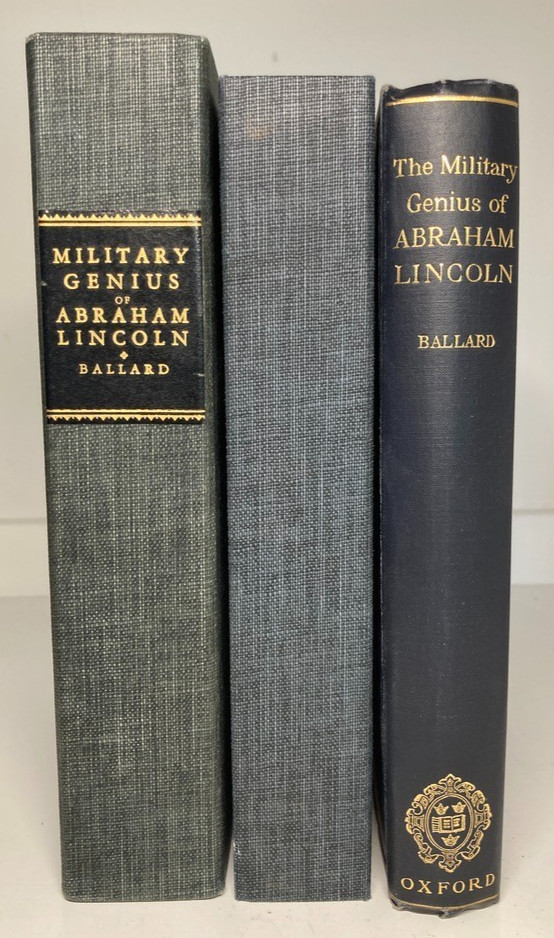
Fitted cloth chemise and slipcase with gilt-lettered leather spine label.
CONDITION
Near Fine overall.
Book
Original dark blue cloth remains clean and attractive.
• gilt spine lettering remains bright
• binding sound
• boards well preserved
• folding maps present
• contents generally clean
Autograph Manuscript
Ballard’s manuscript remains:
• clean
• dark
• fully legible
• well preserved
Letters and Documents
Associated papers show expected:
• old folds
• light handling
• minor age toning
but remain well preserved and readable.
Custom Case
Housed in a fitted cloth chemise and slipcase with gilt-lettered leather spine label.
Please examine all photographs carefully.
BIBLIOGRAPHIC DETAILS
Author: Brigadier-General Colin R. Ballard
Title: The Military Genius of Abraham Lincoln: An Essay
Publisher: Oxford University Press / Humphrey Milford
Place: London
Date: 1926
Edition: First Edition
Pagination: 246 pages
Illustrations: Folding maps
Binding: Original dark blue cloth
Manuscript
Author: Colin R. Ballard
Form: Multi-page autograph manuscript statement
Date: March 21, 1927
Recipient: George Philip Hambrecht
Publication History: Published from this copy in Lincoln Lore, February 22, 1943
Additional Material
Ballard ALS
1926–1927 presentation correspondence
B. F. Stevens & Brown correspondence
Brentano’s correspondence
Original invoice
1943 Lincoln Lore bulletin
Provenance
George Philip Hambrecht, private library No. 4736
Abraham Lincoln Book Shop, Chicago
Housing
Custom chemise and slipcase
WHY THIS ARCHIVE IS EXCEPTIONAL
The combination is unusually complete:
• 1926 first edition
• multi-page autograph manuscript by Ballard
• manuscript written specifically for Hambrecht
• Ballard’s autobiographical account of his discovery of Civil War history
• statement of authorial intention concerning the book
• Ballard autograph letter signed
• complete presentation correspondence
• original invoice
• major Lincoln-collector provenance
• the manuscript published from this very copy in 1943
• original 1943 publication retained
• Abraham Lincoln Book Shop provenance
• custom collector’s housing
A remarkable surviving Lincoln manuscript and association archive, preserving not only Ballard’s published argument for Lincoln’s military genius, but the author’s own private explanation of how that interpretation developed and the documentary history by which it entered Lincoln scholarship.