When you click on links to various merchants on this site and make a purchase, this can result in this site earning a commission. Affiliate programs and affiliations include, but are not limited to, the eBay Partner Network.
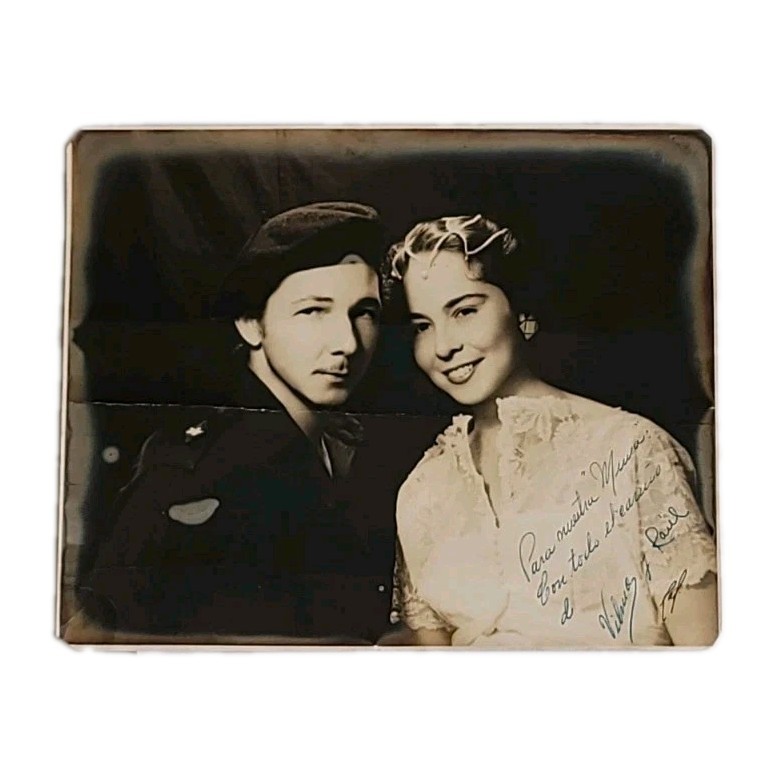
For your consideration is an exceptionally rare and historically important 26 January 1959 original silver gelatin wedding presentation photograph of Ral Castro Ruz (19312022) and Vilma Espn Guillo (19302007), measuring approximately 9.75 by 7.75 inches, associated with their celebrated marriage at the Rancho Club in Santiago de Cuba during the extraordinary opening weeks of the revolutionary government. The intimate formal portrait depicts Ral in military uniform and field cap beside Vilma in her lace bridal dress and distinctive pearl-trimmed Juliet-style headpiece. Most importantly, the photograph was presented to Magdalena Mima Menass Rovenskaya (19111978), celebrated as La Rusa de Baracoa, and bears the deeply personal autograph dedication Para nuestra Mima / Con todo el cario / de / Vilma y Ral For our Mima, with all our affection, from Vilma and Ral written principally in Vilma Espns hand and accompanied by the respective signatures of Vilma Espn and Ral Castro. The unusually affectionate formulation nuestra Mima is especially significant in light of Mimas documented personal association with the couple and the revolutionary leadership. Menass Rovenskaya, a prominent Baracoa hotelier and supporter of the revolutionary movement, provided assistance including money and medicines, while the surviving register of her celebrated Hotel La Rusa documents visits by Ral Castro and Vilma Espn together with Ernesto Che Guevara and Aleida March. Her identification transforms the photograph from an important signed portrait into a presentation artifact with substantial named-recipient provenance.
The photograph belongs to a remarkably well-documented visual record of the CastroEspn wedding. Contemporary TIME devoted coverage to the event in its 9 February 1959 issue, under the heading The Hemisphere: Society Wedding, reporting that approximately 2,500 guests attended the civil ceremony and festivities at the Rancho Club and specifically describing Vilmas lace wedding dress and pearl Juliet cap and Rals appearance in rebel uniform with a .45 automatic. The wedding was simultaneously covered by professional photographers working for both domestic and international publications. LIFE photographer Joe Scherschel photographed Ral and Vilma in connection with the wedding, and the surviving LIFE Picture Collection preserves both black-and-white print and original-negative records from his coverage, including catalogued 1959 wedding material. Cuban photographic documentation likewise survives from photographers including Francisco Panchito Cano and Humberto M. Prez, demonstrating the considerable contemporary photographic attention given to an event occurring only twenty-five days after the fall of the Batista government.
This particular physical photograph is substantially more important than an ordinary archival reproduction. The same underlying portrait is preserved in the Granma photographic archive under the identification Ral Castro y Vilma Espin en su boda, but the documented archival reproduction is presented in the opposite orientation, with Vilma at the left and Ral at the right. The present photograph instead places Ral at the left and Vilma at the right, establishing it as a distinct reversed printing state of the documented portrait. The geometry of the figures and composition corresponds to the known image, indicating the same photographic exposure rather than a separate pose; reversal could have resulted from the negative being inverted during enlarging or through a contemporary duplicate-negative or copy-printing process. The verso provides further primary photographic evidence through the professional Rafael Licea R. studio/archive stamp and associated photographic control markings. Licea was an established professional photographer active in Santiago during precisely this period and is independently documented as one of the city\'s distinguished professional photographers, whose work encompassed official, institutional, social and documentary photography. The precise relationship between Liceas production of this particular print and the surviving LIFE/Joe Scherschel photographic record remains an important unresolved question of photographic authorship: the physical evidence securely associates this print with Liceas photographic operation, while the surviving LIFE archive independently establishes Scherschels coverage of the wedding. Until the corresponding camera negative for this exact exposure is securely identified, it is more rigorous to distinguish the production and archival provenance of this physical print from attribution of the original camera exposure.
The historical and associative importance of the photograph is exceptional. Ral Castro had commanded the Segundo Frente Oriental Frank Pas during the revolutionary campaign and shortly after the wedding became one of the central military and political figures of the new government, ultimately succeeding his brother Fidel as head of state. Vilma Espn, an MIT-educated chemical engineer who had operated clandestinely under the revolutionary name Deborah, was already a major organizer of the underground movement and subsequently became one of the most influential women in the country\'s political and social institutions. Their marriage therefore occurred at the precise intersection between their private lives and their emergence into international political prominence. Preserved in good to fair original condition with pronounced horizontal folds and creasing, edge and corner wear, and scattered surface abrasions consistent with age and historical handling, the photograph nevertheless retains strong tonal definition, while the presentation inscription and signatures remain remarkably bold and legible. Although the underlying wedding portrait is documented institutionally, extensive research has located no other publicly documented example combining this reversed period printing state, Rafael Licea photographic association, archival markings, intimate presentation inscription to Magdalena Mima Menass Rovenskaya, and the respective autographs of both Ral Castro and Vilma Espn. While absolute uniqueness cannot be established without a comprehensive survey of private and institutional holdings, the present photograph may therefore responsibly be described as apparently unique in the publicly searchable record in this signed, inscribed and recipient-provenanced forman exceptional primary artifact uniting revolutionary history, LIFE-era photojournalism, photographic history, named personal provenance, and the private relationship of two of the most consequential political figures of the 20th century.