When you click on links to various merchants on this site and make a purchase, this can result in this site earning a commission. Affiliate programs and affiliations include, but are not limited to, the eBay Partner Network.
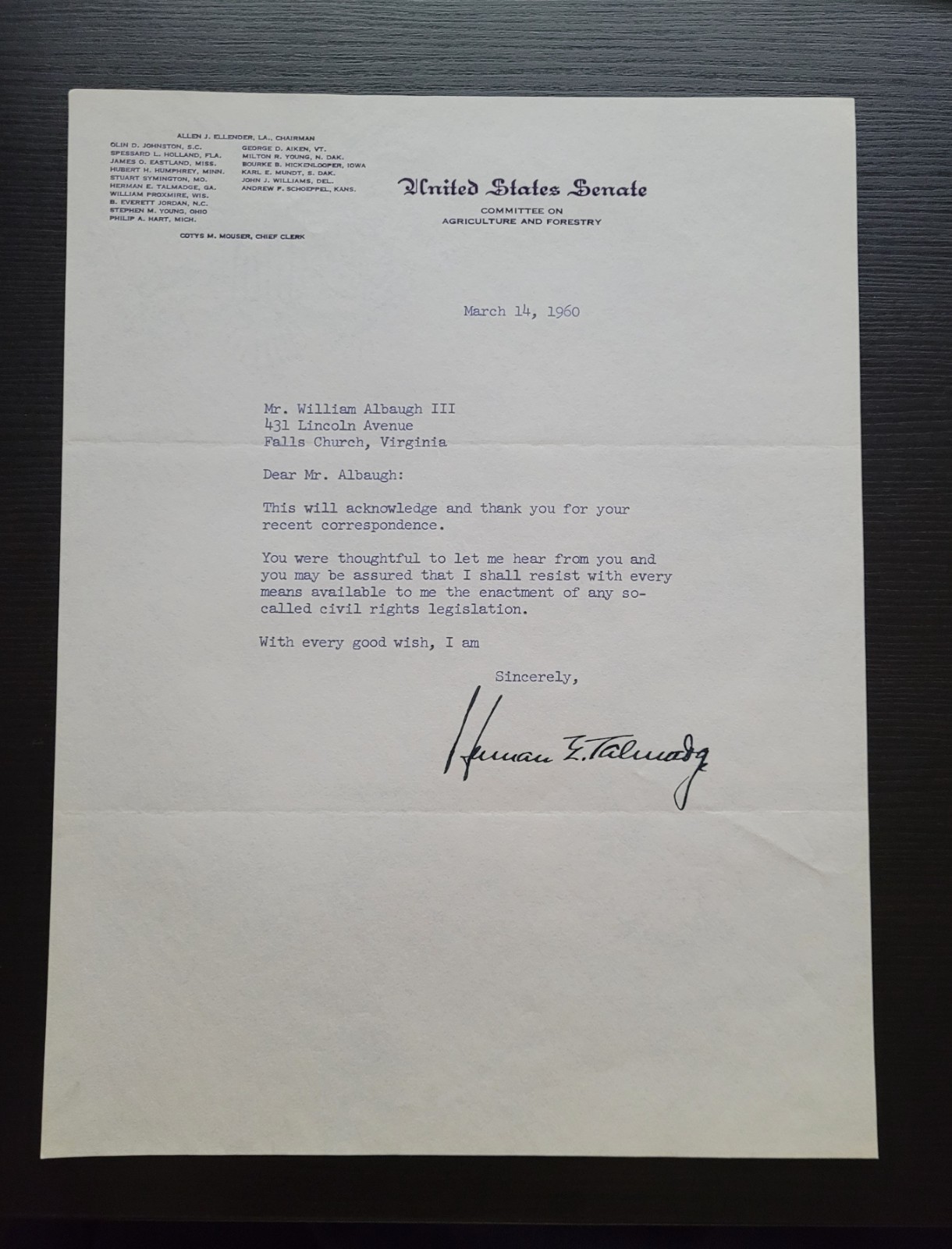
Significant 1960 Herman E. Talmadge Signed Letter - Resisting Civil Rights Legislation
This is an authentic and historically revealing document: an original typed letter signed by Senator Herman E. Talmadge (D-GA), dated March 14, 1960. The letter is addressed to Mr. William Albaugh III, and directly addresses his stance on the civil rights legislation of the era.
Senator Talmadge, a prominent figure in the Southern Democratic resistance to federal civil rights, unequivocally states, \"You may be assured that I shall resist with every means available to me the enactment of any so-called civil rights legislation.\" This direct and firm declaration underscores the political climate of the time and the determined opposition faced by civil rights advocates in the early 1960s.
This letter offers a clear and candid glimpse into the efforts to maintain racial segregation and states\' rights in the face of the growing Civil Rights Movement. It is a valuable piece for collectors of political history, civil rights era documents, or ephemera related to the United States Senate and the state of Georgia. The letter is in excellent condition, suitable for display or research.
Transcription of the Letter:
UNITED STATES SENATECOMMITTEE ON AGRICULTURE AND FORESTRY
March 14, 1960
Mr. William Albaugh III431 Lincoln AvenueFalls Church, Virginia
Dear Mr. Albaugh:
This will acknowledge and thank you for yourrecent correspondence.
You were thoughtful to let me hear from you andyou may be assured that I shall resist with everymeans available to me the enactment of any so-called civil rights legislation.
With every good wish, I am
Sincerely,
[Signature: Herman E. Talmadge]Herman E. Talmadge
Biography of Senator Herman E. Talmadge and His Civil Rights Legislation History:
Herman Eugene Talmadge (1913-1989) was a powerful and influential American politician who served as Governor of Georgia from 1948 to 1955 and then as a U.S. Senator from Georgia from 1957 to 1981. He was a leading figure in the \"Solid South\" Democratic Party and a staunch segregationist.
Early Career and Political Stance:Born in Telfair County, Georgia, Herman Talmadge was the son of Eugene Talmadge, a four-time governor of Georgia known for his populist appeal and ardently segregationist views. Herman followed in his father\'s footsteps, becoming a lawyer and entering politics. He inherited his father\'s conservative ideology, particularly regarding race and states\' rights. His political career was marked by his fierce defense of traditional Southern social structures and his opposition to federal intervention.
Civil Rights Legislation History:Senator Talmadge was one of the most prominent and vocal opponents of the Civil Rights Movement and federal civil rights legislation. His record is characterized by:
Staunch Segregationist: Throughout his career, Talmadge was an outspoken advocate for racial segregation. As governor, he pursued policies aimed at maintaining segregation, including threatening to abolish public education rather than integrate it.
Massive Resistance: He was a key figure in the \"Massive Resistance\" movement against school desegregation following Brown v. Board of Education (1954). He supported state laws designed to circumvent or defy the Supreme Court\'s ruling.
Southern Manifesto: Talmadge was a signatory of the 1956 \"Southern Manifesto,\" which condemned the Brown decision and pledged resistance to racial integration by all lawful means.
Active Opposition to Legislation: As a U.S. Senator, he consistently and forcefully resisted all major civil rights bills. This letter from 1960 clearly states his intention to \"resist with every means available\" against \"so-called civil rights legislation.\" He participated in filibusters and voted against:
Civil Rights Acts of 1957 and 1960: He opposed these early efforts to protect voting rights and address other forms of discrimination.
Civil Rights Act of 1964: Talmadge was a leading voice in the Southern opposition to this landmark legislation, which outlawed segregation and discrimination.
Voting Rights Act of 1965: He also vigorously opposed this crucial act aimed at eliminating barriers to African American suffrage.
Defense of States\' Rights: Like other Southern Democrats, Talmadge framed his opposition in terms of constitutional principles, arguing that civil rights were state, not federal, matters, and that federal legislation was an unconstitutional overreach.
Herman Talmadge remained a significant and unyielding voice of the Old South in the U.S. Senate until his defeat in 1980. His long career and consistent opposition made him a central figure in the legislative battles of the Civil Rights Era.
______________
Herman Eugene Talmadge (August 9, 1913 – March 21, 2002)[1] was a U.S. politician who served as governor of Georgia in 1947 and from 1948 to 1955 and as a U.S. senator from Georgia from 1957 to 1981. A Democrat, Talmadge served during a time of political transition, both in Georgia and nationally.[2] He began his career as a staunch segregationist known for his opposition to civil rights, including supporting legislation that would have closed public schools to prevent desegregation.[3] By the later stages of his career, following the enactment of the Voting Rights Act, which gave substance to the Fifteenth Amendment enacted nearly one hundred years before, and increased African American voter participation, Talmadge, like many other Southern politicians of that period, had modified his views on race. His life eventually encapsulated the emergence of his native Georgia from entrenched white supremacy into a multiracial political culture where many white voters regularly elect Black and other non-white candidates to the U.S. Congress and Georgia General Assembly.[4][5]
When his father, Eugene Talmadge, won the 1946 Georgia gubernatorial election but died before taking office, Herman Talmadge asserted claims to be the 70th governor of Georgia, in what became known as the three governors controversy. He occupied the governor\'s office from January until March 1947, before yielding to a Georgia Supreme Court decision in favor of Lieutenant Governor Melvin E. Thompson. In 1948, Talmadge defeated Thompson by more than 6 percent in a special election to complete the elder Talmadge\'s unfinished four-year term. He was reelected in 1950, defeating Thompson by a narrower margin. Talmadge served until the end of his term in 1955.[6][7]
Talmadge, who first became governor at age 33, supported a new statewide sales tax during his second term to fund the construction of new schools and expanded state services. He also supported other infrastructure improvements and increased teachers\' salaries.[8] In so doing, the younger governor Talmadge departed from his father\'s stingy, low-tax and low-spending philosophy while remaining steadfastly opposed to racial desegregation and political equality for Black Americans. He left the governor\'s office as an incredibly popular executive whose administration earned praise from the traditionally liberal outlets such as the Atlanta Constitution and even Harper\'s Magazine.[7][2][9][10]
Herman Talmadge was elected to the United States Senate in 1956 when Walter F. George, Georgia\'s senior senator and the President pro tempore of the United States Senate, declined to seek reelection. In the Senate, Talmadge was a long-serving member of the Senate Agriculture Committee as well as the Senate Finance Committee. During the latter part of his career, he also served as a member of the Select Committee on Presidential Campaign Activities (better known as the Senate Watergate Committee). As chairman of the Senate Agriculture Committee, he oversaw the passage of numerous pieces of important legislation, including the expansion of the Child Nutrition Act and the Consolidated Farm and Rural Development Act of 1972, the first major legislation dealing with rural development since the Rural Electrification Act of 1936. The Senate later denounced Talmadge for financial irregularities that were revealed during a Senate Ethics Committee investigation following a contentious divorce from his second wife.[2] The investigation, as well as Georgia\'s changing demographics, helped Republican Mack Mattingly defeat Talmadge for re-election in 1980. Following his defeat, Talmadge retired from public life.
Early life, education and military serviceHerman Talmadge was born on August 9, 1913, on a farm near the small town of McRae in Telfair County in southeastern Georgia. He was the only son of Eugene Talmadge and his wife, Mattie (Thurmond), and through his mother, he was a second cousin of South Carolina Senator and 1948 Dixiecrat presidential candidate Strom Thurmond.[11][12][13] Herman attended public schools in Telfair County until his senior year of high school, when his family moved to Atlanta and he enrolled at Druid Hills High School, graduating in 1931.[14] In the fall of 1931, he entered the University of Georgia for his undergraduate degree and was a member of the Demosthenian Literary Society and Sigma Nu fraternity. After completing his undergraduate studies, Talmadge enrolled in the University of Georgia School of Law. He received his law degree in 1936 and joined his father\'s law practice.[15]
In 1937, Talmadge married Katherine Williamson. The marriage ended in divorce after three years. In 1941, he married Betty Shingler, and they had two sons, Herman Eugene Jr. and Robert Shingler.[15] When World War II broke out, Talmadge volunteered to serve in the United States Navy. He served as an ensign with the Sixth Naval District at Charleston, and with the Third Naval District in New York after graduating from midshipman\'s school at Northwestern University. In 1942, Talmadge participated in the invasion of Guadalcanal aboard the USS Tryon. He served as flag secretary to the commandant of naval forces in New Zealand from June 1943 to April 1944 and then as executive officer of the USS Dauphin. Talmadge participated in the battle of Okinawa and was present in Tokyo Bay for the Japanese surrender. He attained the rank of lieutenant commander and was discharged in November 1945.[16]
After his service in World War II, Talmadge returned to his home in Lovejoy, Georgia. While continuing to practice law and to farm, he took over publishing his father\'s weekly newspaper, The Statesman, and started a ham-curing business.[17]
Three governors controversyMain article: Three governors controversyAfter returning from the war, Talmadge became active in Democratic Party politics. He ran his father\'s successful 1946 campaign for governor. Eugene Talmadge had been ill, and his supporters were worried about his surviving long enough to be sworn in. They studied the state constitution and found that if the governor-elect died before his term began, the Georgia General Assembly would choose between the second and third-place finishers. The elder Talmadge ran unopposed among Democrats, so the party officials arranged for write-in votes for Herman Talmadge as insurance.
In December 1946, Eugene Talmadge died before taking office. Melvin E. Thompson, the lieutenant governor-elect; Ellis Arnall, the sitting governor; and Herman Talmadge all arranged to be sworn in and concurrently tried to conduct state business from the Georgia State Capitol. Arnall relinquished his claim in favor of Thompson. Ultimately, the Supreme Court of Georgia supported Thompson.
Elected Georgia governorTalmadge prepared to run for the special gubernatorial election in 1948, and defeated Thompson. He was elected to a full term in the 1950 election. During his tenure, Talmadge attracted new industries to Georgia. He remained a staunch supporter of racial segregation even as the civil rights movement gained momentum. Talmadge was barred by law from seeking reelection in 1954. That year, the U.S. Supreme Court ruled in Brown v. Board of Education that segregated public schools were unconstitutional, and advised school systems to integrate.
United States Senate careerAs part of Talmadge\'s 1956 Senate campaign,[18] he published the infamous segregationist pamphlet You and Segregation,[19] arguing that desegregation was a communist plot, that the use of federal power to ban segregation was unconstitutional, and that, in the now-infamous phrase, the United States was a \"Republic not a Democracy\", since democracy was communist.
Talmadge was elected to the United States Senate in 1956. Most Black people in Georgia were still disenfranchised under state laws passed by white Democrats and discriminatory practices they had conducted since the turn of the 20th century. As a U.S. senator, Talmadge continued to oppose civil rights legislation, even as the civil rights movement gained media coverage and increasing support. After President Lyndon B. Johnson signed the Civil Rights Act of 1964, Talmadge, along with more than a dozen other southern senators, boycotted the 1964 Democratic National Convention.[20]
With the help of Senator Richard Russell, Talmadge had been appointed to the Agriculture Committee during his first year in Washington and to the Senate Finance Committee shortly thereafter. As a junior member of the Agriculture Committee, he worked to address the nation\'s farmers\' changing needs in an evolving global economy. Talmadge also worked to expand support for both farmers and children and families in hunger through his work on the Child Nutrition Act of 1966, but most significantly in 1969 and 1970 as part of the reauthorization and expansion of the 1946 School Lunch Act, which Russell had authored and considered his greatest legislative achievement.
Talmadge was a great admirer of the work Russell did on the 1946 act but recognized that significant improvements were needed. After noting that only a third of American children living in families making less than $2000 a year were able to participate in the program, Talmadge said: \"We must use food as a tool of education. A child cannot learn if he is hungry. It has been the experience of school administrators in economically deprived areas that there is a marked improvement in school attendance when children can look forward to the prospect of a good meal at school.\" Major goals of Talmadge\'s new proposal were to provide funding for equipment; increase the required level of support from states; allow the \"lunch to follow the child\", letting students from low-income families that lived in higher-income areas remain eligible for the program; establish the National Advisory Council on Child Nutrition; and give needy children special assistance. The amendments for these purposes became law on May 14, 1970.[21][22]
When Allen Ellender assumed chairmanship of the Senate Appropriations Committee after Russell\'s death in January 1971, Talmadge became chairman of the Senate Agriculture Committee, a position he held until leaving office in 1981.[23]
Talmadge\'s elevation to Agriculture Committee Chairman came at a time when many analysts were forecasting that the world\'s need for food would soon outstrip its productive capacity. Under Talmadge\'s leadership, the Senate Agriculture Committee confronted these problems throughout the 1970s. Talmadge oversaw the passage of several bills that more than doubled spending on farm programs by the end of the 1970s. In addition to the Rural Development Act of 1972, the Agriculture and Consumer Protection Act of 1973 (also known as the 1973 U.S. Farm Bill), which provided for commodity price support, soil conservation, and food stamp expansion for four years, passed under his chairmanship. The four-year period established a cycle that ensured the next three farm bills appeared on the congressional agenda after presidential elections, thereby preventing them from becoming entangled in election-year politics. The Food and Agriculture Act of 1977 continued the market-oriented loan and target-pricing policies of its predecessor. Title XIV of the Act confirmed the USDA\'s historic role in agricultural research under the National Agricultural Research, Extension, and Teaching Policy Act. The bill also made major modifications to food stamps and solidified the program as a part of the Farm Bill.
Also in 1977, as a result of Senate committee reorganization and in recognition of the Agriculture Committee\'s increased role in addressing hunger and nutrition, growing spending for federally supported child nutrition (which rose from $2.4 billion to more than $8 billion during the decade), and increase of staff size (rising from seven in 1971 to 32 in 1980), the committee\'s name was changed to the Committee on Agriculture, Nutrition, and Forestry. This was the first change to the committee\'s name since adding \"Forestry\" in 1884.[24]
In 1968, Talmadge faced the first of his three Republican challengers for his Senate seat. E. Earl Patton, later a member of the Georgia State Senate, received 256,796 votes (22.5 percent) to Talmadge\'s 885,103 (77.3 percent). A real estate developer, Patton was the first Georgia Republican to run for the U.S. Senate since the Reconstruction era, when most Republicans were African-American freedmen.[25] He was a sign of the shifting white electorate in the South, as white suburbanites moved into the Republican Party.
Talmadge ran a disciplined office, requiring his staff to respond to every constituent letter within 24 hours of receipt.[26] In 1969, he hired Curtis Lee Atkinson as an administrative aide, making Atkinson the first African-American hired to work on a Southern senator\'s personal staff since Reconstruction.[27]
In 1973, Talmadge was appointed to the Select Committee on Presidential Campaign Activities (better known as the United States Senate Watergate Committee), which investigated members of the Nixon administration. He served on the committee until its final report was issued in June 1974. Talmadge\'s service on the committee is generally considered the high-water mark of his time as a U.S. senator.[28]
DenunciationLate in his Senate career, Talmadge became embroiled in a financial scandal. After an extensive Senate investigation, on October 11, 1979, the Senate voted 81–15 to \"denounce\" Talmadge for \"improper financial conduct\" between 1973 and 1978. He was found to have accepted reimbursements of $43,435.83 for official expenses not incurred, and to have improperly reported the \"expenses\" as campaign expenditures.[29][30][31][32]
After the trial, he faced significant opposition in the state\'s Democratic primary for the first time in 24 years. Lieutenant Governor Zell Miller challenged Talmadge in the primary with the support of liberals disenchanted with Talmadge\'s conservatism.[33] Though Talmadge won the primary runoff against Miller, his ethical conduct was a significant issue and he was defeated by the Republican nominee, former state GOP chairman Mack Mattingly.[34] It was believed that the bruising primary battle with Miller left Talmadge weakened for the general election.[33]
DivorceIn 1977, following a long period of personal troubles, including self-admitted alcoholism, which spiraled out of control after his son, Bobby, drowned in 1975, Talmadge filed for divorce from his wife, Betty.[35] The Talmadges reached a divorce settlement in 1978, with Betty receiving $150,000 in cash and 100 acres of their Lovejoy plantation.[36] She was also allowed to use the remaining 1,200 acres on the plantation.[36] Betty testified against Talmadge in 1980 during the Senate investigation into his finances.
Later lifeAfter his defeat, Talmadge retired to his home; his plantation and mansion were now in his ex-wife Betty\'s possession. In 1984, he married Lynda Pierce.[37] He lived on for more than two decades, dying at 88. Talmadge and Betty, who eventually reconciled and remained on respectful terms, had two sons together, Herman E. Talmadge Jr., and Robert Shingler Talmadge. Betty Talmadge died in 2005, surrounded by family, on her estate.[38] At the time of his death, Herman Talmadge was the earliest serving former governor.
Awards1969, he was awarded an honorary degree in Doctor of Laws from Oglethorpe University.[39]1975, Morris Brown College gave Talmadge its \"Man of the Year\" award.[40]See also Biography portalflag Georgia (U.S. State) portalicon Law portalicon Politics portalConservative DemocratList of United States senators expelled or censuredList of members of the American Legion