When you click on links to various merchants on this site and make a purchase, this can result in this site earning a commission. Affiliate programs and affiliations include, but are not limited to, the eBay Partner Network.
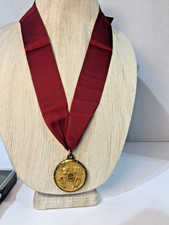
This is an exceptionally rare, hand-embroidered school ceremonial banner by one of early 20th-century America’s most respected regalia makers — a piece that bridges institutional history, textile artistry, and American vernacular design in a single bold object. Whether you are a collector of Americana, a textile historian, or a design-forward decorator, this banner commands a room and demands a story.
History & Provenance
Fuller Regalia & Costume Co. of Worcester, Massachusetts was a premier manufacturer of fraternal, civic, and institutional regalia from the late 19th century through the mid-20th century. Their “Durward” trademark denoted a quality tier of embroidered banners produced for schools, lodges, labor unions, and civic organizations across the country. Worcester itself was a hub of textile manufacturing, and Fuller’s products reflected that industrial heritage — tight wool grounds, substantial silk fringe, and hand-guided embroidery that no machine of the era could fully replicate.
The inscription — M.V.E.H.S. — We Hold the Banner of Freedom — is a stirring motto almost certainly belonging to an evening or vocational high school, likely from the 1910s through the 1940s when such institutions were beacons of civic aspiration for working-class and immigrant communities seeking education alongside their day jobs. The phrase itself carries the full weight of Progressive Era idealism. This is not merely a decorative object; it is a primary document of American educational and social history.
Craftsmanship
The banner is constructed from a heavy navy wool felt ground — the standard substrate for quality regalia of the period — with letters formed by dense satin-stitch silk embroidery in antique gold. The border is finished with a woven gold braid, and the bottom edge carries a substantial twisted-rope silk fringe with a woven header. Corner tassels are formed from the same braided cord. The reverse side shows the embroidery backing through the wool, a characteristic of single-substrate hand-embroidered banners. The maker’s sewn-in label remains fully intact and legible — a significant detail that authenticates the piece and anchors its provenance.
Creative ApplicationsFor the eco-conscious or design-minded buyer, this banner offers compelling possibilities beyond traditional display. It could be professionally mounted and framed behind UV-protective glass as a textile art installation. The bold typography has inspired contemporary graphic designers who source vintage lettering from pieces exactly like this one. Interior designers working in industrial, academic, or Americana aesthetics frequently incorporate parade banners as statement wall pieces in libraries, offices, loft spaces, and hospitality venues. The gold fringe, if the banner were ever deaccessioned, is itself a period-correct passementerie that upholsterers and costume designers actively seek. That said, keeping this piece whole and intact is strongly recommended — its value, both historical and monetary, is greatest as an undivided object.