When you click on links to various merchants on this site and make a purchase, this can result in this site earning a commission. Affiliate programs and affiliations include, but are not limited to, the eBay Partner Network.
EARLIEST-GENERATION H.G. FARRELL ARABIAN LINIMENT BOTTLE
Offered here is an exceptional early H.G. Farrell medicine bottle from Peoria, Illinois, dating to approximately 1846–1849—the introductory years of Farrell’s celebrated Arabian Liniment.
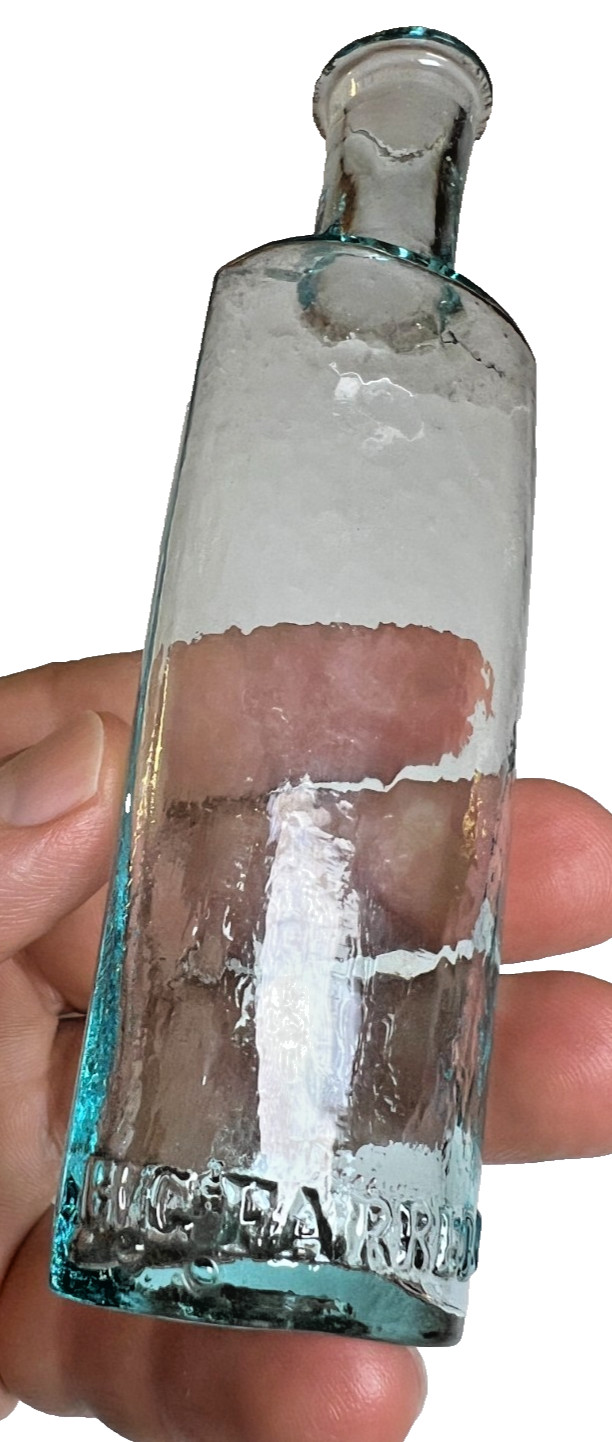
This primitive aqua bottle is heel-embossed:
H.G. FARRELLPEORIA
Its abbreviated embossing, delicate oval form, open pontil, thin whittled glass and hand-finished flared mouth distinguish it from the familiar later bottles boldly embossed H.G. FARRELL’S ARABIAN LINIMENT / PEORIA.
The evidence strongly indicates that this was an earliest-generation, paper-labeled H.G. Farrell bottle, produced before the fully product-embossed Arabian Liniment bottles became standard.
It is quite plausibly one of the oldest H.G. Farrell Arabian Liniment bottle types collectors can obtain.
PRECISE DATE: CIRCA 1846–1849
Hiram G. Farrell began working in his brother William B. Farrell’s Peoria drugstore as a teenager. The brothers were briefly associated in business before their partnership dissolved in late 1844.
The documented chronology is remarkably tight:
1836: William B. Farrell opened his Peoria drugstore.
Late 1844: The Farrell brothers’ business partnership ended.
August 1845: William advertised “Farrell’s Arabian Nerve and Bone Liniment.”
1846: Hiram began marketing his competing Arabian Liniment.
1847: Hiram attempted to patent his preparation.
1847: An illustrated broadside advertised H.G. Farrell’s Arabian Liniment from No. 17 Main Street, Peoria.
By 1851: Hiram’s advertisements described bottles fully embossed “H.G. Farrell’s Arabian Liniment, Peoria.”
Because this bottle identifies H.G. Farrell individually, its earliest logical date is approximately 1846.
Its primitive construction and abbreviated H.G. FARRELL / PEORIA embossing strongly favor production before the fully branded Arabian Liniment bottles were established by approximately 1850–1851.
Best-supported date: circa 1846–1849.WHY THIS IS AN IMPORTANT FARRELL BOTTLE
The standard later bottle advertised the complete product directly in the glass:
H.G. FARRELL’S ARABIAN LINIMENT / PEORIA
This example instead carries only the proprietor’s name and city:
H.G. FARRELL / PEORIA
That difference matters.
Hiram’s Arabian Liniment business was new in 1846. Before investing in separate product-specific molds, he could package his preparations in a generally embossed H.G. Farrell bottle and identify the contents with a paper label.
This would allow a single privately commissioned mold to be used for more than one Farrell preparation, including:
Once Arabian Liniment became successful—and once Hiram’s conflict with William created confusion in the marketplace—the complete product name and H.G. initials became vital anti-counterfeit advertising.
This bottle appears to represent the preliminary stage: permanent merchant identification in the glass, with the exact medicine originally supplied by a paper label.
THE SCHOLARLY BOTTLE EVIDENCE
The principal published reference is Kenneth B. Farnsworth and John A. Walthall’s monumental 816-page study:
Bottled in Illinois: Embossed Bottles and Bottled Products of Early Illinois Merchants from Chicago to Cairo, 1840–1880
Published by the Illinois State Archaeological Survey, this work documents nearly 1,100 embossed bottle varieties used by approximately 500 Illinois merchants.
Its authors report that:
No merchant-embossed Illinois bottles are presently known to predate approximately 1840.
The earliest documented Illinois examples date to approximately 1841.
Evidence suggests that the Farrell brothers were among the earliest Illinois merchants to package Farrell’s Arabian Liniment and Fever & Ague Drops in embossed bottles.
The reference specifically directs readers to its Farrell bottle discussion and illustrations.
Consequently, the connection between early Farrell-embossed bottles and Arabian Liniment is not simply seller speculation—it is supported by the leading archaeological reference devoted to Illinois bottles.
ONE OF THE EARLIEST ARABIAN LINIMENT TYPES
This exact bottle does not spell out the product name, so its missing paper label prevents anyone from proving what was inside this individual example.
Nevertheless, the accumulated evidence is compelling:
It names the correct proprietor: H.G. Farrell
It identifies the correct city: Peoria
It dates to the opening years of Hiram’s Arabian Liniment business
Its form is appropriate for a small medicinal or liniment bottle
The authoritative Illinois bottle study connects the early Farrell embossed series with Arabian Liniment
Its abbreviated embossing appears earlier than the familiar fully branded bottle
Its open pontil and primitive finish agree with late-1840s manufacture
The most accurate conclusion is:
An earliest-generation H.G. Farrell medicine bottle, almost certainly dating from the formative years of Farrell’s Arabian Liniment and plausibly the earliest H.G. Farrell Arabian Liniment bottle style.THE FARRELL BROTHERS’ MEDICINE WAR
The story became more colorful after William and Hiram separated.
Both brothers sold an Arabian Liniment. Both claimed historical priority. Both suggested that the other man’s medicine was an imitation.
Hiram’s later advertisements warned purchasers to look specifically for the initials H.G. before Farrell’s name. William continued marketing his own version as W.B. Farrell’s Arabian Liniment.
Their newspaper advertisements became an extended public battle over which Farrell sold the genuine preparation.
It was the nineteenth-century pharmaceutical equivalent of:
“Don’t buy my brother’s Farrell’s—buy the real Farrell’s!”
The controversy explains why later bottles needed elaborate product-specific embossing. This simpler H.G. FARRELL / PEORIA bottle appears to come from the beginning of the story, before the branding war reached full volume.
ABOUT FARRELL’S ARABIAN LINIMENT
H.G. Farrell marketed his Arabian Liniment as a powerful external remedy for both humans and animals.
Advertisements recommended it for ailments and bruises
Back and joint and wounds
Weakness or paralysis of the limbs
Injuries and ailments affecting horses and livestock
One early broadside claimed that the medicine penetrated deeply and could address numerous diseases of horses.
The “Arabian” name evoked exotic knowledge, exceptional horses and a supposedly mysterious foreign formula. In reality, it was part of the theatrical marketing that helped nineteenth-century patent medicines stand out in an almost completely unregulated marketplace.
THREE SIZES FOR THREE MARKETS
Farrell’s Arabian Liniment was eventually advertised in three price levels:
25 cents
50 price points apparently represented different bottle sizes.
The compact oval form of this bottle is consistent with a smaller, affordable preparation that could be carried in a pocket, medicine chest, saddlebag or traveling case.
Its flattened profile also made it more practical to pack and transport than a fully round bottle—particularly in an age of wagons, riverboats and rough frontier roads.
CONSTRUCTION DETAILSThis bottle possesses an exceptional combination of early manufacturing characteristics:
Open or blowpipe pontil
Thin, delicate aqua glass
Crude mold-blown construction
Pronounced whittling and surface texture
Hand-finished flared mouth
Early oval medicine form
Low heel embossing
Minimal proprietor-and-city wording
Strong early glass character
The open pontil records where the vessel was held while its mouth was finished. Every example was individually gathered, blown into a mold, removed, pontiled and completed by hand.
This was not mechanized bottle production. Each container carries subtle evidence of the glassworkers who made it.
EXCEPTIONAL CONDITIONAttic-mint condition for an approximately 175-year-old bottle.Thin-walled pontiled medicines frequently survive with lip flakes, bruised bases, cracks, staining or heavy mineral haze.
The survival of this extremely delicate example in such outstanding condition is exceptional.
Please examine all photographs closely, as they form an important part of the description.
PEORIA DURING THE 1840sWhen this bottle was made, Peoria was developing from a frontier river settlement into an important commercial center.
The Illinois River connected local merchants with:
Patent medicines could be sold from a Main Street drugstore, distributed aboard riverboats and supplied to agents in communities where trained physicians and established pharmacies remained scarce.
The Farrell enterprise emerged at precisely the right moment: a growing population, expanding river commerce and tremendous demand for recognizable bottled remedies.
AMERICA WHEN THIS BOTTLE WAS MADEDuring the proposed 1846–1849 period:
The Mexican-American War was being fought.
Abraham Lincoln was an Illinois attorney and served one term in Congress.
The California Gold Rush was just beginning.
Telegraph service was a new technological marvel.
Railroads had not yet connected much of the country.
Most western commerce still traveled by horse, wagon and riverboat.
Germ theory was not accepted.
Surgical anesthesia was only beginning to appear.
Medicines routinely contained alcohol, opium, mercury and powerful botanical compounds.
Patent medicines were sold with little meaningful government regulation.
This bottle comes from a period when Peoria was still part of America’s developing western frontier and commercially embossed Illinois medicines were a genuine novelty.
FINAL IDENTIFICATIONH.G. Farrell Medicine BottlePeoria, IllinoisEarliest-Generation Arabian Liniment TypeCirca 1846–1849Open Pontil — Hand-Finished Flared Mouth — Attic MintThis is more than a beautifully preserved early medicine bottle. It represents the opening chapter of one of Illinois’s most successful—and most hotly contested—nineteenth-century patent-medicine businesses.
Its abbreviated embossing appears to capture H.G. Farrell’s packaging at the moment between the locally compounded druggist preparation and the fully branded, nationally advertised Arabian Liniment bottle.