When you click on links to various merchants on this site and make a purchase, this can result in this site earning a commission. Affiliate programs and affiliations include, but are not limited to, the eBay Partner Network.
Large Sonny Boy 5¢ Mild Cigar Box Label, Consolidated Lithographing, Brooklyn 🎩
Size: 8 3/4\" x 8\"
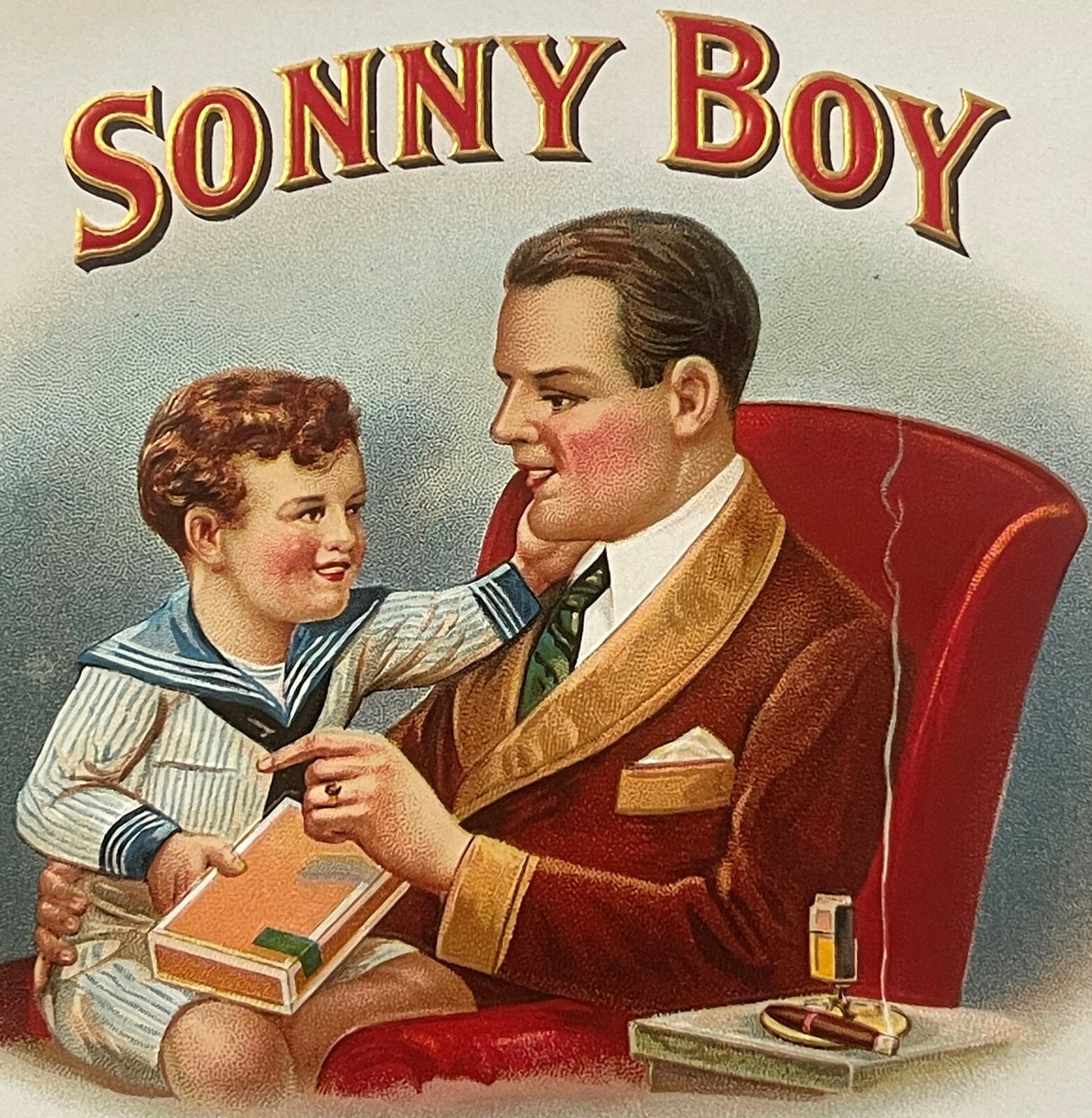
An unused, embossed Sonny Boy cigar box label from the 1920s-1930s: a father in a smoking jacket and a red wingback chair with his boy on his knee holding a box of cigars, a cigar smoking in the ashtray beside them, and 5¢ and MILD shields in the corners. It was printed by Consolidated Lithographing Corporation of Brooklyn, whose head, Jacob A. Voice, Fortune called America\'s foremost maker of cigar box art in 1933.
SPECIFICATIONS
- Brand: Sonny Boy
- Object: cigar box label, large nearly square format, embossed color lithograph with gold
- Size: 8 3/4\" x 8\" ~
- Printed words: SONNY BOY (top and bottom) · 5¢ (two shields) · MILD (two shields) · CONSOLIDATED LITHOGRAPHING CORPORATION BROOKLYN N.Y.
- Picture: a curly-haired boy in a blue-and-white striped sailor suit on his father\'s knee, holding an orange cigar box; the father in a maroon smoking jacket with a gold shawl collar, green tie and white pocket square, seated in a red wingback armchair; a cigar in an ashtray with a table lighter on a side table
- Printer: Consolidated Lithographing Corporation, Brooklyn, N.Y.
- Age: 1920s-1930s
- Back: plain paper, embossing visible in reverse
CONDITION
New old stock, never applied to a box, with little to no wear. The back is clean paper carrying only the reverse of the embossing. My pictures seriously don\'t do it justice.
THE STORY🏭 The Brooklyn printer
Jacob A. Voice was born in Romania in 1884 and came to America at three. He joined the lithographers Wm. Steiner & Sons in 1903, ran his own company by 1911, and around 1925 merged it with Steiner\'s; that year the firm took the name Consolidated Lithographing Corporation, which puts this label at 1925 or later. In 1930 the cigar label business of the old American Lithographic Company, sold the year before to the United States Printing and Lithographic Company, went to Consolidated. Fortune in March 1933 called Voice \"by common acclaim\" America\'s foremost maker of cigar box art. He gave the Museum of the City of New York a collection of cigar box labels from about 1870 to 1930 in 1935, and died in 1942. The collection of Sidney P. Voice, a Consolidated vice-president, covering cigar bands, box labels and salesman\'s sample books from about 1890 to 1963, is at the New-York Historical Society.
🧾 5¢ and MILD
From 1917, to help pay for the First World War, federal law taxed cigars by the price they were made to retail at, with color-coded stamps. The orange Class A stamp meant not more than 5 cents a cigar and was by far the most common stamp in the country. It turned violet in mid-1940, and the colored classes were redesigned in 1942 with the World War II tax increases. The Revenue Act of 1926, signed February 26, 1926, let the Commissioner of Internal Revenue require a conspicuous label on each box naming the tax clause, matching the stamp. Nickel cigars were 63 percent of cigar sales in the twelve months from 1930 and 73 percent by July 1931, and through the 1930s about nine cigars in ten sold in the U.S. cost 5 cents or less. Bayuk cut Phillies from a dime to a nickel and watched sales go from 17 million to 365 million in two years, which made Phillies the best-selling cigar in America.
🧥 The jacket, the sailor suit and the chair
The smoking jacket was designed in the 1850s. After the Crimean War made Turkish tobacco popular in Britain, a gentleman would slip one on after dinner and retire to the smoking room, and the jacket took the smoke and ash instead of his clothes; its classic shawl collar and turn-up cuffs are the ones on this father, and Fred Astaire was buried in one. The sailor suit began in 1846 with a four-year-old Albert Edward, Prince of Wales, dressed in a small copy of the Royal Yacht ratings\' uniform and painted in it by Winterhalter; by the 1870s boys and girls in many countries wore them. The wing chair came out of England in the 1600s, its wings built to block draughts and hold in the heat of the fire, and legend has it the first ones were wooden chairs used by barber-surgeons.
✨ Stone and gold
A label like this was a monthlong job: a sketch, a pencil drawing, a watercolor, then every color drawn by hand onto limestone in grease pencil, after which the printer destroyed the original painting. Embossing and gilding took extra press runs, and by 1892 labels were embossed in 38-ton presses with machined dies. The gold was gold leaf or, on most American labels, bronze powder buffed on with a wheel. By the 1920s metal plates on high-speed presses were replacing the Bavarian stones. Cigar labels show you what vintage advertising is all about with the wonderful graphics that lithography provided that modern printing just can\'t reproduce; this was a lost art after the 1920s, unfortunately.
🎶 The name
Ray Henderson, Buddy DeSylva and Lew Brown wrote \"Sonny Boy,\" and the story goes that they knocked it out in Atlantic City as a joke, so sappy that even Al Jolson would hate it. He loved it, and sang it to three-year-old Davey Lee in The Singing Fool, which opened in New York on September 19, 1928. The record sat at number one for twelve weeks and became the first movie song to sell a million copies, and the film stayed Warner Bros.\' biggest success until Sergeant York in 1941. Davey Lee starred in his own Sonny Boy in 1929. The cigar label never names the song or the film; it shares the name, a father and his boy, and the years.
GOOD FOR
- 🖼️ A square frame for a den, bar or study
- 👨👦 A Father\'s Day or new-dad gift
- 🚬 Cigar and tobacco label collections from the nickel cigar years
- 🎵 Displaying with 1928 \"Sonny Boy\" sheet music or a Jolson 78
- 🗽 Brooklyn and New York printing history