When you click on links to various merchants on this site and make a purchase, this can result in this site earning a commission. Affiliate programs and affiliations include, but are not limited to, the eBay Partner Network.
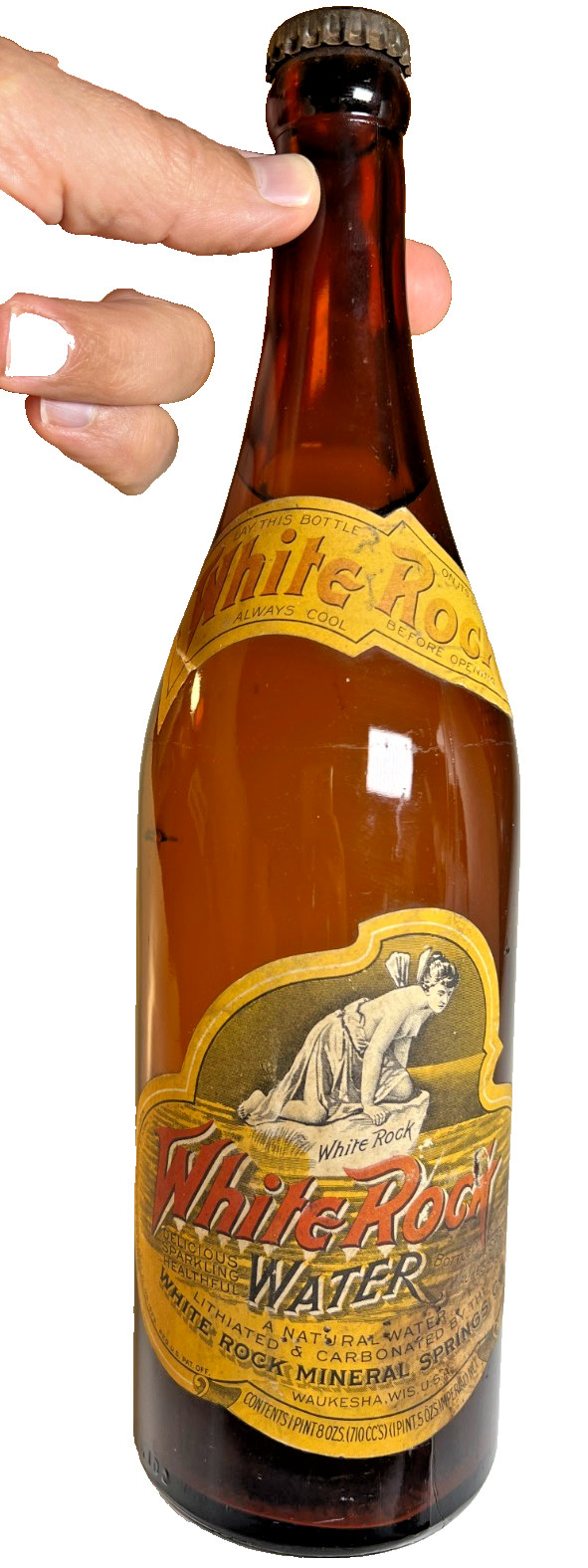
Outstanding circa 1935–1940 White Rock Mineral Water bottle, still sealed beneath its original White Rock crown cap and retaining approximately 80% of its original contents. It also carries both of its wonderfully graphic original paper labels: the large illustrated body label and matching diamond-shaped neck label.
The tall amber bottle measures approximately 11 5/8 inches tall and was sold as 1 pint 8 ounces / 710cc, or roughly 24 imperial fluid ounces. The label identifies the product as:
White Rock Water
A Natural Water — Lithiated & Carbonated
White Rock Mineral Springs Co.
Waukesha, Wisconsin, U.S.A.
Across the center are the wonderfully period claims “Delicious — Sparkling — Healthful,” while the neck label instructs the purchaser to “Lay This Bottle On Its Side” and “Always Cool Before Opening.” Laying the bottle down kept the cork lining inside the crown cap moist, helping preserve a tight seal and retain the carbonation.
The cap itself is an especially desirable survivor, with its original yellow-and-black WHITE ROCK WATER advertising insert still visible. An unopened bottle with its labeled company cap, surviving contents and both paper labels presents far better as a complete commercial artifact than the empty bottles usually encountered.
White Rock and Waukesha’s Mineral-Water Era
White Rock was founded at Waukesha, Wisconsin, in 1871 by pharmacist Hiram M. Colver. Waukesha had become nationally famous for its natural springs and was sometimes promoted as the “Saratoga of the West.” Visitors came to drink and bathe in the waters, while companies bottled them for shipment to hotels, restaurants, drugstores and affluent households throughout the country.
White Rock began nationally distributing its spring water during the 1870s and eventually became one of America’s largest and most recognizable mineral-water concerns. The company successfully transformed spring water from a regional health treatment into an upscale bottled beverage and sophisticated dining-table mixer. White Rock was being distributed nationally while bottled water was still a genuine luxury rather than an everyday grocery-store purchase. White Rock’s company history dates the business to 1871 and the introduction of its famous figure to 1894.
By the early twentieth century, White Rock was sold in fine restaurants, hotels, clubs and railroad dining cars. The company promoted it both as a healthful mineral water and as an ideal companion to whiskey and other spirits. Its large amber bottles protected the contents from light and gave the product an expensive, almost pharmaceutical appearance.
What Was “Lithiated” Water?
The label describes the contents as a natural water, lithiated and carbonated. Lithia waters contained naturally occurring or added lithium salts and were marketed during the late nineteenth and early twentieth centuries as refreshing, restorative and beneficial to digestion, the nerves, rheumatism and numerous other complaints.
Those claims belong to an earlier age of medicine and advertising and should not be interpreted as modern medical advice. By the 1930s, mineral-water companies were increasingly emphasizing refreshment, sparkle and cocktail mixing while still retaining familiar health-oriented words such as “healthful” and “lithiated.” This label captures that transition perfectly: half health tonic, half elegant sparkling beverage.
The surviving liquid is an important part of the artifact, but it is nearly ninety years old and is being sold strictly as a collectible. Do not open or consume the contents.
The White Rock Girl
Dominating the label is White Rock’s celebrated kneeling winged woman, generally identified as Psyche. The company adopted the figure after acquiring rights connected with Paul Thumann’s painting “Psyche at Nature’s Mirror,” displayed at the 1893 World’s Columbian Exposition in Chicago. White Rock introduced the image on its labels in 1894, and it became one of America’s longest-lived beverage trademarks.
Her classical appearance suggested purity, beauty and an almost mythological source for the water. She also gave White Rock a trademark recognizable at a glance—an important advantage when dozens of mineral springs were competing for shelf space.
White Rock was an unusually aggressive national advertiser. Its campaigns included luxury dining scenes, cocktail advertising and even early depictions of Santa Claus enjoying White Rock beverages. The brand was famous enough that White Rock water was reportedly used in connection with Charles Lindbergh’s Spirit of St. Louis flight in 1927 and at the 1924 baptism of Gloria Vanderbilt. These promotional milestones show how successfully an old Wisconsin spring company had positioned itself as a fashionable national brand.
Condition
The amber glass bottle remains sealed with its original crown cap and retains approximately 80% of the apparent original water. The cap shows age, oxidation and surface wear but remains firmly in place, with the original White Rock Water top graphic still legible.
Both original paper labels survive. The large body label remains remarkably complete and visually impressive, with strong yellow, red and black printing and a particularly clear Psyche illustration. It has expected age toning, staining, surface rubbing, creases, small punctures, localized paper loss and edge wear. The neck label is substantially intact but also shows fading, creasing, edge wear and a tear along one side. Please inspect all photographs closely, as they form an important part of the condition description.
The bottle itself shows expected exterior scuffs and scratches from age, storage and handling. No chips or cracks were observed in the photographed areas. Because the bottle remains sealed, its interior has not been cleaned or inspected independently.
A terrific survivor from Waukesha’s celebrated mineral-spring industry—and considerably scarcer and more evocative than an ordinary empty example. The sealed contents, matching cap, large size and two surviving labels make this a particularly desirable display piece for collectors of antique bottles, mineral water, soda advertising, Wisconsin history, pharmacy material or early American branded packaging.