When you click on links to various merchants on this site and make a purchase, this can result in this site earning a commission. Affiliate programs and affiliations include, but are not limited to, the eBay Partner Network.
Antique Sino-Tibetan Ceremonial Dragon Sword — Hand-Chiseled Silver-Plated Copper, Turquoise Cabochons & Ornate Scabbard
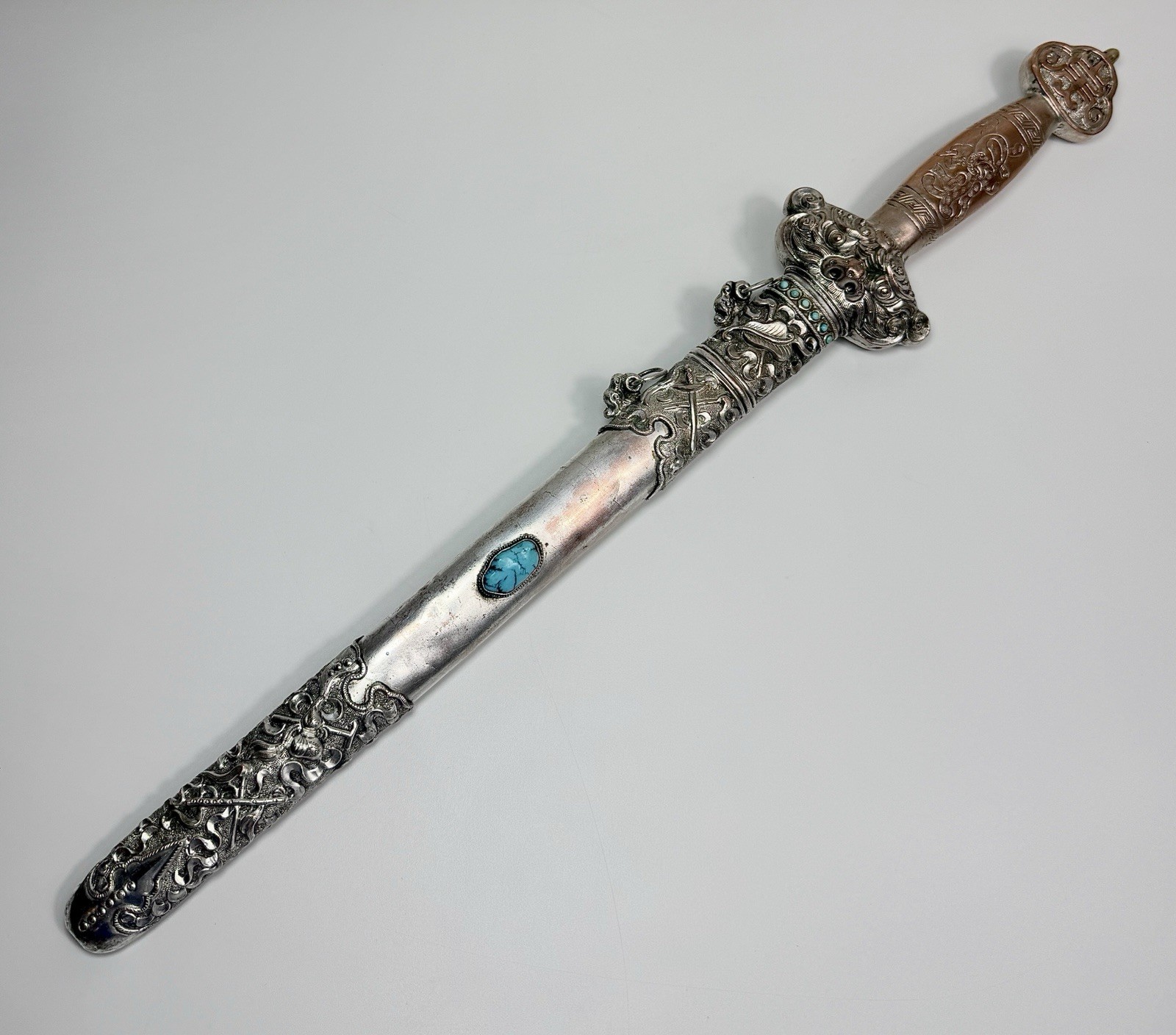
An extraordinary antique-attributed ceremonial or presentation sword displaying the elaborate craftsmanship, rich symbolism, and ornamental metalworking traditions associated with historic Chinese and Sino-Tibetan arms.
This exceptionally substantial piece features an engraved steel blade, heavily sculpted dragon-form handle, intricately hand-chiseled silver-plated copper fittings, two prominent turquoise cabochons, and a richly decorated matching wooden-lined scabbard.
Its design reflects the artistic exchange between China, Tibet, and Mongolia, where ceremonial arms were frequently ornamented with protective imagery, auspicious symbols, and highly accomplished metalwork.
Historical Background and Cultural Significance
Throughout the Qing dynasty (1644–1912) and into the early Republican period, traditional East Asian arms continued to serve purposes extending beyond warfare.
Elaborately decorated swords could function as ceremonial implements, presentation objects, expressions of social status, and symbols of protection or religious devotion.
In Tibetan and Mongolian Buddhist traditions, certain swords also carried ritual associations, particularly with the symbolic destruction of ignorance and the protection of sacred spaces.
The present sword incorporates a remarkable combination of Chinese and Himalayan decorative influences, including dragon imagery, guardian-like faces, elaborate scrolling ornamentation, and turquoise-colored stone settings.
These elements are particularly associated with the historic visual traditions of Sino-Tibetan metalwork.
The precise production date and original ceremonial function of this sword have not been independently documented. Its antiquity is based on the owner’s assessment of its construction, materials, and condition.
Exceptional Hand-Chiseled Metalwork
Perhaps the most impressive feature of this sword is its extraordinarily elaborate metal decoration.
The substantial handle and scabbard fittings exhibit deeply modeled relief incorporating dragons, scrolling tendrils, stylized foliage, guardian-like imagery, and densely textured backgrounds.
Close examination reveals distinctive hand-chiseled and hand-chased workmanship.
The metalworking includes:
* Hand-chiseled outlines defining the raised ornamental figures
* Extensive punched and stippled background texturing
* Deeply modeled scrolling relief decoration
* Intricately worked dragon and guardian-mask details
* Carefully finished recessed surfaces
* Ornamental borders and decorative metal settings
The raised elements may have been initially cast or otherwise formed before receiving extensive hand-chasing and finishing.
This combination of sculptural relief and individually worked surface detail is consistent with techniques used in historic East Asian decorative metalwork.
The silver-plated copper exhibits natural surface patina and areas of plating loss, exposing warm copper-colored metal beneath.
These contrasting surfaces emphasize the depth and texture of the ornamentation.
Dragon Iconography and Its Symbolism
The dragon is among the most important creatures in traditional Chinese visual culture.
Historically associated with strength, authority, protection, and auspicious power, dragon imagery appeared throughout imperial decorative arts, religious objects, ceremonial regalia, and ornamented weaponry.
Dragons were also frequently incorporated into Tibetan decorative metalwork, often accompanied by scrolling clouds, flames, jewels, and protective imagery.
The prominent dragon decoration of this sword, repeated across its metal fittings and engraved blade, creates a unified ornamental theme.
Its richly modeled handle is particularly noteworthy for its sculptural quality and elaborate treatment of the dragon-inspired forms.
Protective Guardian Imagery
The ornamental fittings also feature a guardian-like face surrounded by elaborate scrolling decoration.
Such imagery recalls traditional East Asian protective-mask motifs, including the Chinese taotie tradition and the Tibetan Buddhist kirttimukha, or “Face of Glory.”
The kirttimukha is a protective image historically associated with watchfulness, good fortune, and the warding off of harmful influences.
Related guardian imagery appears on historic Sino-Tibetan sword guards, ceremonial metalwork, and ritual objects.
The exact identification of the guardian motif on this sword remains open to further study, but its presence contributes to the object’s strong protective and ceremonial visual character.
Two Large Turquoise Cabochons
Two prominent turquoise cabochons embellish the ornamental fittings, adding striking color against the silver-plated copper.
Turquoise was highly prized throughout Tibet and neighboring Himalayan regions and was frequently used in the decoration of jewelry, religious objects, ceremonial equipment, and richly ornamented weapons.
The incorporation of turquoise into metal fittings is a characteristic feature of numerous historic Tibetan and Sino-Tibetan swords.
Both large cabochons remain present.
Please note: Three smaller decorative cabochon stones are missing from their settings.
The turquoise identification is based on visual characteristics; the stones have not been independently gemologically tested.
Engraved Steel Blade — Apparent “Dragon Sword” Inscription
The substantial steel blade features decorative engraved imagery on both faces.
One side bears a stylized dragon engraving, while the opposite side carries two Chinese-style characters.
The characters appear to read 龍劍 (龙剑), pronounced Lóng Jiàn, meaning “Dragon Sword.”
This apparent inscription is particularly appropriate to the elaborate dragon imagery throughout the sword.
The reading is a preliminary visual interpretation and has not been verified by a specialist in historic Chinese inscriptions.
Chinese and Tibetan swords were sometimes decorated with inscriptions expressing protective wishes, symbolic associations, religious formulas, or the identity of the object.
The blade is magnetic steel and exhibits darkened oxidation, scattered rust staining, fine scratches, and surface wear.
The original surface character has been retained without aggressive polishing or restoration.
Although the blade displays evident wear and oxidation, its precise history of use cannot be determined from those characteristics alone.
Magnificent Matching Scabbard
The accompanying scabbard is itself an impressive example of ornamental metalwork.
It displays elaborate raised decoration with scrolling foliage, textured backgrounds, and intricate hand-finished detailing consistent with the artistic treatment of the sword’s handle.
The silver-plated copper exterior retains contrasting areas of darkened patina and exposed copper coloration.
Importantly, the interior features a fitted wooden lining.
Wooden scabbard cores were traditionally employed in Chinese and Tibetan sword construction to protect the blade, provide structural support, and separate the steel from external metal fittings.
The overall effect is a highly decorative sword and scabbard displaying a remarkably cohesive ornamental program.
Extraordinary Weight and Construction
A particularly distinctive characteristic of this piece is its exceptionally heavy construction.
Sword: Approximately 14 pounds
Scabbard: Approximately 8.6 pounds
Combined weight: Approximately 22.6 pounds
Much of the sword’s weight is concentrated within its heavily sculpted handle and fittings.
The handle and scabbard are nonmagnetic, consistent with their copper-alloy construction, while the steel blade is magnetic.
This unusual distribution of weight suggests that visual presentation and monumental ornamentation were important considerations in its construction.
Historical Attribution
Antique-attributed Chinese / Sino-Tibetan ceremonial or presentation sword.
The decorative treatment reflects longstanding traditions of East Asian metalwork, including influences associated with late Qing and early Republican-period design.
The combination of dragon imagery, guardian symbolism, hand-chased relief decoration, turquoise ornamentation, and traditional wooden scabbard construction provides meaningful historical and stylistic context.
The precise age, workshop, original owner, and geographical place of manufacture have not been independently established.
Measurements
* Sword overall length: Approximately 19 inches
* Scabbard length: Approximately 15 inches
* Overall length sheathed: Approximately 22 inches
* Sword weight: Approximately 14 pounds
* Scabbard weight: Approximately 8.6 pounds
* Combined weight: Approximately 22.6 pounds
Materials and Craftsmanship
* Engraved magnetic steel blade
* Silver-plated copper metalwork, based on owner testing
* Hand-chiseled and chased decorative relief
* Elaborate cast or formed sculptural elements
* Two large turquoise cabochons, untested
* Wood-lined ornamental scabbard
* Traditional East Asian dragon and guardian iconography
Condition
The sword and scabbard are offered in unrestored condition, retaining visible surface patina, oxidation, scratches, tarnishing, and areas of silver-plating wear revealing the underlying copper.
The steel blade exhibits scattered oxidation, discoloration, and surface wear.
The ornate relief decoration retains extensive detail.
Both large turquoise cabochons are present. Three smaller cabochon stones are missing from their original settings.
The original patina has been retained.
Please carefully examine all photographs for the full condition of this historical collectible.
Collector’s Significance
A striking and exceptionally substantial antique-attributed ceremonial sword combining richly worked dragon imagery, traditional guardian symbolism, hand-chiseled metal decoration, engraved steel, turquoise ornamentation, and a remarkable matching scabbard.
Its unusual weight, richly layered surface decoration, and distinctive Sino-Tibetan artistic influences make it a compelling object for collectors of Asian antiques, ceremonial arms, historic metalwork, and traditional decorative arts.
Includes the sword and matching scabbard photographed.
Shipping: This exceptionally heavy sword and scabbard will be professionally packed with extensive protective cushioning, rigid reinforcement, and a sturdy double-walled shipping box to ensure safe transport. Shipping includes tracking, full insurance coverage, and ships within 1–2 business days.