When you click on links to various merchants on this site and make a purchase, this can result in this site earning a commission. Affiliate programs and affiliations include, but are not limited to, the eBay Partner Network.
Beautifully Clear Victorian Aqua Glass With Its Fascinating Patented Closure
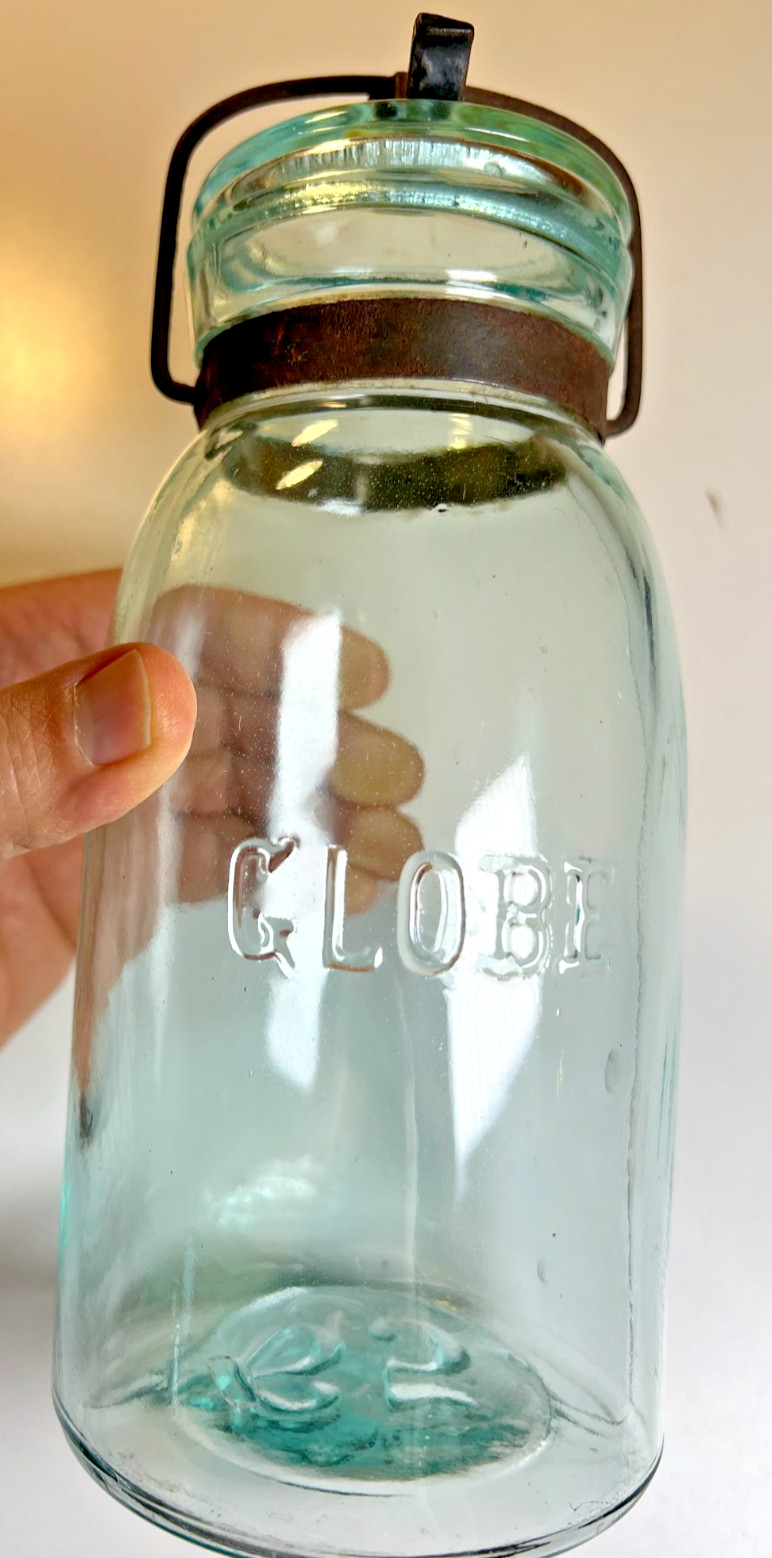
Brilliant pale aquamarine glass, bold GLOBE embossing, and a wonderfully mechanical closure give this antique fruit jar exceptional display appeal. Light passes beautifully through its clean glass, illuminating the bubbles and subtle surface texture that make early glass so captivating. A particularly large enclosed bubble on the reverse adds a lovely individual touch—a little pocket of air preserved from the day it was made.
Standing approximately 8 inches tall, this apparent quart-size jar retains a period-pattern glass lid and the distinctive metal cam-lever assembly that makes Globe jars immediately recognizable.
Hemingray Glass Company - Circa 1890
Made by the Hemingray Glass Company, whose factories operated in Covington, Kentucky, and Muncie, Indiana, this jar belongs to the late-Victorian era of American home preserving. A working date of circa 1890 is appropriate, although its exact manufacturing year and factory cannot be determined from the markings.
Hemingray became famous for the glass insulators that carried America’s telegraph and telephone wires, but its glassmakers also produced bottles, tableware, and preserving jars.
The front is embossed GLOBE, the base bears the large mold number 65, and the glass lid is marked PATENTED. The base number identifies the mold; it is not a date.
An Ingenious Patented Closure
Robert Hemingray patented the Globe closure on May 25, 1886. Its mechanism uses a swinging metal bail and a short cam lever that presses into the molded seat at the center of the glass lid. Lowering the lever applies pressure to hold the lid against a rubber sealing gasket.
The broad metal neck band, arching bail, and sculptural lever give the jar a striking industrial character, especially against the delicate aqua glass.
The surviving lid and hardware are the correct Globe style; their association with this individual jar throughout its entire life cannot be verified.
Summer’s Harvest, Saved For Winter
Imagine a Victorian kitchen at the height of preserving season: a hot stove, bowls of ripe peaches and berries, and freshly filled jars waiting for the pantry. Containers like this helped families carry the abundance of summer into the cold months ahead.
Hemingray was advertising Globe fruit jars to housewives by 1887. Their reusable glass bodies and distinctive patented closures competed for a place in kitchens where a reliable seal protected hours of work and a valuable supply of food.
Today, this example offers an especially attractive combination of domestic history, early glassmaking character, and mechanical ingenuity.
Condition
The glass is bright, clean, and shiny, with no scratches or haze noted. Please review the close-up photographs of the following details:
A faint, shallow open air bubble on the lower front.
A large, attractive enclosed air bubble on the reverse; this bubble is not open.
A tiny flea bite to the edge of the glass lid, shown in the finger-point photograph.
A chip to the raised central cam seat on the lid, where the metal closure bears against the glass.
Age-related oxidation and corrosion to the metal closure.
The lid damage is present despite the jar’s beautiful overall clarity and display quality. Offered as an antique collectible and display piece; sealing performance has not been tested.
Measurements And Markings
A beautiful piece of Victorian kitchen history, with luminous aqua glass and a patented closure worth taking a closer look at.