When you click on links to various merchants on this site and make a purchase, this can result in this site earning a commission. Affiliate programs and affiliations include, but are not limited to, the eBay Partner Network.
Antique \"Signal\" Gold Embossed Cigar Label ✨ American Lithographic Co., John T. Stier & Son, Louisville, KY 1900s–1920s
5 1/4\" x 2 3/4\" ~ New Old Stock (NOS) — clean, intact, and carrying the embossed gold lift of a label that has never known a cigar box.
There is a moment when you hold a piece like this and everything about the American tobacco industry\'s golden age comes rushing back at once. ✨ Not through nostalgia alone — through the craft itself. The embossed gold border. The bold red lettering pressed up from the silver-grey field. The ornate scrollwork in each corner. This is not a printed paper label in any ordinary sense. This is a miniature work of commercial art from the peak years of American chromolithography, produced by the most powerful printing operation in the country and commissioned by a Louisville cigar maker whose name was worth protecting in ink and gold foil.
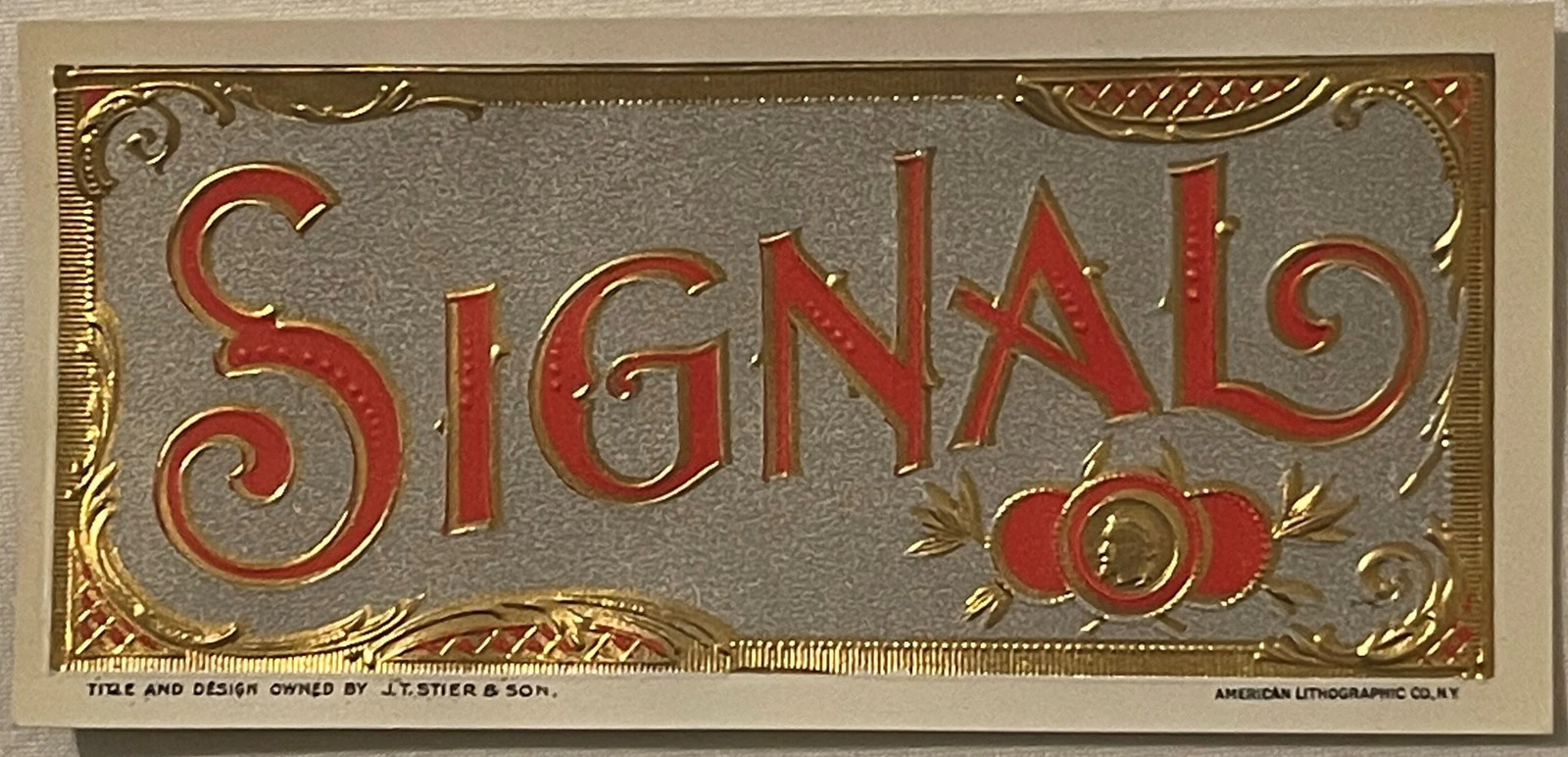
The label reads SIGNAL in large, sweeping red letterforms across a silvery embossed field, with ornamental gold borders framing the whole design. Along the bottom margin, two lines of small printed text identify the parties: Title and Design Owned by J.T. Stier & Son on the left, and American Lithographic Co. N.Y. on the right. Both lines are plainly visible, and together they tell you exactly what you are holding and where it came from.
🏭 The American Lithographic Company — ALCO, as collectors and the trade both called it — was founded in 1892 in New York City. Joseph Palmer Knapp organized the firm by consolidating some of the most skilled lithography houses in America under a single roof: George S. Harris and Sons, Heppenheimer\'s and Sons, the Donaldson Brothers Company, the Giles Company, Eddy and Calaus, Witsch and Schmitt, and Schumacher and Ettinger all came together in that founding merger. Competitors at the time called it a \"label trust\" — the story passed down in printing circles is that at least one rival printer wrote openly to cigar makers in 1892 refusing to join, publicly warning them about the consolidation of power this new firm represented. O.L. Schwencke was his name, and he would have nothing to do with it.
Knapp\'s answer was to build a production facility at 44–56 East 19th Street in New York City and proceed to control roughly 75% of the American market for printed graphics. 🗽 Seventy-five percent. In the cigar label trade — one of the most competitive and lucrative graphic printing categories in late 19th and early 20th century America — that figure meant that nearly every handsome embossed label that came off a press of consequence passed through ALCO\'s operation. The firm ran until 1929, when it was sold to the United States Printing and Lithographic Company, which liquidated the cigar label business to Consolidated Lithographing in 1930. The SIGNAL label, printed during ALCO\'s active years and bearing its imprint, dates squarely to that 1900–1929 window when the company was at full operation.
The cigar maker on record is John T. Stier & Son of Louisville, Kentucky. 🌿 The \"Title and Design Owned by J.T. Stier & Son\" line printed directly on the label is not just a credit — it is a legal declaration of brand ownership, the kind of intellectual property language that cigar makers began pressing printers to include once the courts started recognizing lithographed designs as protectable commercial property. That language tells you the Signal brand mattered enough to Stier that ownership was worth stamping into every copy of the label itself. Art of the Print records the label\'s full name as \"The Signal Perfecto,\" a long-filler cigar format that was a staple of the Louisville and general American market in the early decades of the century.
Louisville in those years was a serious tobacco city. 🏙️ Situated between the burley tobacco country of central Kentucky and the dark-fired growing regions to the west, it had access to some of the finest domestic leaf in the country. The old-timers in the Louisville tobacco trade would have known the Stier name. A family cigar operation — the \"& Son\" construction appearing on the label — carrying enough weight to commission gold embossed labels from the most powerful lithography firm in New York was not a minor regional player. These were people who understood the business of the shelf: that a man reaching into a tobacconist\'s case made his first decision with his eyes, and that the gold foil and the red letterforms and the embossed border were not decoration — they were commerce.
✨ The craft that produced this label is worth pausing over. ALCO\'s process for embossed gold cigar labels combined stone-crayon chromolithography, deep mechanical embossing, and metallic inks in a sequence that required extraordinary registration across multiple press passes. The silver-grey field of the SIGNAL label is not a flat printed tone — it is embossed, giving the surface a subtle texture that catches and diffuses light differently than any flat ink layer could. The red letterforms stand proud from that surface, with gold outlines giving each letter additional definition. The lore in collector circles holds that this multi-pass embossed gold process — prevalent through the 1880s until the 1920s — is a lost art, something modern printing cannot replicate, because the combination of hand-prepared lithographic stones, slow-cure metallic inks, and mechanical embossing dies operated together as a single interdependent system that no one has rebuilt. Whether or not that framing is technically precise, any collector who has handled enough of these labels and then looked at modern commercial printing knows exactly what the lore is pointing at.
🎨 The design itself is entirely consistent with ALCO\'s premium cigar label output from the early 1900s through the mid-1920s. The \"Signal\" name, rendered in a bold decorative serif with swash terminals and elegant curves on the S and the L, is the kind of lettering that a skilled chromolithographic artist spent hours refining on stone before a single proof sheet ever ran. These were not clip-art typefaces pulled from a catalog. They were drawn originals, owned by the cigar maker, which is exactly why that \"Title and Design Owned\" line exists.
5 1/4 inches by 2 3/4 inches. That dimension places this in the inner label format — wider than a band, sized to sit inside the lid of a cigar box facing the smoker when he lifted the top. 🖼️ Where the outer label was the public face, the brand wrapper seen on the shelf, the inner label was the intimate greeting — the thing a man saw every time he reached for a cigar. It was the daily reinforcement of the brand\'s identity, the private handshake between maker and buyer. The inner label format got ALCO\'s most elaborate work because the printing houses and cigar makers alike understood its psychology. You were not advertising to a passerby. You were speaking to a man who had already chosen you and was choosing you again, right now, one cigar at a time.
The Signal name carries its own period resonance. 📡 In the years around the turn of the century and through the first decades of the 1900s, \"signal\" language was charged with modernity — telegraphy, railroading, and early radio were reshaping what it meant to send and receive information, and the word carried connotations of precision, reliability, and reach. A cigar called Signal told the smoker something about the brand\'s ambition: this was not a sleepy local stick. This was a name that wanted to travel.
🌟 New Old Stock (NOS). This label has never been applied to a box. It carries the embossed gold lift and the clean, intact condition of a label that came out of the printer\'s stock and never made it to the factory floor. ALCO produced its labels in quantity — the scale of the cigar industry in the peak years before and just after 1900 demanded enormous print runs — and portions of those print runs survived in printers\' files, tobacconists\' back rooms, and collectors\' accumulations for the better part of a century. A NOS label in this condition, this crisp, this fully embossed, is exactly the kind of object that serious tobacciana collectors and paper ephemera enthusiasts have spent decades chasing.
The American cigar industry at its 19th and early 20th century peak was enormous by any measure. Billions of cigars per year in the prime decades. Every single one of those cigars wore a label. Every label was a small piece of commercial art produced by skilled craftsmen working with equipment and materials that required years of mastery. The vast majority of those labels were opened, used, and discarded. The ones that survived in NOS condition survived by accident, by luck, by the quiet stubbornness of someone who kept them in a drawer or a flat file instead of throwing them away. 🎁
🖼️ Display possibilities for a piece like this are wide open. Shadow-boxed in a deep frame with a dark mat, the gold embossing catches directional light in a way that makes the piece read as the three-dimensional object it actually is. Floated between UV-protective glass so both faces can be seen, hung with a period cigar advertisement or a Louisville ephemera piece as companions, displayed in a tobacciana collection alongside bands and box art from the same era — every approach works because the design is this strong and the craft is this evident.
🎁 Who reaches for a piece like this:
🎁 The tobacciana collector building a focused collection of ALCO-printed inner labels — a Signal Perfecto from J.T. Stier & Son is a documented brand entry, not a generic find
🎁 The Louisville and Kentucky history collector who wants tangible commercial artifacts from the city\'s tobacco trade years
🎁 The American commercial art enthusiast who collects chromolithography from the great printing houses — ALCO\'s story, and the \"label trust\" lore, is a major chapter
🎁 The paper ephemera archivist adding NOS printed labels to a preservation collection of early American advertising art
🎁 The framer and shadowbox artist who understands that a gold embossed cigar label in the right frame is a permanent conversation piece
🎁 The history-minded gift-giver looking for something genuinely antique, genuinely beautiful, and genuinely different from anything that comes in a box from a retailer
🎁 The collector of Louisville business history — a family firm named on a gold ALCO label is documented commercial heritage from the city\'s tobacco years
✨ From the founding of the American Lithographic Company in 1892 to its sale in 1929, ALCO produced some of the finest commercial printing in American history. The SIGNAL label — commissioned by J.T. Stier & Son of Louisville, printed in New York at the height of ALCO\'s power — is a direct artifact of that story. The gold is real. The embossing is real. The craft is real. And the label is exactly what the bottom margin says it is: a design worth owning, from a firm that understood what ownership meant.