When you click on links to various merchants on this site and make a purchase, this can result in this site earning a commission. Affiliate programs and affiliations include, but are not limited to, the eBay Partner Network.
Antique Stanley & Patterson Wet-Cell Battery – New York City – Circa 1923–1924
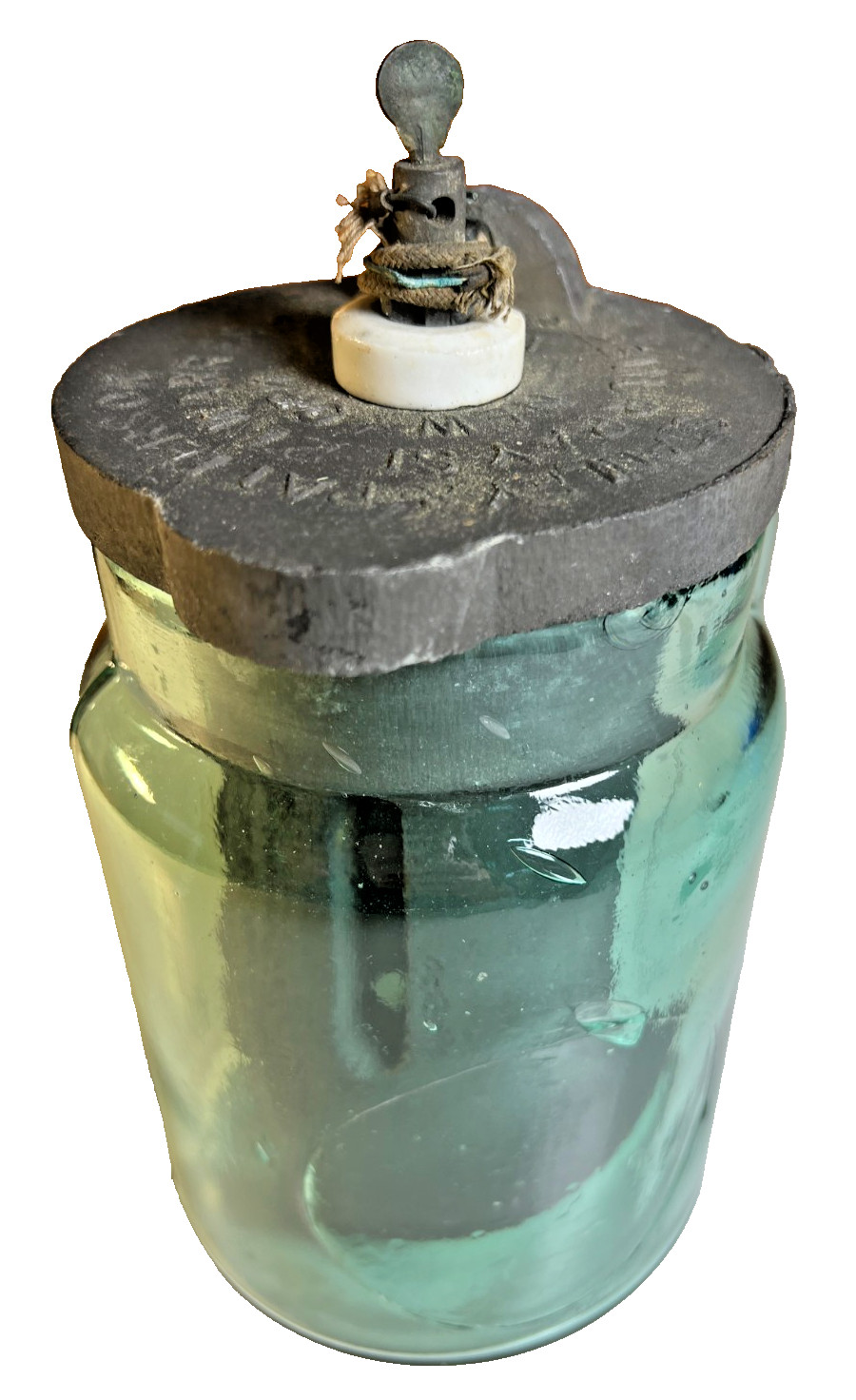
An unusually complete survivor from the early electrical age, this original Stanley & Patterson wet-cell battery features a beautiful green-teal glass jar and retains its substantial internal electrode assembly.
The heavy black top is marked:
STANLEY & PATTERSON23 MURRAY ST. – 27 WARREN ST.NEW YORK
The combination of these two New York addresses allows this example to be dated with unusual precision. Period advertisements show Stanley & Patterson operating its downtown stores at 23 Murray Street and 27 Warren Street together during 1923–1924.
How It Worked
This was a liquid-electrolyte electrical cell from the period before dependable household electricity reached every building and every room.
The green-teal glass jar was filled with an electrolyte solution. Its internal zinc and carbon components reacted chemically to produce low-voltage direct current. The porcelain component insulated the conducting parts, while the exterior terminals allowed the battery to be wired into a circuit.
One cell produced relatively modest voltage, so several jars could be connected together when more electrical power was required.
This type of battery was particularly useful for equipment that operated intermittently, including:
- Electric doorbells and call bells
- Burglar- and fire-alarm systems
- Hotel and household annunciators
- Telephone and intercommunication equipment
- Telegraph and signaling devices
- Laboratory and educational apparatus
The battery remained at rest until someone pushed a button or closed an electrical contact. That completed the circuit and supplied enough current to ring a bell, operate an indicator, or trigger an alarm.
Original Components
Unlike the many empty battery jars encountered today, this example retains an impressive collection of its original working components:
- Large black carbon cylinder
- Porcelain insulating liner
- Removable electrode rod
- Metal terminal fittings
- Surviving cloth-covered wires
- Heavy marked upper assembly
- Original green-teal glass jar
It looks remarkably close to something that could be filled and placed back into service. However, because of its age, unknown internal condition, and the chemicals originally required, it is offered strictly as a historical display piece and has not been tested.
Life During the Period
In 1923 and 1924, electricity was rapidly transforming American life, but modern electrical service was still far from universal. Urban homes might have electric lighting while continuing to rely on independent batteries for bells, alarms, telephones, and signaling systems.
New York City was alive with elevated trains, electric streetcars, automobiles, telegraph offices, telephone switchboards, and brilliantly illuminated theaters. Radio broadcasting was the exciting new technology of the decade, and electrical-supply businesses such as Stanley & Patterson served professional electricians, experimenters, businesses, theaters, hotels, and the rapidly growing radio trade.
Inside a hotel or prosperous household, batteries like this could operate an annunciator system. Pressing a button in one room rang a bell and activated a numbered indicator elsewhere, showing an attendant exactly where assistance was needed. In a shop or warehouse, similar cells might power an alarm or communication circuit.
It is a wonderfully tangible artifact from the brief period when advanced electrical technology could still consist of a colorful glass jar filled with liquid—a battery that looked like laboratory equipment because, essentially, it was.
Color and Glass Character
The jar is hand-finished from especially attractive green-teal glass. Under changing light it displays shades of pale aqua, sea green, and blue-green.
Its color and subtle handmade character make it highly decorative even apart from its considerable historical and technological interest.
Measurements
Approximately 6¼ inches tall × 3¾ inches wide.
Condition
The glass is exceptionally bright, clean, and shiny.
- No cracks
- No internal haze
- No dirt or staining
- No scratches observed
- Beautiful, strongly colored green-teal glass
- Retains the porcelain liner, rod, carbon assembly, terminals, and wiring
- Numerous tiny flea bites and rough points along the originally cut, unfinished lip
- One small chip-flake on the interior edge of the lip (seen in the past pic)
- Expected oxidation, residue, and age wear to the metal, carbon, and electrical components
The small interior lip flake is disclosed for accuracy but does not greatly detract when the battery is assembled. Please examine all photographs carefully.