When you click on links to various merchants on this site and make a purchase, this can result in this site earning a commission. Affiliate programs and affiliations include, but are not limited to, the eBay Partner Network.
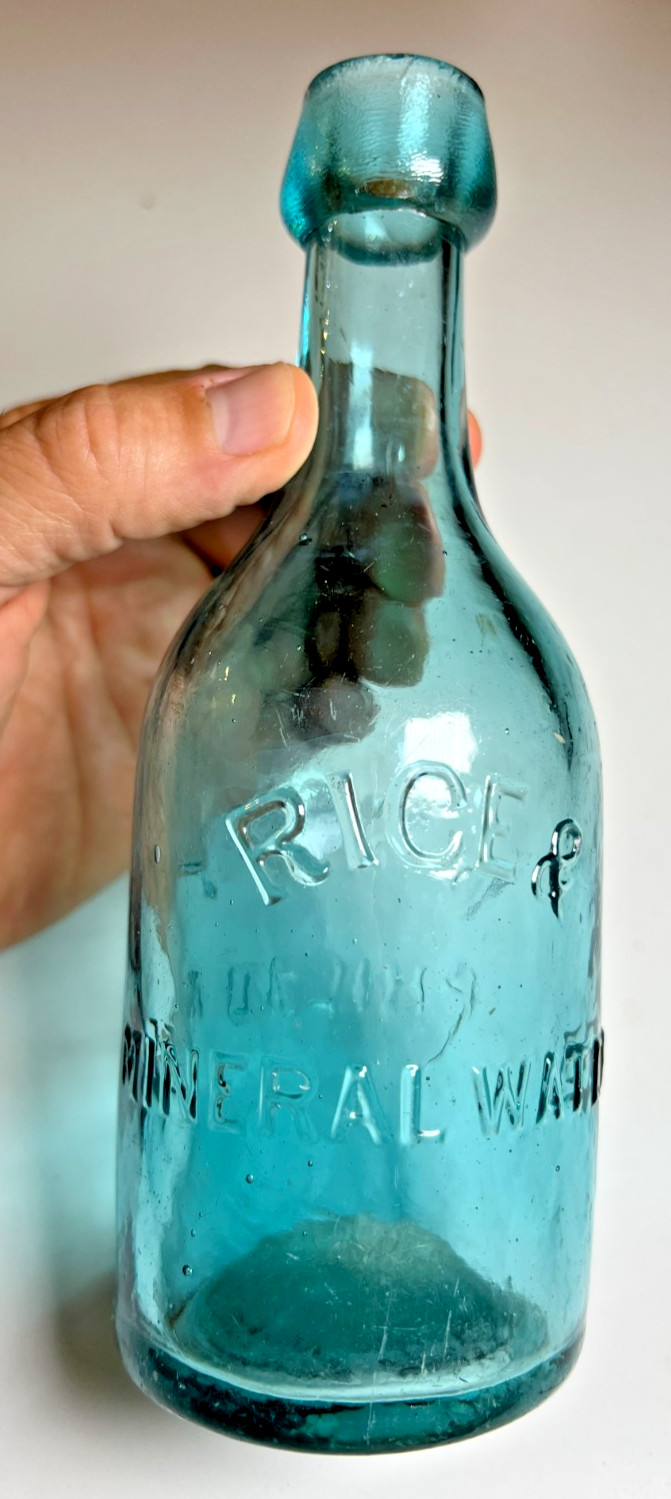
Step back to the bustling streets of pre-Civil War Philadelphia with this outstanding Rice & McKinney embossed mineral water bottle, hand blown circa 1858–1862. Crafted from beautiful aqua glass with a heavy applied blob top and retaining its original graphite pontil residue, this bottle is a tangible piece of mid-19th century American craftsmanship. More than 160 years later, it remains remarkably well preserved, with bold embossing, glossy glass, and only minor honest signs of age. An exceptional example that beautifully captures the era when horse-drawn wagons delivered refreshing carbonated mineral water through one of America's great industrial cities.Estimated Date
Circa 1855–1865 (most likely 1858–1862).
Several features firmly place this bottle in the years just before and during the Civil War:
- Hand-blown in a two-piece mold.
- Heavy applied blob top designed for a cork closure.
- Rich aqua glass typical of Philadelphia soda bottles of the era.
- Proprietary embossed lettering, reflecting the growing practice of bottlers branding their own reusable bottles.
- Open graphite pontil base retaining original dark pontil residue, a highly desirable manufacturing characteristic that confirms early hand production.
Maker
Rice & McKinney
Philadelphia ("Philada."), Pennsylvania
Rice & McKinney operated as one of Philadelphia's many mineral water bottlers during the late antebellum period. Philadelphia was one of America's leading centers for bottled soda and mineral water production, thanks to its thriving population, excellent transportation network, skilled glassworkers, and easy access to quality water.
Like most bottlers of the day, Rice & McKinney almost certainly commissioned their embossed bottles from a regional glasshouse in New Jersey or eastern Pennsylvania before filling and distributing them throughout the city.
What Was Inside?
This bottle likely contained refreshing carbonated beverages such as:
- Mineral water
- Soda water
- Lemon soda
- Ginger soda
- Sarsaparilla
- Cream soda
- Birch beer
Before mechanical refrigeration, an ice-cold bottle of mineral water was considered both a luxury and, by many, a health tonic.
Why the Blob Top?
The heavy applied blob finish was designed to hold a cork securely under pressure, often reinforced with wire or twine. Carbonated beverages were expensive to manufacture, and preserving the carbonation was essential.
Philadelphia Around 1860
Picture Philadelphia in the years before the Civil War.
Horse-drawn wagons rumbled over uneven cobblestone streets. Coal smoke drifted above rows of brick buildings as factories, shipyards, and workshops powered one of America's largest cities. Ice harvested from northern lakes each winter was stored in insulated icehouses, allowing bottlers like Rice & McKinney to sell chilled mineral water during the hottest summer months.
This bottle may have ridden through those very streets in a wooden delivery wagon, destined for a hotel, pharmacy, tavern, or family table.
America During Its Lifetime
Your bottle survived one of the most transformative periods in American history.
- Abraham Lincoln was elected President.
- The Civil War erupted in 1861.
- Telegraph lines connected distant cities almost instantly.
- Railroads expanded rapidly across the Northeast.
- Photography was becoming increasingly common.
- Germ theory was still largely unknown, and mineral waters were widely believed to offer genuine medicinal benefits.
Glass Quality
This example exhibits many characteristics collectors seek:
- Rich aqua color
- Thick, heavy glass
- Crisp, deeply struck embossing
- Heavy applied blob top
- Scattered seed bubbles
- Original graphite pontil residue still visible on the base
- Excellent overall symmetry and craftsmanship
The remaining graphite residue is a particularly appealing feature, providing visible evidence of the hand-finishing process used over 160 years ago.
Condition
Excellent collector-grade condition.
Highlights
- No chips
- No cracks
- Bright, glossy glass
- Strong embossing
- Attractive aqua color
- Original graphite pontil residue retained on the base
Minor imperfections
- Light interior haze ring in the lower neck (see finger point pic)
- Moderate case wear on the ampersand ("&") in the embossing.
These minor flaws are insignificant compared to the bottle's overall outstanding preservation.