When you click on links to various merchants on this site and make a purchase, this can result in this site earning a commission. Affiliate programs and affiliations include, but are not limited to, the eBay Partner Network.
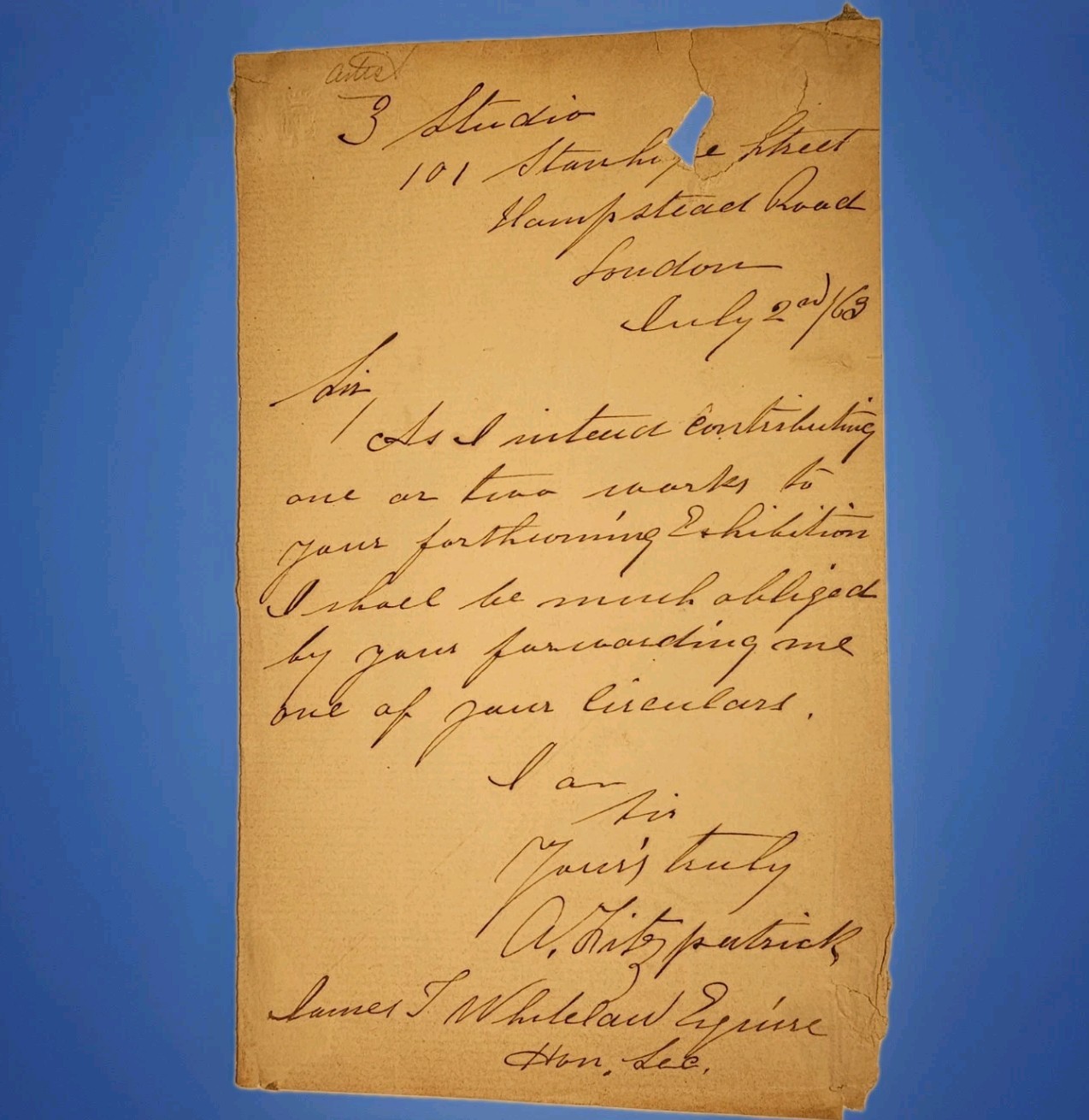
Original handwritten and signed letter by Arthur Fitzpatrick (1830–1883), the Irish-born British painter and later stained-glass artist/manufacturer, dated July 2, 1863.
Written from Fitzpatrick’s studio at 101 Stanhope Street, Hampstead Road, London, the letter concerns his intention to submit “one or two works” to a forthcoming art exhibition. He asks James S. Whitehead, Esq., Honorary Secretary, to forward one of the exhibition circulars containing the necessary information or regulations.
The letter is particularly interesting because it documents Fitzpatrick’s professional activities during the height of his London exhibition career. 101 Stanhope Street is a documented address associated with Fitzpatrick’s appearances at the British Institution during the 1860s, making this an appealing primary-source artifact relating directly to the mechanics of Victorian art exhibitions.
Rather than being a routine personal note, the content concerns Fitzpatrick actively preparing paintings for public exhibition.
Full Transcription
3 Studio
101 Stanhope Street
Hampstead Road
London
July 2nd /63
Sir,
As I intend contributing
one or two works to
your forthcoming Exhibition
I shall be much obliged
by your forwarding me
one of your Circulars.
I am
Sir
Yours truly
A. Fitzpatrick
James S. Whitehead Esquire
Hon. Sec.
Historical Importance
This letter provides a small but unusually direct glimpse into the working life of a professional Victorian artist.
During the nineteenth century, artists seeking inclusion in major exhibitions generally obtained printed circulars or prospectuses explaining submission deadlines, regulations, admission procedures, delivery arrangements, and other requirements. Fitzpatrick\'s request indicates that he was preparing one or two paintings for an upcoming exhibition and needed the official circular before submitting them.
The letter is therefore connected directly with the Victorian exhibition system through which artists built reputations, attracted patrons, and sold their work.
Its July 1863 date is especially appealing because Fitzpatrick was actively exhibiting during this period. His known work from the same year includes Musical Union (1863), and he exhibited at important London institutions during the 1860s.
The fact that the letter was written from 101 Stanhope Street, Hampstead Road, an address independently associated with Fitzpatrick\'s professional exhibition career, further strengthens the attribution.
Arthur Fitzpatrick Biography
Arthur Fitzpatrick (1830–1883) was an Irish-born British artist active principally in England during the Victorian period.
He worked as a genre painter, producing scenes concerned with people, domestic life, music, and everyday Victorian society. Fitzpatrick participated in the competitive London exhibition world of the 1860s and exhibited works at established artistic venues including the British Institution and the Society of British Artists at Suffolk Street.
His address at 101 Stanhope Street, Hampstead Road, London, appearing at the head of this letter, is documented in connection with his professional career and exhibition activity.
Among Fitzpatrick\'s surviving paintings is Musical Union (1863), a work from precisely the same year as this letter and now held in a public collection at Wolverhampton. The painting demonstrates his interest in Victorian genre subjects and provides useful context for the type of work he may have been preparing for exhibition when this letter was written.
Fitzpatrick later became involved with stained-glass design and manufacture, extending his artistic work beyond easel painting.
He died in 1883.
James S. Whitehead
The recipient is written as:
James S. Whitehead Esquire
Hon. Sec.
Whitehead was evidently serving as Honorary Secretary of the exhibition or art organization to which Fitzpatrick intended to submit his work.
The precise organization has not yet been conclusively identified. Fitzpatrick was associated during this period with significant London exhibition venues including the British Institution and the Society of British Artists, although the letter itself does not name the institution.
As Honorary Secretary, Whitehead would likely have been involved in the administrative operation of the exhibition, including distributing circulars, communicating with prospective exhibitors, and coordinating entries.
No firm biographical identification of this particular James S. Whitehead has yet been established. He should not be confused with Sir James Whitehead (1834–1917), later Lord Mayor of London, unless additional evidence establishes such a connection.
Collecting Significance
Especially desirable features include:
Original 1863 autograph letter signed by Arthur Fitzpatrick
Written during Fitzpatrick\'s active Victorian exhibition career
Directly concerns the submission of “one or two works” to an exhibition
Written from his documented 101 Stanhope Street, Hampstead Road London studio address
Association with the administration of a nineteenth-century art exhibition
Excellent primary-source material relating to Victorian painters, British art, London exhibitions, and nineteenth-century artistic practice
Clearly signed “A. nineteenth-century manuscript showing expected age toning, foxing and handling wear. There is a small area of paper loss/tear near the upper portion, together with edge and corner wear and apparent old mounting or adhesive residue at several corners.
Despite these faults, the manuscript remains highly legible and Fitzpatrick\'s signature is clear.
Please examine photographs carefully as they form an important part of the condition description.
An appealing original document connecting Victorian artist Arthur Fitzpatrick directly with the London exhibition world of 1863.