When you click on links to various merchants on this site and make a purchase, this can result in this site earning a commission. Affiliate programs and affiliations include, but are not limited to, the eBay Partner Network.
After years of collecting, I’m now selling off my nearly all-Marvel comic collection, focusing on Spider-Man, Daredevil, and the Hulk! This collection spans from 1975 to 2012, with issues purchased firsthand from 2003 to 2013. Whether you're looking to fill gaps in your run, revisit classic storylines, or start a new collection, these comics offer a great mix of key issues, fan-favorite arcs, and hidden gems.
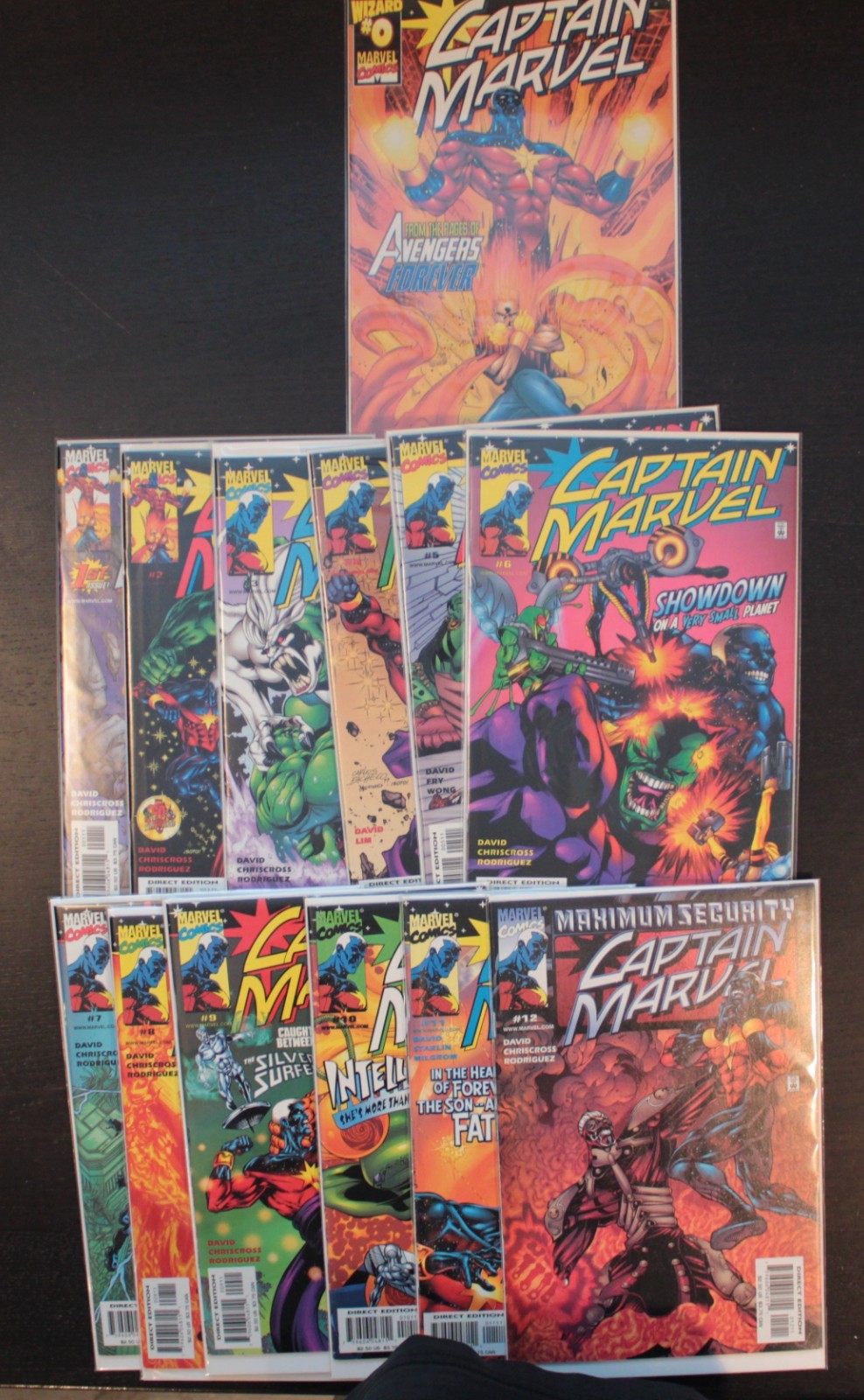
Peter David's run on Captain Marvel follows Genis-Vell, the son of the original Captain Marvel, Mar-Vell. The series combines cosmic superhero adventures, science-fiction concepts, humor, and the increasingly complicated relationship between Genis and Rick Jones, who are linked by the Kree Nega-Bands.
One important numbering note: the run consists of Volume 4 #1–35 (2000–2002) and Volume 5 #1–25 (2002–2004), for 60 numbered issues altogether. Volume 5 is a direct continuation of Volume 4 despite restarting at #1.Below, the issues are grouped by major storylines rather than summarized one at a time, making this useful as a reference for organizing your comic collection or writing listing descriptions.
Volume 4 — Captain Marvel #1–35 (2000–2002)
1. First Contact — Volume 4 #1–6
Genis-Vell struggles to establish himself as a worthy successor to his father, Mar-Vell. His molecular bond with Rick Jones forces the two men to switch places between Earth and the Negative Zone, echoing Rick's earlier partnership with the original Captain Marvel. Rick acts as Genis's guide to life on Earth, but Genis's immense power, impulsive behavior, and unusual cosmic awareness repeatedly create trouble.
The opening storyline features encounters with the Hulk, Wendigo, Drax the Destroyer, and threats involving the Microverse. Genis also begins experiencing events out of chronological order, hinting that his cosmic awareness is becoming more complicated than he can understand.
2. Cosmic Adventures and the Growing Bond — Volume 4 #7–14
These issues expand Genis's adventures beyond Earth, introducing further encounters with cosmic threats, Skrulls, and characters from the wider Marvel Universe. The stories continue to develop the comic's blend of space opera, superhero action, and comedy, while Rick and Genis struggle to manage their unusual partnership.
Rick's personal life also remains important, particularly his relationship with his former wife, Marlo Chandler-Jones. The series explores the consequences of Genis's powers and the strange situations produced by his incomplete understanding of cosmic awareness. Issue #14, written by Fabian Nicieza, revisits plot threads from the earlier Captain Marvel series.
3. Microverse and the Alternate Genis — Volume 4 #15–18
Genis's adventures take him into the Microverse, where Psycho-Man's schemes bring Drax the Destroyer and the Micronauts into the conflict. The story introduces Fredd, an alternate-dimensional version of Genis who describes himself as an evil clone and a future counterpart.
The encounter forces Genis to face a distorted version of himself while the action shifts between cosmic adventure, bizarre alternate realities, and the continuing complications of his bond with Rick. These issues highlight how easily Genis's powers and unusual circumstances can turn an ordinary mission into a reality-bending crisis.
4. Gods, Dreams, and Personal Consequences — Volume 4 #19–26
Genis's adventures become increasingly unpredictable as the series balances cosmic threats with personal and emotional storylines. Marlo, Rick, and Moondragon remain important to Genis's life, while his extraordinary awareness and powers repeatedly complicate his attempts to behave like a conventional superhero.
The run also includes “Quiet Miracles” (#26), a distinctive silent issue with no dialogue. Rather than relying on Peter David's usual banter, the story uses visual storytelling to convey its events and emotions. It stands out as one of the most formally unusual installments of the series.
5. Time Flies — Volume 4 #27–30
Genis and Rick become caught up in a time-travel adventure that takes them into the future. The storyline explores the consequences of altering events across time and places the characters in situations that challenge their assumptions about their own lives and destinies.
The four-part arc, consisting of “Outfoxed,” “So Tonight We're Gonna Party Like It's 2099,” “Future Shares,” and “Jonesing,” uses the future setting for both science-fiction adventure and character-driven humor. It also brings the unusual Genis–Rick partnership into contact with the longer-term consequences of their adventures.
6. The Closing Volume 4 Storylines — Volume 4 #31–35
The final five issues of Volume 4 bring Genis's first ongoing series toward its conclusion. Genis continues to grapple with his identity as Mar-Vell's son, his responsibilities as Captain Marvel, and the personal complications arising from his partnership with Rick. The supporting cast's relationships and the consequences of Genis's previous adventures remain central as the series prepares to transition into a new phase.
Volume 4 ends with #35, but Genis's story is not over: Marvel relaunches the title with a new #1, continuing Peter David's run and taking the character in a significantly darker direction.
Volume 5 — Captain Marvel #1–25 (2002–2004)
7. Nothing to Lose — Volume 5 #1–6
The relaunch marks a major turning point in Genis's life. His cosmic awareness expands until he begins perceiving reality on a scale that no ordinary mind can comfortably handle. Information about past, present, and future floods his consciousness, eroding his judgment and threatening his sanity.
Rick Jones remains the person most capable of grounding Genis, but their partnership is increasingly strained as Genis's behavior becomes erratic and dangerous. The story shifts the series from lighthearted cosmic adventure toward a more serious examination of power, identity, and mental instability.
8. The Asgard Conflict and Coven — Volume 5 #7–12
Genis's deteriorating mental state becomes impossible to ignore when he confronts the gods of Asgard, believing his cosmic power places him on their level. The resulting conflict demonstrates how far his judgment has deteriorated and how dangerous his distorted perception of reality has become.
The surrounding issues continue to explore the consequences of Genis's unstable powers, while introducing Coven, a dangerous figure whose encounters with Captain Marvel lead to an unusual experiment involving justice and the legal system. Spider-Man becomes involved in a bizarre mock trial, illustrating Peter David's continued use of absurd humor even as the series' main character grows more troubled.
9. Crazy Like a Fox — Volume 5 #13–18
Genis's struggle with his cosmic awareness continues as his perception of reality becomes increasingly unreliable. His relationship with Rick is tested by his unpredictable behavior, and the series explores the difference between possessing extraordinary knowledge and having the emotional maturity to use it responsibly.
These issues continue developing the darker direction established by the relaunch, mixing superhero confrontations with psychological drama and the consequences of Genis's increasingly unstable state. The storyline helps bridge the Asgard conflict and the larger cosmic crisis that follows.
10. Odyssey — Volume 5 #19–25
The concluding storyline begins with the return of Marlo Chandler-Jones, whose arrival has devastating implications for Genis. Rather than providing a happy reunion, the encounter sets off a chain of events that forces Captain Marvel to confront a threat extending into the future.
Genis embarks on an odyssey through time and discovers that Earth faces conquest by an alliance of the Kree, Skrulls, and Shi'ar. He becomes the one person capable of preventing this future, but the mission demands that he confront the consequences of his own powers and choices. The saga concludes Peter David's original Captain Marvel run by returning to the series' central themes: the burden of cosmic knowledge, the importance of personal relationships, and the uncertain line between heroism and madness.
My collection has been kept bagged & boarded (bags & board changed every 5 years) from purchase after a read, below is the grade based on my own judgement & 40 years of comic collecting:
Volume 4: #0 - 9.2 #1 - 9.4 #2 - 9.4 #3 - 9.6 #4 - 9.6#5 - 9.2 #6 - 9.6 #7 - 9.2 #8 - 9.2#9 - 9.4 #10 - 9.6 #11- 9.6 #12 - 9.4#13 - 9.4
#14 - 9.6#15 - 9.4 #16 - 9.4#17 - 9.2 #18 - 9.4#19 - 9.4 #20 - 9.4#21 - 9.2 #22 - 9.4#23 - 9.4#24 - 9.4 #25 - 9.4#26 - 9.6
#27 - 9.2#28 - 9.6#29 - 9.4#30 - 9.4 #31 - 9.4#32 - 9.4 #33 - 9.2#34 - 9.6#35 - 9.4
Volume 5: #1 - 9.6 #2 - 9.2 #3 - 9.2 #4 - 9.2#5 - 9.2 #6 - 9.2 #7 - 9.2 #8 - 9.2#9 - 9.6 #10 - 9.6 #11- 9.6 #12 - 9.6#13 - 9.6 #14 - 9.2
#15 - 9.4 #16 - 9.6#17 - 9.2 #18 - 9.6#19 - 9.2 #20 - 9.2#21 - 9.6 #22 - 9.6#23 - 9.6#24 - 9.4 #25 - 9.2
All comics are carefully packaged in a protective, crush-proof corrugated cardboard box from Bags Unlimited, designed specifically to keep comics safe during shipping. Your books will be securely bagged, boarded, and packed to prevent damage in transit. Combined shipping is available—buy multiple items and save on shipping costs! Feel free to ask any questions before purchasing.