When you click on links to various merchants on this site and make a purchase, this can result in this site earning a commission. Affiliate programs and affiliations include, but are not limited to, the eBay Partner Network.
Ancient Viking / Kievan Rus Shield-Shaped Belt Mount 38mm Early Medieval Period
Authentic ancient artifact, guaranteed genuine and accompanied by a Certificate of Authenticity. Northern / Eastern European Early Medieval Horizon.
Culture: Viking / Kievan Rus / Magyar
Date: Circa 9th–11th Century AD
Material: Bronze (Copper Alloy)
Type: Belt Fitting / Martial Harness Plaque
Form: Shield-Shaped / Heart-Shaped (Bifid Top) Plaque with Interlace Decoration and Integrated Attachment Lugs
Size: Approx. 38 mm
Technical & Functional Analysis
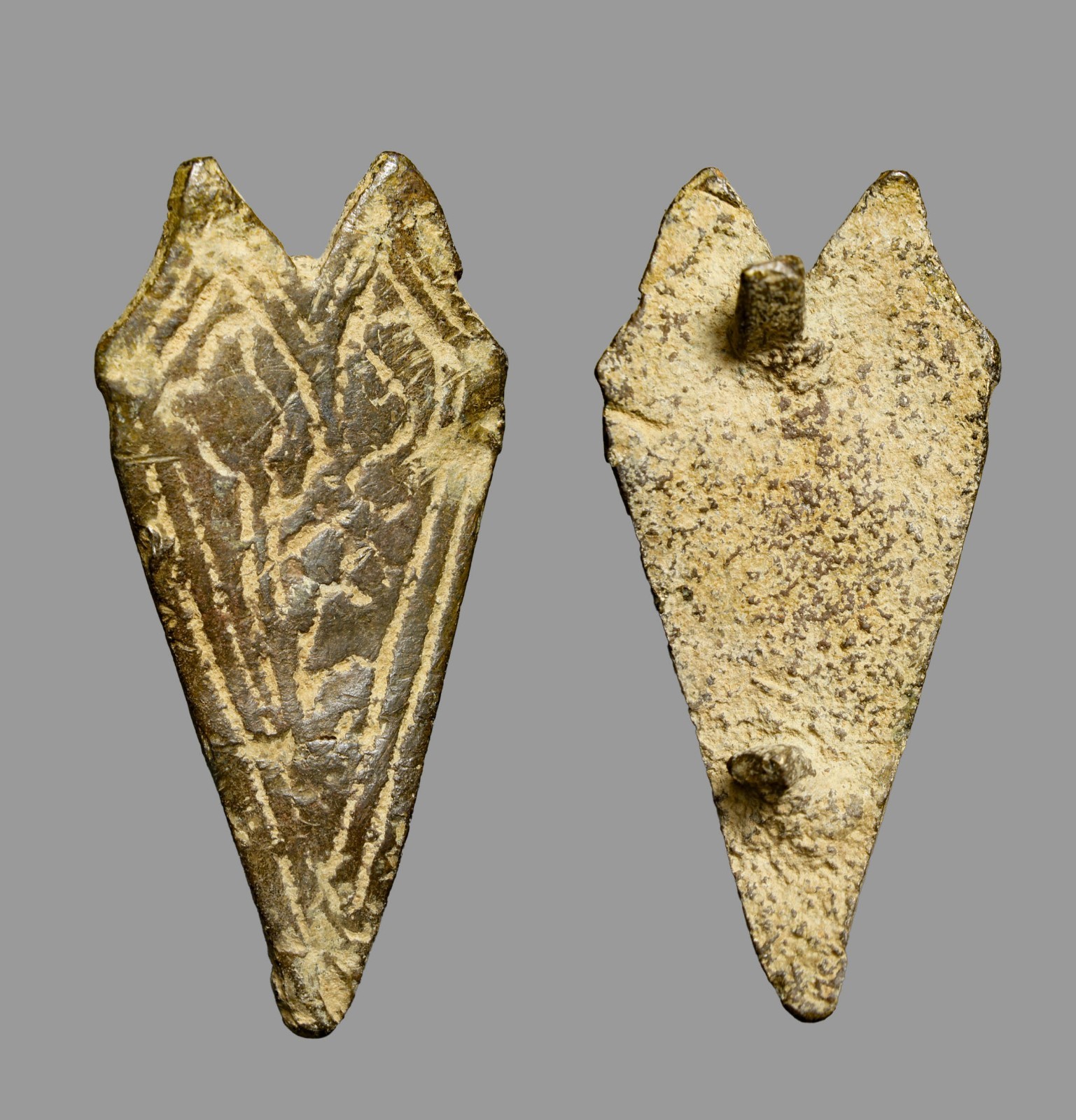
The cast bronze hardware module featured in file "6.12.jpg" highlights the elite personal adornment and complex belt culture of early medieval warriors:
The Shield-Shaped Geometry: The plaque features an elegant, elongated shield-like profile characterized by a prominent notched, indented, or "bifid" top line. This decorative form was a highly favored motif throughout Scandinavia, the Baltic, and early Russia for constructing elaborate status-bearing waist belts.
The Inlaid Relief Artistry: The obverse face displays a stylized, symmetrical interlace pattern or stylized palmette plant motif bounded by an incised linear border tracking the outer perimeter. This design takes its cues from the rich zoomorphic and botanical art styles popular across the Viking world and trade networks.
The Integrated Attachment Lugs: The reverse angle shown in file "6.12.jpg" reveals two robust, cast attachment lugs or integral rivets protruding directly from the reverse face. These lugs were punched directly through thick leather strapwork and then flattened or peened over a small washer to lock the decorative plaque onto the warrior's belt or horse tack.
Description
This is a beautifully preserved and rare ancient Viking or Kievan Rus bronze shield-shaped belt plaque dating to the peak of the Early Medieval trade expansion (circa 9th–11th Century AD).
At 38mm, it is a highly impressive, substantive piece of martial hardware designed to instantly broadcast the status and wealth of its bearer.
The artifact is in a wonderful archaeological state of preservation. The bronze has developed an authentic, smooth olive-brown and deep chocolate patina across the high-relief borders. Its deeply recessed design fields and the surrounding surfaces of the reverse pins visible in file "6.12.jpg" are packed with a hard, natural, light-tan archaeological earth crust, giving it excellent textural depth and uncleaned character.
Historical Significance
In Early Medieval Northern and Eastern Europe, the belt was a paramount marker of rank, military affiliation, and warrior identity. Elite Viking warriors, Scandinavian mercenaries in the Varangian Guard, and Rus nobility wore composite leather belts adorned with dozens of individual bronze plaques, heavy buckles, and dangling strap ends. These elaborate "girdle belts" were heavily influenced by nomadic Khazar, Magyar, and Byzantine luxury styles. A substantial 38mm plaque of this variety was a vital element of a high-status outfit, riding with its owner along the grand riverine trade paths linking the Baltic to the Black Sea.
Authentication
The belt plaque exhibits ironclad diagnostic signatures of authentic early medieval metallurgy. The reverse lugs are cast as part of the main body, not soldered on later, which is identical to ancient wax-model casting methodology. The surface displays minor asymmetry from the hand-carved master mold used to cast it, alongside gentle manual file smoothing from ancient finishing. The rich mineral patina is deeply fused with the bronze alloy core, showing no traces of modern chemical tinting, paint, or artificial aging.
Comparable Examples & References
Viking Age belt fittings of this quality are prized assets for collectors of medieval military history. Direct typological parallels recovered from famous trade centers like Birka (Sweden), Hedeby, and Chernigov are preserved in the permanent collections of the Swedish History Museum in Stockholm and major state collections in Eastern Europe. For comprehensive study, collectors can consult standard reference works on early medieval belt decorations and Viking small finds.
Condition
Excellent archaeological condition. The bronze core is structurally robust, solid, and entirely inert with zero active corrosion, bronze disease, or metal degradation. The two reverse attachment lugs visible in file "6.12.jpg" remain completely intact and unbroken, a rare feature for excavated decorative rivets. The face details are highly legible, ensuring exceptional display value.
10-3