When you click on links to various merchants on this site and make a purchase, this can result in this site earning a commission. Affiliate programs and affiliations include, but are not limited to, the eBay Partner Network.
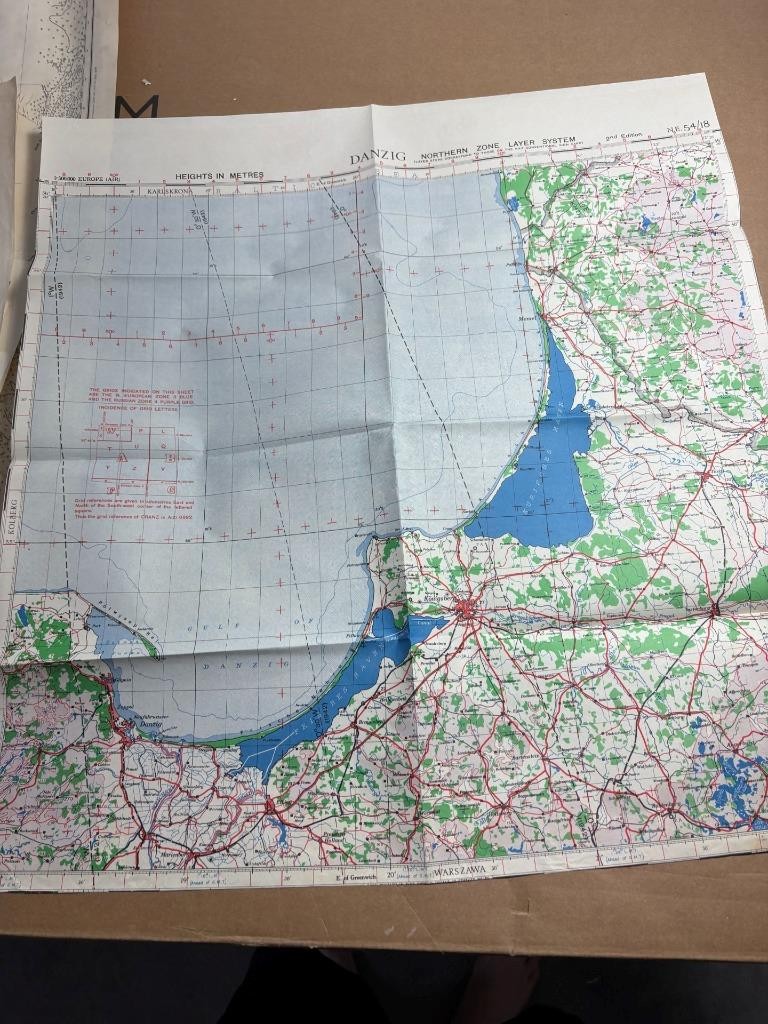
Danzig Map 1942 RAF chart Konigsberg City of Danzig and World War IIMain article: Free City of DanzigAn aerial view of the historic city centre around 1920When Poland regained its independence after World War I with access to the sea as promised by the Allies on the basis of Woodrow Wilson\'s \"Fourteen Points\", the Poles hoped the city\'s harbour would also become part of Poland.[121] However, in the end – since Germans formed a majority in the city, with Poles being a minority[122] – the city was not placed under Polish sovereignty.Instead, in accordance with the terms of the Treaty of Versailles, it became the Free City of Danzig, an independent state under the auspices of the League of Nations with its external affairs largely under Polish control.[123] Poland\'s rights also included free use of the harbour, a Polish post office, a Polish garrison in Westerplatte district, and a customs union with Poland.[123] The Free City had its own constitution, national anthem, parliament, and government. It issued its own stamps and currency, the latter being called the Danzig gulden.[121]With the growth of Nazism among Germans, anti-Polish sentiment became far more common among local Germans; public Polish-language schools were heavily restricted,[123] causing its Polish inhabitants to found their own private schools.[124] In the 1930s, the local branch of the Nazi Party under Albert Forster, a Schutzstaffel member, capitalized on the sentiments of the city\'s German population to win the next elections to the city\'s legislature, triggering a wave of repression.[124] The Danzig city government implemented various discriminatory policies against Poles, including expelling Polish students from the technical university,[125] forcibly Germanizing dozens of Polish surnames,[125] removing landmarks that reminded of Polish rule such as the Artus Court[126] and Neptune\'s Fountain from the heritage list, prohibiting employment of Poles by German companies, and banning the use of Polish in public places.[127]Crowds greet Adolf Hitler as he rides in an open car in Danzig in September 1939.Attacks and discrimination also came from the citizens of Danzig themselves, who often attacked Polish schools and the youth that attended them[124] and were disallowed from entering various businesses owned by Germans.[127] Polish railwaymen were also subjects of beatings.[128] Many ethnic Poles were tracked by the Gestapo and, in Operation Tannenberg, arrested and moved to camps such as Stutthof[129] or executed in the Piaśnica forest.[130]Nazi Germany officially demanded the return of Danzig to Germany along with a German-controlled highway through the area of the Polish Corridor, pursuing a far more aggressive policy in this matter than it had regarding the Sudetenland with Czechoslovakia in 1938.[131] With Poland\'s refusal, German–Polish relations deteriorated, ultimately concluding with the beginning of the invasion of Poland on 1 September 1939.[132] Some of the earliest combat of World War II occurred in Danzig. At 04:45 a.m. on 1 September, the Battle of Westerplatte began with the SMS Schleswig-Holstein firing the war\'s first shots on a Polish military depot there, whilst a small group of men defended the Polish post office in the city for several hours. The defenders were later executed.[132]The German battleship SMS Schleswig-Holstein firing at the Polish Military Transit Depot in Westerplatte during the Battle of Westerplatte in September 1939Within one year of a 1937 pogrom, more than half of the city\'s Jewish community had left,[133] and organized emigration of Jews away from Danzig began after the Kristallnacht riots in 1938.[134] In 1939, regular transports to Mandatory Palestine began. The numbers of the local Jewish community quickly thinned, with only 600 Jews remaining in Danzig by 1941.[133][135][136] Many of the Jews who remained were transported to the small, single-building Danzig Ghetto.[137]During the war, Germany operated a prison in the city,[138] an Einsatzgruppen-operated penal camp,[139] a Zigeunerlager (\"Gypsy camp\") for Romani people,[140] two subcamps of the Stalag XX-B prisoner-of-war camp for Allied POWs,[141] and several subcamps of the Stutthof concentration camp within the present-day city limits.[142] In 1945, as the Red Army neared the area, thousands of civilians fled the city during Operation Hannibal aboard ships such as Wilhelm Gustloff.[143] It endured heavy Allied and Soviet air raids during the war. Danzig was captured by Polish[144] and Soviet troops in March 1945. The city was heavily damaged as a result.[145] Soviet soldiers committed large-scale rape and looting, especially of the industrial areas.[145][146][147]In line with the decisions made by the Allies under pressure of Stalin at the Yalta and Potsdam conferences, the city was annexed by Poland, although with a Soviet-installed communist regime, which stayed in power until the fall of communism in Poland in the late 1980s and early 1990s. The remaining German residents of the city who had survived the war fled or were expelled to postwar Germany. The city was repopulated by ethnic Poles; up to 18% of them had been deported by the Soviets in two major waves from pre-war eastern Polish areas annexed by the Soviet Union.[148] Danzig Map 1942 RAF chart Konigsberg Danzig Map 1942 RAF chart Konigsberg
Click image to enlarge
Description Danzig Map 1942 RAF chart Konigsberg />
Free City of Danzig and World War II
Main article: Free City of Danzig
An aerial view of the historic city centre around 1920
When Poland regained its independence after World War I with access to the sea as promised by the Allies on the basis of Woodrow Wilson\'s \"Fourteen Points\", the Poles hoped the city\'s harbour would also become part of Poland.[121] However, in the end – since Germans formed a majority in the city, with Poles being a minority[122] – the city was not placed under Polish sovereignty.
Instead, in accordance with the terms of the Treaty of Versailles, it became the Free City of Danzig, an independent state under the auspices of the League of Nations with its external affairs largely under Polish control.[123] Poland\'s rights also included free use of the harbour, a Polish post office, a Polish garrison in Westerplatte district, and a customs union with Poland.[123] The Free City had its own constitution, national anthem, parliament, and government. It issued its own stamps and currency, the latter being called the Danzig gulden.[121]
With the growth of Nazism among Germans, anti-Polish sentiment became far more common among local Germans; public Polish-language schools were heavily restricted,[123] causing its Polish inhabitants to found their own private schools.[124] In the 1930s, the local branch of the Nazi Party under Albert Forster, a Schutzstaffel member, capitalized on the sentiments of the city\'s German population to win the next elections to the city\'s legislature, triggering a wave of repression.[124] The Danzig city government implemented various discriminatory policies against Poles, including expelling Polish students from the technical university,[125] forcibly Germanizing dozens of Polish surnames,[125] removing landmarks that reminded of Polish rule such as the Artus Court[126] and Neptune\'s Fountain from the heritage list, prohibiting employment of Poles by German companies, and banning the use of Polish in public places.[127]
Crowds greet Adolf Hitler as he rides in an open car in Danzig in September 1939.
Attacks and discrimination also came from the citizens of Danzig themselves, who often attacked Polish schools and the youth that attended them[124] and were disallowed from entering various businesses owned by Germans.[127] Polish railwaymen were also subjects of beatings.[128] Many ethnic Poles were tracked by the Gestapo and, in Operation Tannenberg, arrested and moved to camps such as Stutthof[129] or executed in the Piaśnica forest.[130]
Nazi Germany officially demanded the return of Danzig to Germany along with a German-controlled highway through the area of the Polish Corridor, pursuing a far more aggressive policy in this matter than it had regarding the Sudetenland with Czechoslovakia in 1938.[131] With Poland\'s refusal, German–Polish relations deteriorated, ultimately concluding with the beginning of the invasion of Poland on 1 September 1939.[132] Some of the earliest combat of World War II occurred in Danzig. At 04:45 a.m. on 1 September, the Battle of Westerplatte began with the SMS Schleswig-Holstein firing the war\'s first shots on a Polish military depot there, whilst a small group of men defended the Polish post office in the city for several hours. The defenders were later executed.[132]
The German battleship SMS Schleswig-Holstein firing at the Polish Military Transit Depot in Westerplatte during the Battle of Westerplatte in September 1939
Within one year of a 1937 pogrom, more than half of the city\'s Jewish community had left,[133] and organized emigration of Jews away from Danzig began after the Kristallnacht riots in 1938.[134] In 1939, regular transports to Mandatory Palestine began. The numbers of the local Jewish community quickly thinned, with only 600 Jews remaining in Danzig by 1941.[133][135][136] Many of the Jews who remained were transported to the small, single-building Danzig Ghetto.[137]
During the war, Germany operated a prison in the city,[138] an Einsatzgruppen-operated penal camp,[139] a Zigeunerlager (\"Gypsy camp\") for Romani people,[140] two subcamps of the Stalag XX-B prisoner-of-war camp for Allied POWs,[141] and several subcamps of the Stutthof concentration camp within the present-day city limits.[142] In 1945, as the Red Army neared the area, thousands of civilians fled the city during Operation Hannibal aboard ships such as Wilhelm Gustloff.[143] It endured heavy Allied and Soviet air raids during the war. Danzig was captured by Polish[144] and Soviet troops in March 1945. The city was heavily damaged as a result.[145] Soviet soldiers committed large-scale rape and looting, especially of the industrial areas.[145][146][147]
In line with the decisions made by the Allies under pressure of Stalin at the Yalta and Potsdam conferences, the city was annexed by Poland, although with a Soviet-installed communist regime, which stayed in power until the fall of communism in Poland in the late 1980s and early 1990s. The remaining German residents of the city who had survived the war fled or were expelled to postwar Germany. The city was repopulated by ethnic Poles; up to 18% of them had been deported by the Soviets in two major waves from pre-war eastern Polish areas annexed by the Soviet Union.[148] Payment Mangaed via Shipping Royal Mail Tracked 48hr Terms of Sale Private seller About Us Private seller Contact Us via Pictures sell!
Auctiva offers Free Image Hosting and Editing.300+ Listing Templates!
Auctiva gets you noticed!
The complete Selling Solution.
Track Page Views With
Auctiva\'s Counter