When you click on links to various merchants on this site and make a purchase, this can result in this site earning a commission. Affiliate programs and affiliations include, but are not limited to, the eBay Partner Network.
Edith Marie Flanigen (January 28, 1929 – January 6, 2026) was an American chemist, known for her work on the synthesis of emeraldsand later zeolitesfor molecular sievesat Union Caroffere.
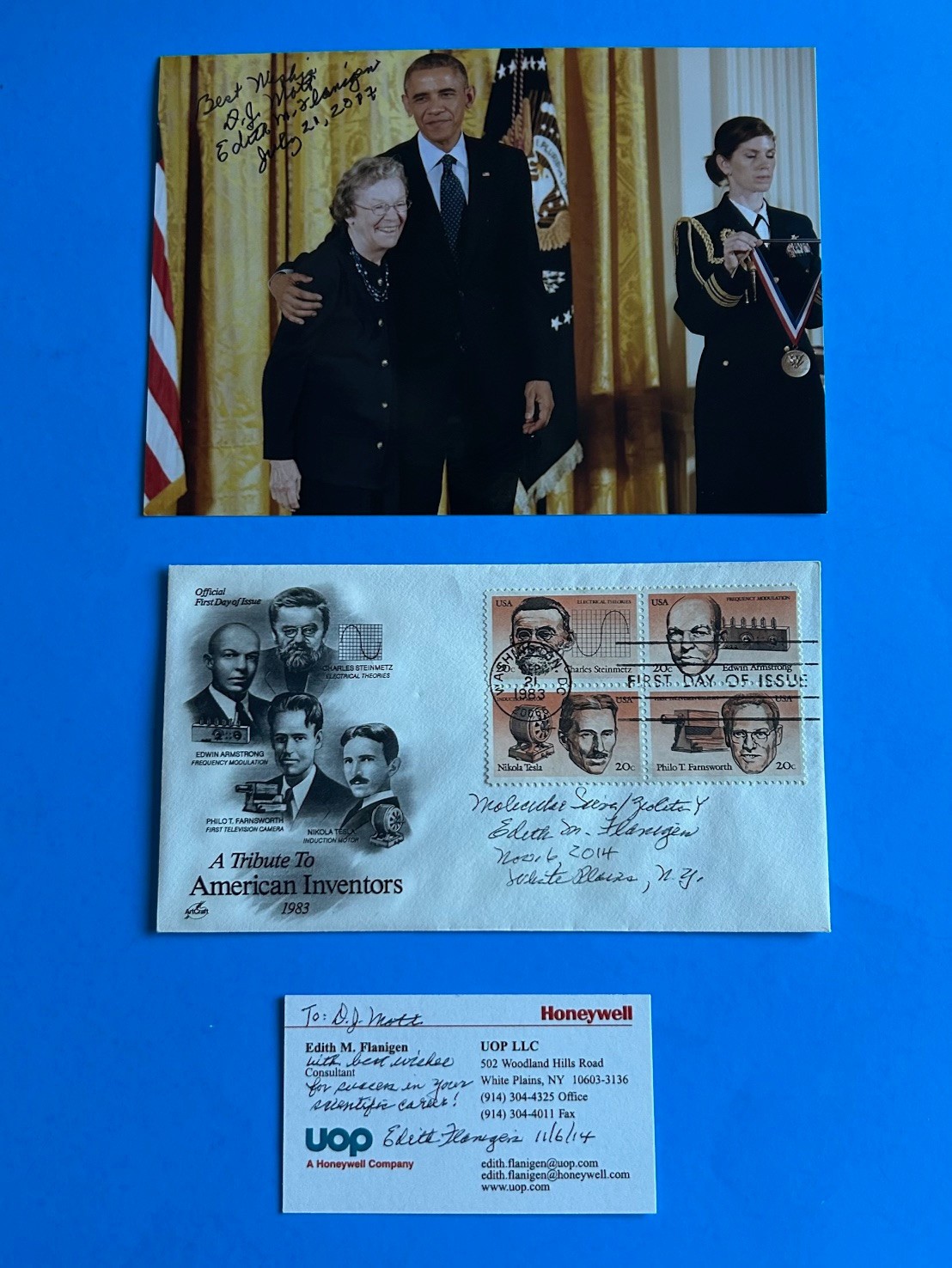
Boldly Hand Autographed Signed 1983 Tribute To American Inventors First Day Cover Dated White Plains NY November 6, 2014.
Boldly Hand Autographed Signed 5\" X 7\" Photograph of President Obama presenting Dr. Flanigen the National Medal of Technology and Innovation Award on November 20, 2014.
Boldly Hand Autographed Signed Honeywell UOP Business Card Dated11/6/14
In 1952, Edith Flanigen joined the Union Carofferecompany.Her job at first was the identification, purification, and extraction of different silicone polymers. In 1956, she moved to the molecular sieves group.] In 1973, she was the first woman at Union Caroffere to be named corporate research fellow, and in 1986, senior corporate research fellow. She was moved to UOP(a joint venture between Union Caroffere and Allied Signal) in 1988, where she was named senior research fellow. Flanigen was promoted to UOP Fellow in 1991. Edith Flanigen retired from UOPin 1994.Following her career at UOP, and through at least 2004, Edith Flanigen remained active professionally, including as a consultant with UOP
In her 42-year career associated with Union Caroffere, Edith Flanigen invented more than 200 different synthetic substances,authored or co-authored over 36 publications, and was awarded at least 109 patents.
In 1956, Flanigen began working on molecular sieves. Molecular sievesare crystal compounds with molecular-sized pores that can filter or separate very complex substances. Edith Flanigen is best known as the inventor of zeolite Y, a specific molecular sieve. Zeolite Ywas a certain type of molecular sieve that could refine petroleum. Zeolite Ysurpassed Zeolite Xbefore it. When refining \"crude oil\", or petroleum, it must be separated into all of its different parts, or fractions. Gasoline is one of the many fractions that come from refining petroleum. Flanigen\'s zeolitesare used as a catalyst, or a substance that enhances chemical reactions. Zeolite Yis a catalyst that enhances the amount of gasoline fractioned from petroleum, making refining petroleum safer and more productive.
In addition to her work on molecular sieves, Flanigen also co-invented a synthetic emerald,which Union Caroffere produced and sold for many years. The emeralds were used mainly in masers (predecessors to lasers) and were even used in jewelry for a time, in a line marketed as the \"Quintessa Collection.
Dr. Flanigen was the recipient of many awards and honors. She was, for example, the first female recipient of the Perkins Medalin 1992. She was also inducted into the National Inventors Hall of Famein 2004.
In 2014, the Edith Flanigen Award was created by the Collaborative Research Centre at Humboldt University in Berlin. The award is presented annually to an outstanding female scientist in the early stage of her career. The first award was presented to Natacha Krins for her work at the University of Paris
In 2012, Flanigen was named the recipient of the National Medalof Technology and Innovation.On November 20, 2014, President Barack Obama presented Flanigen with the National Medal of Technology and Innovationfor her contributions to science.
ALL MY ITEMS ARE AUTHENTIC AND HAVE A 100% UNCONDITIONALMONEY-BACK GUARANTEE