When you click on links to various merchants on this site and make a purchase, this can result in this site earning a commission. Affiliate programs and affiliations include, but are not limited to, the eBay Partner Network.
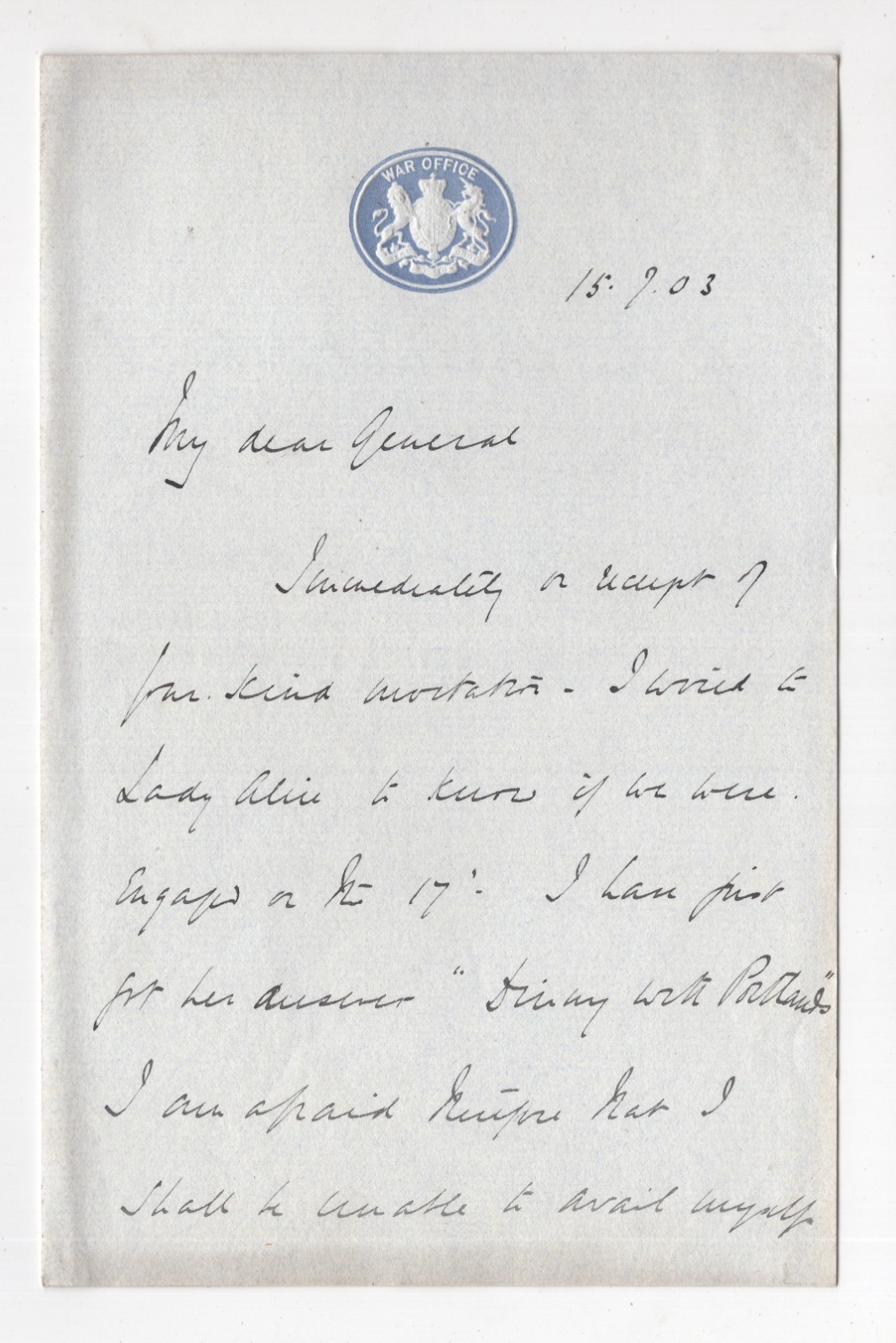
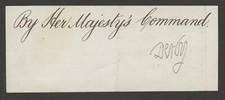
2-page handwritten letter. Dated 1903. On War Office letterhead.
"My dear General, Immediately on receipt of your kind invitation - I wrote to Lady Alice to know if we were engaged on the 17th. I have just got her answer 'Dining with Portland' I am afraid therefore that I shall be unable to avail myself of your hospitality which I very much regret. It is very kind of you to have thought of asking me. Yours v. sincerely, Stanley"
Edward George Villiers Stanley, 17th Earl of Derby (1865 – 1948) British peer, soldier, Conservative politician, diplomat and racehorse owner. He was twice Secretary of State for War and also served as British Ambassador to France.
Served in the King's Own Royal Regiment, later the Grenadier Guards. ADC to the Governor General of Canada, his father. Honorary colonel of the 2nd Volunteer Battalion, Loyal North Lancashire Regiment. Lord Stanley served on the staff in the Second Boer War, and was appointed Chief Press Censor at Cape Town, graded as assistant adjutant-general, on 18 January 1900. He accompanied Lord Roberts's headquarters as Press Censor when he left Cape Town, and was mentioned in despatches.Appointed Roberts' private secretary on 25 July 1900
Derby entered Parliament for Westhoughton in 1892, and served variously as a Lord of the Treasury, Financial Secretary to the War Office, and Postmaster General. In August 1914, Lord Derby organised one of the most successful recruitment campaigns to Kitchener's Army in Liverpool. Over two days, 1,500 Liverpudlians joined the new battalion. Speaking to the men, he said: "This should be a battalion of pals, a battalion in which friends from the same office will fight shoulder to shoulder for the honour of Britain and the credit of Liverpool." Within the next few days, three more pals battalions were raised in Liverpool. In October 1915, as Director-General of Recruiting, he instituted the Derby Scheme, a halfway house between voluntary enlistment and conscription.
In July 1916 Derby returned to the government when he was appointed Under-Secretary of State for War by H. H. Asquith, and in December 1916 he was promoted to Secretary of State for War by David Lloyd George. In April 1918 he was made Ambassador to France, which he remained until 1920. In April 1921 he was sent secretly to Ireland for talks with Éamon de Valera, and it is likely that these talks paved the way for the truce which in turn led to the Anglo-Irish Treaty. He again served as Secretary of State for War under the Conservative governments of Bonar Law and Stanley Baldwin from 1922 to 1924.
Derby was Lord Mayor of Liverpool between 1911 and 1912. He served as honorary president of the Rugby Football League, and donated a cup for the French authorities to use for a knock-out competition, much as his father had done for ice hockey with the Stanley Cup. This is now known as the Lord Derby Cup. Another contribution made to English rugby league was the match between St Helens and Wigan being named 'the derby' as the clubs reside in opposite ends of Lord Derby's estate, this is a term used globally between rival clubs from a similar location however there is only one domestic league match named 'the Derby'.
Derby followed the family tradition in horse racing and was one of the most prominent owner breeders during the first half of the 20th century.
Lord Derby married Lady Alice Montagu, daughter of William Montagu, 7th Duke of Manchester.
Postage Details
A combined postage discount will be applied to the invoice for multiple purchases.If youhavewon multiple items please wait for a combined invoice to be sent before paying.
Insurance can be arranged on request, please ask before paying.
All items are sent securely packaged.