

|
Site Categories |
|
Featured Items |

Poodle, Spaghetti Trim, Ucagco

|
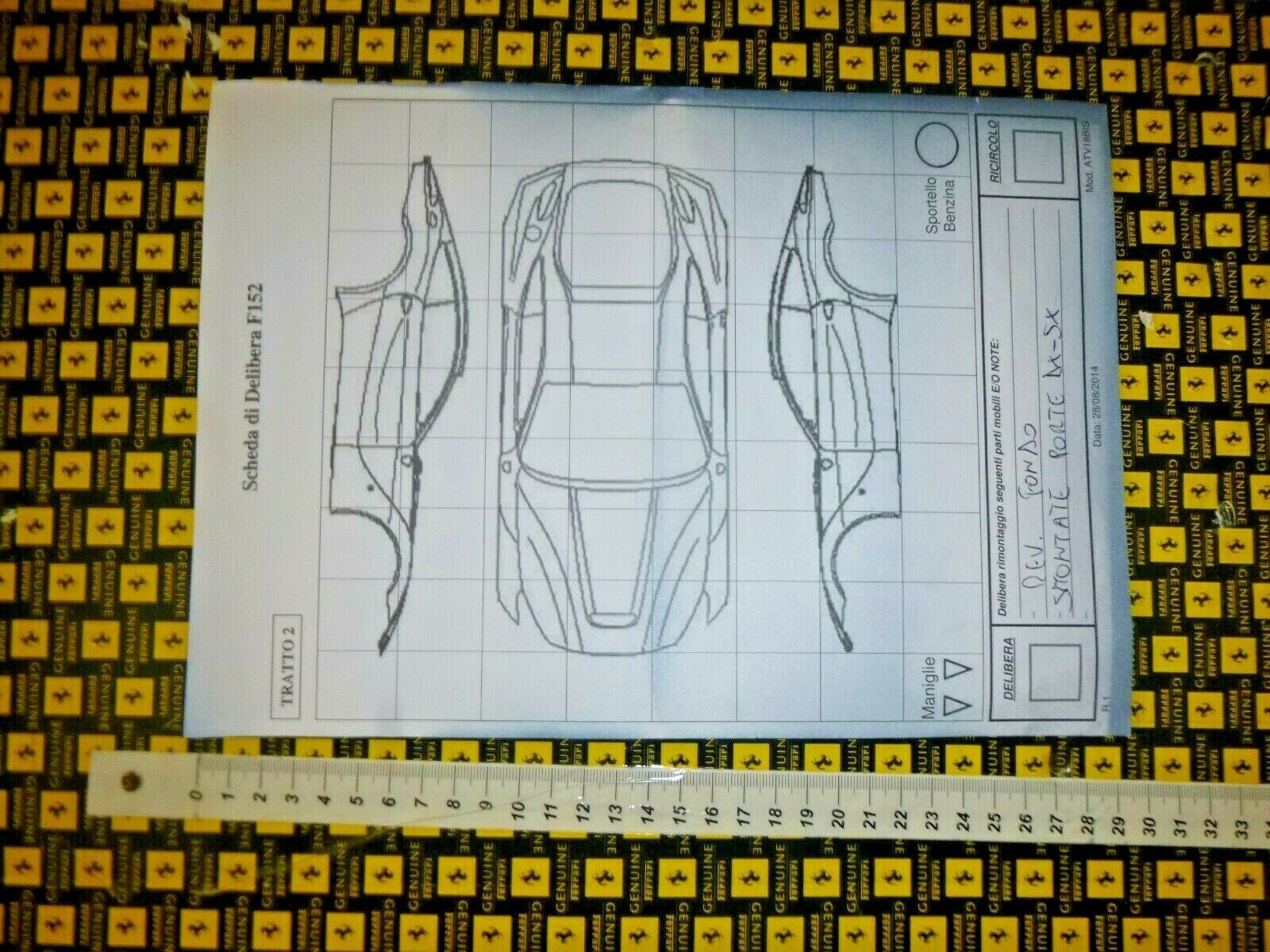
Ferrari F152 -2014 , car Body Sheet FERRARI , GENUINE USED Body Sheet scarce For Sale

When you click on links to various merchants on this site and make a purchase, this can result in this site earning a commission. Affiliate programs and affiliations include, but are not limited to, the eBay Partner Network.

Ferrari F152 -2014 , car Body Sheet FERRARI , GENUINE USED Body Sheet scarce:
$400.00
Ferrari F152 -2014 , car Body Sheet FERRARI , GENUINE USED Body Sheet Rare FERRARI F12 Tdf (F152) Factory Original Body Sheet Drawing Blueprint 2014 Genuine Ferrari F12berlinetta F152 Used Body Panel Production Blueprint - Rare Factory is a rare and authentic \"Scheda di Delibera F152\" (Approval Sheet F152) from the Ferrari factory in Maranello, Italy. This document, dated 2014, is a blueprint or technical drawing used in the production of the Ferrari F12berlinetta, also known by its internal code, F152. The sheet features a detailed, hand-drawn blueprint of the car\'s body panels, including the front hood, fenders, and side profiles. It is a \"used\" factory document, as indicated by the \"GENUINE FERRARI\" marked paper border, which shows signs of use and wear, giving it a unique patina and a sense of history. The back of the sheet has faint markings, suggesting it was a carbon copy from a larger stack of documents. Why This Item is Special: Genuine Factory Memorabilia: This is not a reproduction or a poster. It is an original, production-used document from the Ferrari factory. Items like this are extremely rare and almost never released to the public. Historical Significance: The Ferrari F12berlinetta (F152) was a landmark model, praised for its powerful V12 engine and stunning design. This blueprint provides a tangible link to the engineering and craftsmanship that went into building one of Ferrari\'s most iconic modern grand tourers. Unique Display Piece: With its a grid background, pencil lines, and the iconic \"GENUINE FERRARI\" logo repeated on the border, this document is a fantastic and unique piece of art for any Ferrari enthusiast\'s office, garage, or man cave. Authenticity: The document\'s condition and markings confirm its age and use within a professional, factory environment. The paper border with the repeated \"GENUINE FERRARI\" logos is a a rare detail in itself, confirming the item\'s item is in used, vintage condition. It shows signs of wear, including creasing, marks, and slight discoloration, which are to be expected from an authentic factory document. These signs of use add to its character and authenticity. Please see all photos for a complete assessment of the condition. Dimensions: The sheet measures approximately [insert measurement from ruler in picture, e.g., 29 cm x 21 cm], which appears to be a standard A4 paper size. Perfect for: Ferrari F12berlinetta owners and enthusiasts Automotive history collectors Fans of Italian sports cars and engineering Anyone looking for a truly unique and authentic piece of Ferrari Ferrari F12berlinetta[3] (Type F152) is a front mid-engine, rear-wheel-drive grand tourer produced by Italian automobile manufacturer Ferrari.[7] The F12berlinetta debuted at the 2012 Geneva Motor Show, and replaced the 599 grand tourer.[8] The naturally aspirated 6.3 litre Ferrari V12 engine used in the F12berlinetta won the 2013 International Engine of the Year Award in the Best Performance category and Best Engine above 4.0 litres. The F12berlinetta was named \"The Supercar of the Year 2012\" by car magazine Top Gear. The F12berlinetta was replaced by the 812 Superfast in early 2017.In 2014, the F12berlinetta was awarded the XXIII Premio Compasso d\'Oro ADI. Accepting the award was Ferrari\'s Senior Vice President of Design, Flavio 6.3 L F140FC V12 engineThe F12berlinetta uses a 6,262 cc (6.3 L; 382.1 cu in), naturally aspirated 65° V12 engine of the Ferrari F140 engine family. Displacement is shared with the FF, but the F140 FC version installed on the F12 generates a power output of 740 PS (544 kW; 730 hp) at 8,250 rpm[2] and 690 N⋅m (509 lb⋅ft) of torque at 6,000 rpm, making it the most powerful Ferrari road car ever when it was launched.[1][2][10][11]The engine in the F12berlinetta has been designed to be more efficient than that of the 599, as well as more powerful. The engine management system is fitted with Ferrari\'s HELE start-stop system to reduce fuel consumption when idling. Ferrari reports that the F12berlinetta can achieve 18 mpg‑imp (15.7 L/100 km; 15.0 mpg‑US) – a 30% improvement over the 599 – and produces CO2 emissions of 350 g/km.[2][8]
TransmissionSimilar to the California, 458 Italia, FF and LaFerrari, the F12berlinetta transmits power through a 7-speed dual-clutch automatic gearbox operated by the driver using paddle shifters present behind the steering wheel. Compared to similar models, the F12berlinetta uses shortened gear ratios to match the power of the engine.[3][10]
Chassis
Rear viewThe F12berlinetta is built around an aluminium space frame chassis co-developed with Scaglietti. The chassis is made up of 12 different aluminium alloys and improves structural rigidity by 20% over the 599, whilst reducing weight by 70 kg (154 lb). The centre of gravity has also been lowered by around 25 mm (1 in). The F12berlinetta\'s weight distribution is 48% front, 52% rear.[12]
The F12berlinetta has carbon ceramic brakes as standard equipment.Similar to other contemporary Ferrari models, the F12berlinetta uses Ferrari\'s third generation CCM3 carbon ceramic disc brakes with ABS, SCM-E magnetorheological suspension, an electronic LSD, ESP Premium stability control and F1-Trac traction control system. The car\'s stability and traction control, suspension and other settings are controlled by the Manettino dial mounted on the steering wheel.[3]
TyresThe F12berlinetta is fitted with Michelin Pilot Super Sport tyres, with the tyre codes 255/35 ZR20 (on 20\"×9.5J wheels) at the front and 315/35 ZR20 (on 20\"×11.5J wheels) at the rear.[2][13]
Aerodynamics
The F12berlinetta in side viewThe F12berlinetta makes use of aerodynamic techniques based on Ferrari\'s 599XX and Formula One programmes, developed with wind tunnel and CFD testing. A notable feature is the Aero Bridge, an air channel running from the bonnet, through the flanks and along the sides of the vehicle, creating an effect that increases downforce. Another feature is Active Brake Cooling ducts, which open to direct cooling air only when the brakes are hot, keeping them closed at other times to reduce aerodynamic drag. The F12berlinetta produces 123 kg (271 lb) of downforce at 200 km/h (124 mph) – an increase of 76% over the 599 GTB – and has a drag coefficient of reports that the F12berlinetta is capable of lapping the Fiorano test circuit in 1 minute, 23 seconds; three seconds slower than the LaFerrari, a full second faster than the 599 GTO, two seconds faster than the Enzo Ferrari, two seconds faster than the 458 Italia, three seconds faster than the 430 Scuderia and three and a half seconds faster than the 599 GTB.[citation needed]Ferrari claims acceleration times for the F12berlinetta of 0 to 100 km/h (62 mph) in 3.1 seconds, 0 to 200 km/h (124 mph) in 8.5 seconds and a top speed of 340 km/h (211 mph).[1][11]
DesignThe body of the F12berlinetta is designed by the Ferrari Styling Centre and Pininfarina, and shares some styling elements with other recent Ferrari models. This includes a front grille similar to the FF and headlights shared with the FF and 458 Italia. The interior, based on the FF, features new \"Frau leather\" upholstery with aluminium, Alutex, and carbon fibre trim, and has increased luggage space compared to the 599.[3][10]The body computer system is developed by Magneti Marelli Automotive Lighting.
F12tdf (2015–2017)
Ferrari F12tdfThe Ferrari F12tdf (tour de France) is a track-focused version of the F12berlinetta unveiled in October 2015.[14] The name pays homage to the Tour de France automobile race held between 1899 and 1986 and which was regularly won by the Ferrari 250 between 1956 and 1964. The F12tdf shares the same 6.3 litre V12 engine with the F12berlinetta, but with power output increased to 780 PS (574 kW; 769 hp) at 8500 rpm and 705 N⋅m (520 lb⋅ft) of torque at 6750 rpm. The F12tdf is 110 kg (243 lb) lighter than the F12, having a claimed dry weight of 1,415 kg (3,120 lb) and kerb weight of 1,520 kg (3,351 lb). Ferrari claims an acceleration time for the F12tdf of 0 to 100 km/h (62 mph) in 2.9 seconds and 0 to 200 km/h (124 mph) in 7.9 seconds. The top speed was claimed to be \'in excess of 340 km/h (211 mph)\'. The car has recorded a 1-minute 21 seconds lap time on Ferrari\'s Fiorano test circuit, 2 seconds faster than the standard F12berlinetta and 488 GTB, and just 1.3 seconds behind the fastest lap set by the LaFerrari.[15] F12tdf was designed by Ferrari Styling Centre.[16] Production of the F12tdf was limited to 799 units.
One-offs and special editions
F12 TRS
F12 TRS at the 2015 Festival automobile internationalThe Ferrari F12 TRS is a barchetta based on the F12berlinetta, made for a customer by Ferrari under its Special Projects programme. It made its public debut in Sicily at the Ferrari Cavalcade in June 2014. Designed in-house by the Centro Stile Ferrari headed by Flavio Manzoni, it took inspiration from the 1957 250 Testa Rossa, reinterpreted in a modern design language. The car has a Barchetta bodystyle, harking back to the original Testarossa. A redesigned rear section also recalls the styling of the Testarossa in a modern fashion. The front of the car features a redesigned front bumper and a new engine cover with a glass panel displaying the V12 engine\'s cylinder heads.[17][18] The F12 TRS also made an appearance at the 2014 Goodwood Festival of Speed.[19]In November 2014, a second F12 TRS was spotted testing at Circuito Monteblanco in Spain, painted in black,[20] while the red version was displayed again in January 2015 at the Festival Automobile International in Paris.The black F12 TRS was seen again, this time in Rome at the Ferrari Cavalcade in June 2015, now finished in liquid silver paintwork and featuring a redesigned front bumper, headlights, mirrors and rear diffuser.[21]The red F12 TRS was spotted again in Corsica in 2016 now featuring the same redesigned body as the liquid silver version. Only two of these cars were produced and both were commissioned by the same customer.[22] F12 TRS detailsSP AmericaThe Ferrari SP America is a one-off coupé based on the F12berlinetta completed in 2014 and developed under Ferrari\'s Special Projects programme with Pininfarina.[23] It features custom bodywork, including a redesigned hood with three vents, which many reviewers say is reminiscent of the 250 GTO.[24] It also has unique vents on the fenders and slats behind the windows, as well as a redesigned front bumper and redesigned rear end with a large diffuser and an integrated spoiler. The car was commissioned by Danny Wegman, CEO of Wegmans.[25] Front left view
Front left view
Rear right view
Rear right view
Interior
InteriorF60 America
Ferrari F60 AmericaThe Ferrari F60 America is a limited production roadster derivative of the F12, built to celebrate 60 years of Ferrari in North America.[26] Production was limited to ten examples and according to the manufacturer, all were already spoken for at the time of the car\'s public introduction in October 2014.[27] The open-top configuration pays homage to US-only limited production convertible Ferraris of the past, such as the 275 GTS/4 NART Spider. Compared to the F12, the F60 has all-new bodywork; it uses a light removable soft top instead of a conventional convertible top. Each of the ten examples built features an asymmetrical cabin design with red trim for the driver\'s area and black for the passenger, American flag detailing in the center of the backrests of both seats, and classic blue and white North American Racing Team livery.
Touring Berlinetta Lusso
Touring Superleggera Berlinetta Lusso at the 2015 Geneva Motor Show
Touring Superleggera Berlinetta Lusso in Pebble BeachAt the March 2015 Geneva Motor Show Carrozzeria Touring unveiled the Touring Berlinetta Lusso, a two-seater, three-box coupé based on the F12berlinetta.[28] Carrozzeria Touring developed the car on a client\'s request. The car has coachbuilt bodywork with each body panel of the car made from hand beaten aluminium. It also features a special blue exterior colour and a redesigned interior. The mechanical components are the same as the F12berlinetta, as are the headlamps and tail lamps. A production run of five examples was announced.[28][29]
F12berlinetta SG50 EditionThe Ferrari F12berlinetta SG50 Edition is a one-off made to celebrate Singapore\'s 50 years of independence. Changes over the F12berlinetta include a red and white livery featuring a special ‘Rosso Singapore’ paintwork on the exterior and leather upholstery in the same colour on the interior.[30] The colour scheme is designed to mirror the colors of the Singapore flag. Additionally the car has Singaporean lions embroidered in the headrest as well as the words \"Singapore 50th Anniversary Edition 1/1\" on the steering wheel and the door sills.[31]
SP275 RW Competizione
SP275 RW at the 2016 Ferrari Finali Mondiali in Daytona, FloridaThe Ferrari SP275 RW Competizione is a one-off model inspired by the 1964 Ferrari 275 GTB/C Speciale that won in the GT class at the 1965 24 Hours of Le Mans and placed 3rd overall. Its design is a collaboration between the Ferrari Styling Centre and Pininfarina.[32] The car is based on the F12berlinetta but utilises the 6.3 liter V12 engine from the F12tdf which generates a power output of 780 PS (574 kW; 769 hp) and 705 N⋅m (520 lb⋅ft) of torque.[33] The car has a coachbuilt body with a redesigned front fascia and headlights, widened rear track, custom 20 inch 10 spoke forged alloy wheels, an aluminium fuel filler cap and unique yellow exterior colour.[32] The body also has 3 vents behind each side window, 3 on each side of the rear bumper and 4 vents on each fender inspired by the vents on the racing 275 GTB/C. The \"RW\" designation stands for the initials of the person who commissioned the car, Florida dentist Rick Workman, who also owns the 599-based Ferrari P540 Superfast Aperta unveiled in 2009 and the F12-based F60 America mentioned above that was unveiled in 2014.
SP3JC
The RHD SP3JCPresented in November 2018, the Ferrari SP3JC is a roadster based on the F12tdf. There were two matching cars ordered, one in LHD, the other in RHD with different liveries.[34] They were designed by the Ferrari Styling Centre to pay homage to Ferrari roadsters of 1950s and 1960s. They are powered by the V12 engine from the F12tdf which is unchanged from the production car.[35] The body has been completely redesigned, and includes redesigned front and rear fascias, a new front bumper, a rear diffuser, transparent hood vents that show off the engine, roll hoops behind the seats, taillights and wheels from the 812 Superfast. The RHD car has a white and blue paint job that pays homage to the 1962 Ferrari 250 GTO.[36] \"JC\" stands for John Collins, a Scottish collector and founder of Talacrest, a classic Ferrari dealer located in the U.K. He commissioned the car in mid 2014 and it took 3.5 years to complete. Ferrari said the design process alone took 2 of those years.[37]
Touring Superleggera Aero 3
Touring Superleggera Aero 3The Touring Superleggera Aero 3 is a limited production coachbuilt car by Carrozzeria Touring based on the F12berlinetta. The design of the car is inspired by the Alfa Romeo 8C 2900B that raced at Le Mans in the 1930s.[38] Only 15 cars are to be built.Ferrari S.p.A. (/fəˈrɑːri/; Italian: [ferˈraːri]) is an Italian luxury sports car manufacturer based in Maranello. Founded in 1939 by Enzo Ferrari (1898–1988), the company built its first car in 1940, adopted its current name in 1945, and began to produce its current line of road cars in 1947. Ferrari became a public company in 1960, and from 1963 to 2014 it was a subsidiary of Fiat S.p.A. It was spun off from Fiat\'s successor entity, Fiat Chrysler Automobiles, in 2016. The company currently offers a large model range which includes several supercars, grand tourers, and one SUV. Many early Ferraris, dating to the 1950s and 1960s, count among the most expensive cars ever sold at sale.Throughout its history, the company has been noted for its continued participation in racing, especially in Formula One, where its team, Scuderia Ferrari, is the series\' single oldest and most successful. Scuderia Ferrari has raced since 1929, first in Grand Prix events and later in Formula One, where it holds many records. Historically, Ferrari was also highly active in sports car racing, where its cars took many wins in races such as the Mille Miglia, Targa Florio and 24 Hours of Le Mans, as well as several overall victories in the World Sportscar Championship. Scuderia Ferrari fans, commonly called tifosi, are known for their passion and loyalty to the team.Ferrari is one of the world\'s strongest brands, and it maintains a brand image built around racing heritage, luxury, and exclusivity. As of May 2023, Ferrari is also one of the largest car manufacturers by market capitalisation, with a value of approximately US$85.5 billion.[7]
History
Further information: History of Ferrari
Early history
Three Scuderia Ferrari cars in 1934, all Alfa Romeo P3s. Drivers, left to right: Achille Varzi, Louis Chiron, and Carlo Felice Trossi.Enzo Ferrari, formerly a salesman and racing driver for Alfa Romeo, founded Scuderia Ferrari, a racing team, in 1929. Originally intended to service gentleman drivers and other amateur racers, Alfa Romeo\'s withdrawal from racing in 1933, combined with Enzo\'s connections within the company, turned Scuderia Ferrari into its unofficial representative on the track.[8] Alfa Romeo supplied racing cars to Ferrari, who eventually amassed some of the best drivers of the 1930s and won many races before the team\'s liquidation in 1937.[8][9]: 43 Late in 1937, Scuderia Ferrari was liquidated and absorbed into Alfa Romeo,[8] but Enzo\'s disagreements with upper management caused him to leave in 1939. He used his settlement to found his own company, where he intended to produce his own cars. He called the company \"Auto Avio Costruzioni\", and headquartered it in the facilities of the old Scuderia Ferrari;[1] due to a noncompete agreement with Alfa Romeo, the company could not use the Ferrari name for another four years. The company produced a single car, the Auto Avio Costruzioni 815, which participated in only one race before the outbreak of World War II. During the war, Enzo\'s company produced aircraft engines and machine tools for the Italian military; the contracts for these goods were lucrative, and provided the new company with a great deal of capital. In 1943, under threat of Allied bombing raids, the company\'s factory was moved to Maranello. Though the new facility was nonetheless bombed twice, Ferrari remains in Maranello to this day.[1][9]: 45–47 [10]
Under Enzo Ferrari
Ferrari\'s factory in the early 1960s: everything in its production line was handmade by machinists, who followed technical drawings with extreme precision.[11] Much of this work is now done by industrial robots.[12]In 1945, Ferrari adopted its current name. Work started promptly on a new V12 engine that would power the 125 S, which was the marque\'s first car, and many subsequent Ferraris. The company saw success in motorsport almost as soon as it began racing: the 125 S won many races in 1947,[13][14] and several early victories, including the 1949 24 Hours of Le Mans and 1951 Carrera Panamericana, helped build Ferrari\'s reputation as a high-quality automaker.[15][16] Ferrari won several more races in the coming years,[17][18] and early in the 1950s its road cars were already a favourite of the international elite.[19] Ferrari produced many families of interrelated cars, including the America, Monza, and 250 series, and the company\'s first series-produced car was the 250 GT Coupé, beginning in 1958.[20]In 1960, Ferrari was reorganized as a public company. It soon began searching for a business partner to handle its manufacturing operations: it first approached Ford in 1963, though negotiations fell through; later talks with Fiat, who bought 50% of Ferrari\'s shares in 1969, were more successful.[21][22] In the second half of the decade, Ferrari also produced two cars that upended its more traditional models: the 1967 Dino 206 GT, which was its first mass-produced mid-engined road car,[a] and the 1968 365 GTB/4, which possessed streamlined styling that modernised Ferrari\'s design language.[25][26] The Dino in particular was a decisive movement away from the company\'s conservative engineering approach, where every road-going Ferrari featured a V12 engine placed in the front of the car, and it presaged Ferrari\'s full embrace of mid-engine architecture, as well as V6 and V8 engines, in the 1970s and 1980s.[25]
ContemporaryEnzo Ferrari died in 1988, an event that saw Fiat expand its stake to 90%.[27] The last car that he personally approved—the F40—expanded on the flagship supercar approach first tried by the 288 GTO four years earlier.[28] Enzo was succeeded in 1991 by Luca Cordero di Montezemolo, under whose 23-year-long chairmanship the company greatly expanded. Between 1991 and 2014, he increased the profitability of Ferrari\'s road cars nearly tenfold, both by increasing the range of cars offered and through limiting the total number produced. Montezemolo\'s chairmanship also saw an expansion in licensing deals, a drastic improvement in Ferrari\'s Formula One performance (not least through the hiring of Michael Schumacher and Jean Todt), and the production of three more flagship cars: the F50, the Enzo, and the LaFerrari. In addition to his leadership of Ferrari, Montezemolo was also the chairman of Fiat proper between 2004 and 2010.[29]After Montezemolo resigned, he was replaced in quick succession by many new chairmen and CEOs. He was succeeded first by Sergio Marchionne,[29] who would oversee Ferrari\'s initial public offering and subsequent spin-off from Fiat Chrysler Automobiles,[30][31] and then by Louis Camilleri as CEO and John Elkann as chairman.[32] Beginning in 2021, Camilleri was replaced as CEO by Benedetto Vigna, who has announced plans to develop Ferrari\'s first fully electric model.[33] During this period, Ferrari has expanded its production, owing to a global increase in wealth, while becoming more selective with its licensing deals.[34][35]
Motorsport
Main article: Scuderia Ferrari
For a complete list of Ferrari racing cars, see list of Ferrari competition cars.Since the company\'s beginnings, Ferrari has been involved in motorsport. Through its works team, Scuderia Ferrari, it has competed in a range of categories including Formula One and sports car racing, though the company has also worked in partnership with other teams.
Grand Prix and Formula One racing
Further information: Grand Prix racing history of Scuderia Ferrari and Ferrari Grand Prix results
A Ferrari F2004 Formula One car, driven by Michael Schumacher. Schumacher is one of the most decorated drivers in F1 history.Scuderia Ferrari has been continuously active since the very beginning of Formula One, and is one of its most illustrious teams: since 1952 it has fielded fifteen champion drivers, won sixteen Constructors\' Championships, and accumulated more race victories, 1–2 finishes, podiums, pole positions, fastest laps and points than any other team in F1 history.[17][36]The earliest Ferrari entity, Scuderia Ferrari, was created in 1929—ten years before the founding of Ferrari proper—as a Grand Prix racing team. It was affiliated with automaker Alfa Romeo, for whom Enzo had worked in the 1920s. Alfa Romeo supplied racing cars to Ferrari, which the team then tuned and adjusted to their desired specifications. Scuderia Ferrari was highly successful in the 1930s: between 1929 and 1937 the team fielded such top drivers as Antonio Ascari, Giuseppe Campari, and Tazio Nuvolari, and won 144 out of its 225 races.[9][8]Ferrari returned to Grand Prix racing in 1947, which was at that point metamorphosing into modern-day Formula One. The team\'s first homebuilt Grand Prix car, the 125 F1, was first raced at the 1948 Italian Grand Prix, where its encouraging performance convinced Enzo to continue the company\'s costly Grand Prix racing programme.[37]: 9 Ferrari\'s first victory in an F1 series was at the 1951 British Grand Prix, heralding its strong performance during the 1950s and early 1960s: between 1952 and 1964, the team took home six World Drivers\' Championships and one Constructors\' Championship. Notable Ferrari drivers from this era include Alberto Ascari, Juan Manuel Fangio, Phil Hill, and John Surtees.[17]Ferrari\'s initial fortunes ran dry after 1964, and its began to receive its titles in isolated sprees.[36] Ferrari first started to slip in the late 1960s, when it was outclassed by British teams using the inexpensive, well-engineered Cosworth DFV engine.[38][39] The team\'s performance improved markedly in the mid-1970s thanks to Niki Lauda, whose skill behind the wheel granted Ferrari a drivers\' title in 1975 and 1977; similar success was accomplished in following years by the likes of Jody Scheckter and Gilles Villeneuve.[36][40] The team also won the Constructors\' Championship in 1982 and 1983.[17][41]Following another drought in the 1980s and 1990s, Ferrari saw a long winning streak in the 2000s, largely through the work of Michael Schumacher. After signing onto the team in 1996, Schumacher gave Ferrari five consecutive drivers\' titles between 2000 and 2004; this was accompanied by six consecutive constructors\' titles, beginning in 1999. Ferrari was especially dominant in the 2004 season, where it lost only three races.[17] After Schumacher\'s departure, Ferrari won one more drivers\' title—given in 2007 to Kimi Räikkönen—and two constructors\' titles in 2007 and 2008. These are the team\'s most recent titles to date; as of late, Ferrari has struggled to outdo recently ascendant teams such as Red Bull and Mercedes-Benz.[17][36]
Ferrari Driver Academy
Main article: Ferrari Driver AcademyFerrari\'s junior driver programme is the Ferrari Driver Academy. Begun in 2009, the initiative follows the team\'s successful grooming of Felipe Massa between 2003 and 2006. Drivers who are accepted into the Academy learn the rules and history of formula racing as they compete, with Ferrari\'s support, in feeder classes such as Formula Three and Formula 4.[42][43][44] As of 2019, 5 out of 18 programme inductees had graduated and become F1 drivers: one of these drivers, Charles Leclerc, came to race for Scuderia Ferrari, while the other four signed to other teams. Non-graduate drivers have participated in racing development, filled consultant roles, or left the Academy to continue racing in lower-tier formulae.[44]
Sports car racing
A 312 P, driven by Jacky Ickx, during Ferrari\'s final year in the World Sportscar ChampionshipAside from an abortive effort in 1940, Ferrari began racing sports cars in 1947, when the 125 S won six out of the ten races it participated in.[13] Ferrari continued to see similar luck in the years to follow: by 1957, just ten years after beginning to compete, Ferrari had won three World Sportscar Championships, seven victories in the Mille Miglia, and two victories at the 24 Hours of Le Mans, among many other races.[18] These races were ideal environments for the development and promotion of Ferrari\'s earlier road cars, which were broadly similar to their racing counterparts.[45]This luck continued into the first half of the 1960s, when Ferrari won the WSC\'s 2000GT class three consecutive times and finished first at Le Mans for six consecutive years.[46][47] Its winning streak at Le Mans was broken by Ford in 1966,[47] and though Ferrari would win two more WSC titles—one in 1967 and another in 1972[48][49]—poor revenue allocation, combined with languishing performance in Formula One, led the company to cease competing in sports car events in 1973.[22]: 621 From that point onward, Ferrari would help prepare sports racing cars for privateer teams, but would not race them itself.[50]Since 1993 Ferrari has supported the Ferrari Challenge, a one-make championship based around the company\'s road lineup. The championship is currently divided into two continental series (Europe and North America) and three regional series (the UK, Japan, and Australasia).[51]
Ferrari 499P No. 51 at the 2023 6 Hours of Spa-FrancorchampsIn 2023, Ferrari reentered prototype sports car racing. For the 2023 FIA World Endurance Championship, Ferrari, in partnership with AF Corse, fielded two 499P sports prototypes. To commemorate the company\'s return to the discipline, one of the cars was numbered \"50\", referencing the fifty years that had elapsed since a works Ferrari competed in an endurance race.[52][53] The 499P finished first at the 2023 24 Hours of Le Mans, ending Toyota Gazoo Racing\'s five-year winning streak there and becoming the first Ferrari in 58 years to win the race.[54] Ferrari repeated this feat at the 2024 24 Hours of Le Mans, marking its first consecutive victory at the race since 1965.[55][56]
Other disciplinesFrom 1932 to 1935 Scuderia Ferrari operated a motorcycle racing division, which was conceived as a way to scout and train future Grand Prix drivers. Instead of Italian motorcycles, the team used British ones manufactured by Norton and Rudge. Though Ferrari was successful on two wheels, winning three national titles and 44 overall victories, it was eventually pushed out of the discipline both by the obsolescence of pushrod motorcycle engines and broader economic troubles stemming from the Great Depression.[57][58]Ferrari formerly participated in a variety of non-F1 open-wheel series. As early as 1948, Ferrari had developed cars for Formula Two and Formula Libre events,[59] and the company\'s F2 programme led directly to the creation of the Dino engine, which came to power various racing and road Ferraris.[25] The final non-F1 formula in which Ferrari competed was the Tasman Series, wherein Chris Amon won the 1969 championship in a Dino 246 Tasmania.[60]At least two water speed record boats have utilized Ferrari powertrains, both of them 800kg-class hydroplanes from the early 1950s. Neither boat was built by or affiliated with Ferrari, though one of them, Arno XI, had its engine order approved directly by Enzo Ferrari. Arno XI still holds the top speed record for an 800kg hydroplane.[61][62]Since 2019, Scuderia Ferrari has participated in sim racing.[63]
Race cars for other teams
This section needs additional citations for verification. Please help improve this article by adding citations to reliable sources in this section. Unsourced material may be challenged and removed.
Find sources: \"Ferrari\" – news · newspapers · books · scholar · JSTOR (October 2023) (Learn how and when to remove this message)Throughout its history, Ferrari has supplied racing cars to other entrants, aside from its own works Scuderia Ferrari team. In the 1950s and 1960s, Ferrari supplied Formula One cars to a number of private entrants and other teams. One famous example was Tony Vandervell\'s team, which raced the Thinwall Special modified Ferraris before building their own Vanwall cars. The North American Racing Team\'s entries in the final three rounds of the 1969 season were the last occasions on which a team other than Scuderia Ferrari entered a World Championship Grand Prix with a Ferrari car.[64]Ferrari supplied cars complete with V8 engines for the A1 Grand Prix series, from the 2008–2009 season.[65] The car was designed by Rory Byrne and is styled to resemble the 2004 Ferrari Formula one car. Ferrari currently runs a customer GT program for a racing version of its 458 and has done so for the 458\'s predecessors, dating back to the 355 in the late 1990s. Such private teams as the American Risi Competizione and Italian AF Corse teams have been very successful with Ferrari GT racers over the years. This car, made for endurance sportscar racing to compete against such racing versions of the Audi R8, McLaren MP4-12C, and BMW Z4 (E89) has proven to be successful, but not as successful as its predecessor, the F430. The Ferrari Challenge is a one-make racing series for the Ferrari 458. The FXX is not road legal and is therefore only used for track events.
Road cars
For a complete list, including future and concept car models, see List of Ferrari road cars.
This section needs additional citations for verification. Please help improve this article by adding citations to reliable sources in this section. Unsourced material may be challenged and removed. (September 2023) (Learn how and when to remove this message)
This section may contain an excessive amount of intricate detail that may only interest a particular audience. Please help by spinning off or relocating any relevant information, and removing excessive detail that may be against Wikipedia\'s inclusion policy. (September 2023) (Learn how and when to remove this message)
166 Inter Touring BerlinettaThe first vehicle made with the Ferrari name was the 125 S. Only two of this small two-seat sports/racing V12 car were made. In 1949, the 166 Inter was introduced marking the company\'s significant move into the grand touring road car market. The first 166 Inter was a four-seat (2+2) berlinetta coupe with body work designed by Carrozzeria Touring Superleggera. Road cars quickly became the bulk of Ferrari sales. The early Ferrari road cars typically featured bodywork designed and customised by independent coachbuilders such as Vignale, Touring, Ghia, Pininfarina, Scaglietti and Bertone.The original Ferrari road cars were typically two-seat front-engined V12s. This platform served Ferrari well through the 1950s and 1960s. In 1967, the V6 powered Dino 206 GT was introduced as the first production rear mid-engined car built by Ferrari. The 206 GT was sold under the lower cost Dino marque, named after Enzo Ferrari\'s late son, and sold in greater numbers than any previous Ferrari model. The first rear mid-engine model to be sold under the Ferrari name came in 1973 with the flat 12 powered Berlinetta Boxer.[66] This rear mid-engine layout would go on to be used in many Ferraris continuing into the present day. Current Ferrari road cars typically use V8 or V12 engines, with V8 models making up over half of the marque\'s total production.For a time, Ferrari built 2+2 versions of its mid-engined V8 cars. Although they looked quite different from their 2-seat counterparts, both the GT4 and Mondial were closely related to the 308 GTB.[citation needed]The company has also produced several front-engined 2+2 cars, culminating in the recent V12 model Lusso and V8 models Roma, Portofino and Lusso T. The California is credited with initiating the current model line of V8 front-engined 2+2 grand touring performance sports cars.[citation needed]Starting in the early 2010s with the LaFerrari, Ferrari shifted its focus away from using independent coachbuilders, including Pininfarina, to instead relying on in-house design from the Centro Stile Ferrari for the design of all its road cars. The Ferrari F12 was the last Ferrari production model to feature Pininfarina design, although Ferrari has stated that they will continue to collaborate with Pininfarina on special projects.[67]The Ferrari SF90 Stradale is the first-ever Ferrari to feature PHEV (Plug-in Hybrid Electric Vehicle) architecture which sees the internal combustion engine integrated with three electric motors, two of which are independent and located on the front axle, with the third at the rear between the engine and the gearbox.[68]In February 2025, Ferrari announced that they would be unveiling their first-ever fully electric car in October, \"in a unique and innovative way\", according to CEO Benedetto Vigna.[69]
Current models
Model Calendar year
introduced Vehicle description SF90 Stradale 2019 Mid-engine, plug-in hybrid V8 sports car. Roma 2020 Front mid-engine, V8 grand tourer. 296 2022 Mid-engine, plug-in hybrid V6 sports car. Daytona SP3 2022 Limited production mid-engine V12 sports car, part of the Icona series. Purosangue 2022 Ferrari\'s first SUV, front mid-engine, V12 4-door vehicle. 12Cilindri 2024 Front mid-engine, V12 grand tourer. Successor to the 812. F80 2024 Hybrid V6 sports car, successor to the LaFerrari.
CustomisationIn the 1950s and 1960s, clients often personalized their vehicles as they came straight from the factory.[70] This philosophy added to the mystique of the brand at the time. Every Ferrari that came out of Maranello could be built to an individual customer\'s specification.Ferrari formalized this concept with its earlier Carrozzeria Scaglietti programme. The options offered here were more typical such as racing seats, rearview cameras, and other special trim. In late 2011, Ferrari announced a significant update of this philosophy. The Tailor Made programme allows clients to work with designers in Maranello to make decisions at every step of the process. Through this program almost any trim, any exterior colour or any interior material is possible. The program carries on the original tradition and emphasizes the idea of each car being unique.[70]
Supercars
Enzo FerrariMany consider the 1984 288 GTO the first in the line of Ferrari flagship supercars. This pedigree is considered to extend through the F40, F50, Enzo, LaFerrari, and the F80. Prior to the unveiling of the F80, Ferrari\'s sixth supercar, the cars were commonly referred to as the \"Big Five.\"[71][72]
Concept cars and specials
Ferrari PininFerrari has produced a handful of concept cars such as the Modulo, Mythos, and Pinin. Some of these were quite radical and never intended for production, while others showed styling elements that were later incorporated into production models. Most of Ferrari\'s concept cars have been collaborations with design studio Pininfarina. The most recent concept car to be produced by Ferrari themselves was the 2010 Millechili.A number of one-off special versions of Ferrari road cars have also been produced, commissioned to coachbuilders by wealthy owners. Examples include the P4/5[73] and the 612 Kappa.
Special Projects programme
Further information: List of Ferrari Special Projects carsThe Special Projects programme, also called the Portfolio Coachbuilding Program, was launched in 2008 as a way to revive the tradition of past one-off and limited production coachbuilt Ferrari models, allowing clients to work with Ferrari and top Italian coachbuilders to create bespoke bodied models based on modern Ferrari road cars.[74][75] Engineering and design is done by Ferrari, sometimes in cooperation with external design houses such as Pininfarina or Fioravanti, and the vehicles receive full homologation to be road legal.[75] Since the creation of Ferrari\'s in-house styling centre in 2010 though, the focus has shifted away somewhat from outside coachbuilders and more towards creating new in-house designs for clients.[76][77]The first car to be completed under this programme was the 2008 SP1, commissioned by a Japanese business executive. The second was the P540 Superfast Aperta, commissioned by an American collector.[75]
Bio-fuel and hybrid carsAn F430 Spider that runs on ethanol was displayed at the 2008 Detroit Auto Show. At the 2010 Geneva Motor Show, Ferrari unveiled a hybrid version of their flagship 599. Called the \"HY-KERS Concept\", Ferrari\'s hybrid system adds more than 100 horsepower on top of the 599 Fiorano\'s 612 hp.[78] Also in mid-2014, the flagship LaFerrari was put into production featuring a hybrid system. Ferrari introduced their first plug-in hybrid (PHEV) model in 2019 with the SF90 Stradale, followed by the 296 in 2021.[79]
Identity
The \"Prancing Horse\"
Main article: Prancing Horse
Tifosi flying Prancing Horse flags at the 2003 Italian Grand PrixFerrari\'s symbol is the \"Prancing Horse\" (Italian: Cavallino Rampante, lit. \'little prancing horse\'), a prancing black horse on a yellow background. Minor details of its appearance have changed many times, but its shape has remained consistent: it is always presented either as a shield, with the Italian tricolour above the horse and the initials SF (\"Scuderia Ferrari\") below; or as a rectangle, replacing \"SF\" with the word \"Ferrari\" rendered in the company\'s trademark typeface.[80]Enzo Ferrari offered an account of the horse\'s origins. In his story, after a 1923 victory in Ravenna, the family of Francesco Baracca, a deceased flying ace who painted the emblem on his airplane, paid him a visit. Paolina de Biancoli, Francesco\'s mother, suggested that Ferrari adopt the horse as a good luck charm: he accepted the request, and the Prancing Horse was first used by his racing team in 1932, applied to their Alfa Romeo 8C with the addition of a canary yellow background—the \"colour of Modena\", Enzo\'s hometown.[80][9]: 43 The rectangular Prancing Horse has been used since 1947, when the Ferrari 125 S—also the first Ferrari-branded sports car—became the first to wear it.[80]
Colour
Main article: Rosso corsa
A Ferrari 550 painted in rosso corsa. Both varieties of the Prancing Horse logo are present: the shield is located in front of the door, the rectangle is on the bonnet. The horse alone can also be found on the wheels, grille, and seats.For many years, rosso corsa (\'racing red\')[81] was the required colour of all Italian racing cars. It is also closely associated with Ferrari: even after livery regulations changed, allowing race teams to deviate from their national colours, Scuderia Ferrari continued to paint its cars bright red, as it does to this day.[82] On Ferrari\'s road-going cars, the colour has always been among the company\'s most popular choices: in 2012, 40 per cent of Ferraris left the factory painted red, while in the early 1990s the figure was even higher, at 85 per cent.[81][83] Some Ferrari vehicles, such as the 288 GTO, have only been made available in red.[81]Although rosso corsa is the colour most associated with Ferrari,[81][84] it has not always been the colour of choice. Ferraris raced by privateers have run in a rainbow of colours, and one 250 GT SWB, used as a test mule for the 250 GTO, was a rare non-red factory-backed car: it raced in blue.[85][86] In a particularly noteworthy case from 1964, while protesting the FIA\'s homologation requirements, the company moved its racing assets to the North American Racing Team, an affiliated team based in the United States. As a result, Ferrari and the driver John Surtees won the 1964 Formula One season in American colours—blue, with a white racing stripe.[87][88] By the early 2010s, red had also become less common on Ferrari\'s road cars, fighting with newly popular colours such as yellow, silver, and white.[83][84]Speaking to both the popularity of rosso corsa and the power of the Ferrari brand, Enzo Ferrari is reported to have once said the following: \"Ask a child to draw a car, and he will certainly paint it red.\"[81]
Brand imageDescribed by the Wall Street Journal as \"synonymous with opulence, meticulous craftsmanship and ridiculously fast cars for nearly a century\",[89] Ferrari possesses a robust and powerful brand image. Owing to a combination of its cars, enthusiast culture, and successful licensing deals, in 2019 Ferrari was labelled the world\'s strongest brand by the financial consultancy Brand Finance.[90]Ferrari meticulously manages its brand image and public perception: it goes to great lengths to protect its trademarks, and its customers are expected to honour its rules and guidelines when caring for their cars. The company is noted for its frequent and diverse lawsuits, which have centred around such subjects as the shape of the Ferrari 250 GTO\'s bodywork,[91] exclusive rights to model names (including \"Testarossa\" and \"Purosangue\"),[92][93] replica vehicles, and several unsanctioned owner modifications.[94] Via a bounty system, individuals may receive rewards for reporting counterfeit Ferrari products to the company.[95]
A pink Ferrari 360. Ferrari offers no pink paint from the factory, and has discouraged its customers from customising their cars in a manner contrary to the company\'s brand image.Ferrari aims to cultivate an image of exclusivity and refined luxury. To facilitate this, vehicle production is deliberately limited to below customer demand, and purchasers are internally ranked based on their desirability and loyalty.[96] Some cars may only be purchased by customers who have already owned multiple Ferraris,[97] and the company\'s most exclusive supercars, such as the LaFerrari, have wait lists many times in excess of total production, with only the most loyal customers selected to purchase one.[98] In 2015, the company\'s head of sales stated that the purpose of this strategy was to maintain the brand\'s value, and to \"keep alive this dream that is called Ferrari\".[96]Sometimes, Ferrari\'s desire to maintain its brand perception goes against the wishes of its clientele. In one case, the company sued the fashion designer Philipp Plein over \"distasteful\" Instagram posts featuring his personal 812 Superfast. The posts, which showcased two models in suggestive positions atop the car, were seen by Ferrari as \"unlawfully appropriating\" the Ferrari brand to promote Plein\'s clothing, and as being outside Ferrari\'s intended brand perception.[99] Furthermore, the company places restrictions on what owners may do: various modifications are prohibited,[94] criticism of the company is discouraged, and the company\'s terms of sale, designed to prevent flipping, disallow unauthorised resale within the first year of ownership.[100] Purchasers who break these rules are placed on a \"blacklist\", and may not be permitted to buy a Ferrari vehicle through official means.[100][101] These owner restrictions came to high profile in 2014, when the musician Deadmau5 was sent a cease and desist letter regarding his highly customised 458 Italia: the car, which he dubbed the \"Purrari\", possessed custom badges and a Nyan Cat-themed wrap, and was put up for sale on Craigslist.[94][102]Ferrari does encourage its buyers to personalise their cars, but only through official channels, which include its Tailor Made programme for bespoke trim packages and special coachbuilding initiatives for more demanding commissions.[103] The customisation options offered through these channels are extensive, though they are always in line with Ferrari\'s desired branding—for example, the company offers no pink paint for its cars. In 2017, the CEO of the company\'s Australasia branch commented that this and similar customisations are \"against the company\'s ethos,\" and that such a stance is \"a brand rule. No pink. No Pokémon Ferraris!\".[104]
Corporate affairsIn 1963, Enzo Ferrari was approached by the Ford Motor Company about a possible buy out.[105] Ford audited Ferrari\'s assets but legal negotiations and talks were unilaterally cut off by Ferrari when he realized that the deal offered by Ford would not enable him to stay at the helm of the company racing program. Henry Ford II consequently directed his racing division to negotiate with Lotus, Lola, and Cooper to build a car capable of beating Ferrari on the world endurance circuit, eventually resulting in the production of the Ford GT40 in 1964.As the Ford deal fell through, FIAT approached Ferrari with a more flexible proposal and purchased controlling interests in the company in 1969. Enzo Ferrari retained a 10% share, which is currently owned by his son Piero Lardi Ferrari.Ferrari has an internally managed merchandising line that licences many products bearing the Ferrari brand, including eyewear, pens, pencils, electronic goods, perfume, cologne, clothing, high-tech bicycles, watches, cell phones, and laptop computers.Ferrari also runs a museum, the Museo Ferrari in Maranello, which displays road and race cars and other items from the company\'s history.[106][107]
Formula Uomo programmeIn 1997, Ferrari launched a long term master planned effort to improve overall corporate efficiency, production and employee happiness. The program was called Formula Uomo and became a case study in social sustainability.[108] It took over ten years to fully implement and included over €200 million (2008) in investment.[109]
Technical partnershipsFerrari has had a long-standing relationship with petroleum company Shell Oil from the late 1950s to the early 1970s, and currently since 1996. Shell develops and supplies fuel and oils to the Scuderia Ferrari\'s Formula One and World Endurance Championship teams, as well as Ducati Corse\'s MotoGP and World Superbike teams. The Shell V-Power premium gasoline fuel is claimed to have been developed with the many years of technical expertise between Shell and Ferrari.[110]Ferrari has had agreements to supply Formula One engines to a number of other teams over the years, and currently supply the Sauber[111][112] and Haas F1 F1 teams.
Sales historyAs of the end of 2019, the total of Ferrari built and sold cars in their whole company history is 219,062.[113]In October 2023, Ferrari started accepting payment in cryptocurrency for its vehicles in the US with intentions to expand the scheme to Europe in 2024. The cryptocurrency payments will be immediately traded into traditional currency to avoid price swings.[114][115]Annual Ferrari sales to end customers (number of type-approved vehicles)Year Sales
1947[116] ‡3
1948[116] ‡5
1949[116] ‡21
1950[116] ‡25
1951[116] ‡33
1952[116] ‡44
1953[116] ‡57
1954[116] ‡58
1955[116] ‡61
1956[116] ‡81
1957[116] ‡113
1958[116] ‡183
1959[116] ‡248
1960[116] ‡306
1961[116] ‡441
1962[116] ‡493
1963[116] ‡598
1964[116] ‡654
1965[116] ‡619
1966[116] ‡928
Year Sales
1967[116] ‡706
1968[116] ‡729
1969[116] ‡619
1970[116] ‡928
1971[116] ‡1,246
1972[116] ‡1,844
1973[116] ‡1,772
1974[116] ‡1,436
1975[116] ‡1,337
1976[116] ‡1,426
1977[117] ‡1,798
1978[116] ‡1,939
1979[116] ‡2,221
1980[116] ‡2,470
1981[116] ‡2,565
1982[116] ‡2,209
1983[118] ‡2,366
1984[119] ‡2,856
1985[117] 3,051
1986[117] 3,663
Year Sales
1987[120] 3,942
1988[121] 4,001
1989[121] 3,821
1990[122] 4,293
1991[122] 4,487
1992[122] 3,384
1993[122] 2,345
1994[122] 2,671
1995[122] 3,144
1996[123] 3,350
1997[123] 3,581
1998[124] 3,652
1999[124] 3,775
2000[125] 4,070
2001[126] 4,289
2002[127] 4,236
2003[128] 4,238
2004[129] 4,975
2005[130] 5,409
2006[131] 5,671
Year Sales
2007[132] 6,465
2008[133] 6,587
2009[134] 6,250
2010[135] 6,461
2011[136] 7,001
2012[137] 7,318
2013[138] 6,922
2014[139] †7,255
2015[140] †7,664
2016[141] †8,014
2017[142] †8,398
2018[143] †9,251
2019[144] †10,131
2020[145] †9,119
2021[146] 11,115
2022[147] 13,221
2023[3] 13,663
2024[3] 13,752 ‡ Figure refers to units produced rather than to units sold.
† Figure refers to units shipped rather than to units sold.Annual Ferrari sales to end customers (number of type-approved vehicles)
RecallsIn January 2020, the Italian carmaker said it will recall 982 vehicles for passenger airbags due to the Takata airbag recalls.[148] If the inflator explodes, the airbag will spew metal shrapnel at passengers, which can cause severe injury.[148][149] Every car involved will get a new passenger-side airbag assembly, complete with a new inflator without the dangerous propellant.[148]On 8 August 2022, the company recalled almost every car it\'s sold in the US since 2005 over a potential for brake failure.[150][151] According to an NHTSA recall filing, 23,555 Ferrari models sold in America are fitted with a potentially faulty brake fluid reservoir cap that may not vent pressure adequately.[150] The affected cars will be fitted with a replacement cap and receive a software update.[150]
Stores and attractionsRoughly thirty Ferrari boutiques exist worldwide, with two owned by Ferrari and the rest operating as franchises. The stores sell branded clothes,[152] accessories and racing memorabilia; some stores also feature racing simulators where visitors can drive virtual Ferrari vehicles. Clothing includes upscale and lower-priced collections for men, women, and children.[153] Ferrari debuted their high fashion brand with their first runway in June 2021.[154]There are also two Ferrari-themed amusement parks: Ferrari World Abu Dhabi opened in 2010, is the first Ferrari-branded theme park in the world, and is situated on Yas Island in Abu Dhabi, in the United Arab Emirates. It boasts 37 rides and attractions and is home to the world\'s fastest roller coaster—Formula Rossa, and a dynamic coaster with one of the world\'s tallest loop—Flying Aces.[155]
Ferrari Land, opened since 2017, is the second such Ferrari-themed amusement park, and is located in PortAventura World resort, Catalonia Spain. It has 16 rides and attractions, and is home to Europe\'s fastest and highest vertical accelerator coaster—Red Force.[156]See also flagItaly portalCars portalCompanies portal Automotive industry in Italy
List of automobile manufacturers of Italy
List of companies of Italy
List of Ferrari competition cars
List of Ferrari enginesEnzo Anselmo Giuseppe Maria Ferrari (/fəˈrɑːri/; Italian: [ˈɛntso anˈsɛlmo ferˈraːri]; 18 February 1898 – 14 August 1988) was an Italian racing driver and entrepreneur, the founder of Scuderia Ferrari in Grand Prix motor racing, and subsequently of the Ferrari automobile marque. Under his leadership in Formula One, Ferrari won nine World Drivers\' Championships and eight World Constructors\' Championships during his lifetime.He was widely known as il Commendatore or il Drake, a nickname given by British opponents in reference to the English privateer Francis Drake, due to Ferrari\'s demonstrated ability and determination in achieving significant sports results with his small company. In his final years, he was often referred to as l\'Ingegnere (\"the Engineer\"), il Grande Vecchio (\"the Grand Old Man\"), il Cavaliere (\"the Knight\"), il Mago (\"the Wizard\"), and il Patriarca (\"the Patriarch\").[1]
Early lifeEnzo Ferrari was born on 18 February 1898 in Modena, Italy, while his birth certificate states 20 February.[2][3] His parents were Alfredo Ferrari and Adalgisa Bisbini; he had an older brother Alfredo Junior (Dino). The family lived in via Paolo Ferrari n°85, next to the mechanical workshop founded by Alfredo, who worked for the nearby railways. This site is now the Enzo Ferrari Museum.[4] Alfredo Senior was the son of a grocer from Carpi, and began a workshop fabricating metal parts at the family home.[5]Enzo grew up with little formal education. Unlike his brother, he preferred working in his father\'s workshop and participated in the construction of the canopy at the Giulianova station in 1914. He had ambitions of becoming an operetta tenor, sports journalist, or racing driver. When he was 10 he witnessed Felice Nazzaro\'s win at the 1908 Circuito di Bologna, an event which inspired him to become a racing driver.[6] During World War I, he served in the 3rd Mountain Artillery Regiment of the Italian Army. His father Alfredo, and his older brother, Alfredo Jr., died in 1916 as a result of a widespread Italian flu outbreak. Ferrari became seriously sick himself during the 1918 flu pandemic and was consequently discharged from the Italian service.[citation needed]
Racing career
Ferrari in 1920 \"Second place is the first loser\".
(Original: \"Il secondo è il primo dei perdenti\".)[7]After the collapse of his family\'s carpentry business, Ferrari searched for a job in the car industry. He unsuccessfully volunteered his services to Fiat in Turin, eventually settling for a job as test-driver for CMN (Costruzioni Meccaniche Nazionali), a car manufacturer in Milan which rebuilt used truck bodies into small passenger cars. He was later promoted to race car driver and made his competitive debut in the 1919 Parma-Poggio di Berceto hillclimb race, where he finished fourth in the three-litre category at the wheel of a 2.3-litre 4-cylinder C.M.N. 15/20. On 23 November of the same year, he took part in the Targa Florio but had to retire after his car\'s fuel tank developed a leak.[8] Due to the large number of retirements, he finished 9th.[9]
Drivers Enzo Ferrari (1st from left), Tazio Nuvolari (4th) and Achille Varzi (6th) of Alfa Romeo with Alfa Romeo Managing Director Prospero Gianferrari (3rd) at Colle della Maddalena, c. 1933In 1920, Ferrari joined the racing department of Alfa Romeo as a driver. Ferrari won his first Grand Prix in 1923 in Ravenna on the Savio Circuit. 1924 was his best season, with three wins, including Ravenna, Polesine and the Coppa Acerbo in Pescara.[10] Deeply shocked by the death of Ugo Sivocci in 1923 and Antonio Ascari in 1925, Ferrari, by his admission, continued to race half-heartedly. At the same time, he developed a taste for the organisational aspects of Grand Prix racing. Following the birth of his son Alfredo (Dino) in 1932, Ferrari decided to retire and form a team of superstar drivers, including Giuseppe Campari and Tazio Nuvolari. This team was called Scuderia Ferrari (founded by Enzo in 1929) and acted as a racing division for Alfa Romeo. The team was very successful, thanks to excellent cars like the Alfa Romeo P3 and to the talented drivers, like Nuvolari. Ferrari retired from competitive driving having participated in 41 Grands Prix with a record of 11 wins.[11]During this period, the prancing horse emblem appeared on his team\'s cars. The emblem had been created and sported by Italian fighter plane pilot Francesco Baracca. During World War I, Baracca\'s mother gave her son a necklace with the prancing horse on it before takeoff. Baracca was shot down and killed by an Austrian aeroplane in 1918.[12] In memory of his death, Ferrari used the prancing horse to create the emblem that would become the world-famous Ferrari shield. Initially displayed on Ferrari\'s Alfa Romeo racing car, the shield was first seen on a factory Ferrari in 1947.[13]
Building FerrariAlfa Romeo agreed to partner with Ferrari\'s racing team until 1933, when financial constraints forced them to withdraw their support – a decision subsequently retracted thanks to the intervention of Pirelli. Despite the quality of the Scuderia drivers, the team struggled to compete with Auto Union and Mercedes. Although the German manufacturers dominated the era, Ferrari\'s team achieved a notable victory in 1935 when Tazio Nuvolari beat Rudolf Caracciola and Bernd Rosemeyer on their home turf at the German Grand Prix.[14]In 1937 Scuderia Ferrari was dissolved and Ferrari returned to Alfa\'s racing team, named \"Alfa Corse\". Alfa Romeo decided to regain full control of its racing division, retaining Ferrari as Sporting Director. After a disagreement with Alfa\'s managing director Ugo Gobbato, Ferrari left in 1939 and founded Auto-Avio Costruzioni, a company supplying parts to other racing teams. Although a contract clause restricted him from racing or designing cars for four years, Ferrari managed to manufacture two cars for the 1940 Mille Miglia, which were driven by Alberto Ascari and Lotario Rangoni. With the outbreak of World War II, Ferrari\'s factory was forced to undertake war production for Mussolini\'s fascist government. Following Allied bombing of the factory, Ferrari relocated from Modena to Maranello. At the end of the war, Ferrari decided to start making cars bearing his name, and founded Ferrari S.p.A. in 1947.[15]
Alberto Ascari (left), Enzo Ferrari (centre) and Mike Hawthorn (right) in the box of the Monza Circuit in 1953Enzo decided to battle the dominating Alfa Romeos and race with his own team. The team\'s open-wheel debut took place in Turin in 1948 and the first win came later in the year in Lago di Garda. The first major victory came at the 1949 24 Hours of Le Mans, with a Ferrari 166 MM driven by Luigi Chinetti and (Baron Selsdon of Scotland) Peter Mitchell-Thomson. In 1950 Ferrari enrolled in the newly born Drivers World Championship and is the only team to remain continuously present since its introduction. Ferrari won his first world championship Grand Prix with José Froilán González at Silverstone in 1951. Apocryphally, Enzo cried like a baby when his team finally defeated the mighty Alfetta 159. The first championship came in 1952, with Alberto Ascari, a task that was repeated one year later. In 1953 Ferrari made his only attempt at the Indianapolis 500, but the car driven by Ascari crashed on lap 41 of the race.[16]In order to finance his racing endeavors in Formula One as well as in other events such as the Mille Miglia and Le Mans, the company started selling sports cars.[citation needed]Ferrari\'s decision to continue racing in the Mille Miglia brought the company new victories and greatly increased public recognition. However, increasing speeds, poor roads, and nonexistent crowd protection eventually spelled disaster for both the race and Ferrari. During the 1957 Mille Miglia, near the town of Guidizzolo, a 4.0-litre Ferrari 335 S driven by Alfonso de Portago was traveling at 250 km/h (160 mph) when it blew a tyre and crashed into the roadside crowd, killing de Portago, his co-driver and nine spectators, five of whom were children. In response, Enzo Ferrari and Englebert, the tyre manufacturer, were charged with manslaughter in a lengthy criminal prosecution that was finally dismissed in 1961.[17]Deeply unsatisfied with the way motorsports were covered in the Italian press, in 1961 Ferrari supported Bologna-based publisher Luciano Conti\'s decision to start a new publication, Autosprint. Ferrari himself regularly contributed to the magazine for a few years.[18][circular reference]Many of Ferrari\'s greatest victories came at Le Mans (nine victories, including six in a row in 1960–1965) and in Formula One during the 1950s and 1960s, with the successes of Juan Manuel Fangio (1956), Mike Hawthorn (1958), and Phil Hill (1961).[citation needed]
The Great WalkoutEnzo Ferrari\'s strong personality and controversial management style became notorious in 1962. Following a rather weak title defence of Phil Hill\'s 1961 world title, sales manager Girolamo Gardini, together with manager Romolo Tavoni, chief engineer Carlo Chiti, sports car development chief Giotto Bizzarrini and other key figures in the company left Ferrari to found the rival car manufacturer and racing team Automobili Turismo e Sport (ATS). Based in Bologna, and financially supported by Count Giovanni Volpi, ATS managed to lure away Phil Hill and Giancarlo Baghetti from Ferrari, who responded by promoting junior engineers like Mauro Forghieri, Sergio Scaglietti and Giampaolo Dallara,[19] and hiring Ludovico Scarfiotti, Lorenzo Bandini, Willy Mairesse and John Surtees to drive his Formula One cars.[citation needed]The \"great walkout\" came at an especially difficult time for Ferrari. At the urging of Chiti, the company was developing a new 250-based model. Even if the car would be finished, it was unclear if it could be raced successfully. Ferrari\'s shakeup proved to be successful. The mid-engined Dino racers laid the foundation for Forghieri\'s dominant 250-powered 250 P. Driver John Surtees won the world title in 1964 following a tense battle with Jim Clark and Graham Hill. The Dino road cars sold well, and other models like the 275 and Daytona were on the way. Conversely, ATS, following a troubled Formula One 1963 campaign, with both cars retiring four times in five races, folded at the end of the year.[20]In 1998, Tavoni declared in an interview that he and the remainder of Ferrari\'s senior figures did not leave on their initiative, but were ousted following a disagreement with Ferrari over the role of his wife in the company. He said: \"Our mistake was to go to a lawyer and write him a letter, instead of openly discussing the issue with him. We knew that his wife wasn\'t well. We should have been able to deal with it in a different way. When he called the meeting to fire us, he had already nominated our successors.\"[21]
Merging with Fiat
Ferrari at Monza in 1966By the end of the 1960s, increasing financial difficulties and the problem of racing in many categories and having to meet new safety and clean air emissions requirement for road car production and development, caused Ferrari to start looking for a business partner. In 1969 Ferrari sold 50% of his company to Fiat S.p.A., with the caveat that he would remain 100% in control of the racing activities and that Fiat would pay a sizable subsidy until his death for use of his Maranello and Modena production plants. Ferrari had previously offered Ford the opportunity to buy the firm in 1963 for US$18 million ($184,871,739 in 2024 dollars [22]) but, late in negotiations, Ferrari withdrew once he realized that Ford would not agree to grant him independent control of the company racing department. Ferrari became a joint-stock company, and Fiat took a small share in 1965. In 1969, Fiat increased their holding to 50% of the company. In 1988 Fiat\'s holding rose to 90%.[23]Following the agreement with Fiat, Ferrari stepped down as managing director of the road car division in 1971. In 1974, Ferrari appointed Luca Cordero di Montezemolo as Sporting Director/Formula One Team manager. Montezemolo eventually assumed the presidency of Ferrari in 1992, a post he held until September 2014. Clay Regazzoni was runner-up in 1974, while Niki Lauda won the championship in 1975 and 1977. In 1977, Ferrari was criticized in the press for replacing World Champion Lauda with newcomer Gilles Villeneuve.[24] Ferrari claimed that Villeneuve\'s aggressive driving style reminded him of Tazio Nuvolari.[25] These feelings were reinforced after the 1979 French Grand Prix when Villeneuve finished second after an intense battle with René Arnoux. According to technical director Mauro Forghieri, \"When we returned to Maranello, Ferrari was ecstatic. I have never seen him so happy for a second place.\"[26]
The Modena AerautodromeIn the early 1970s, Ferrari, aided by fellow Modena constructors Maserati and Automobili Stanguellini, demanded that the Modena Town Council and Automobile Club d\'Italia upgrade the Aerautodromo di Modena, the reasoning being that the race track was obsolete and inadequate to test modern racing cars. The proposal was initially discussed with interest, but eventually stalled due to lack of political will. Ferrari then proceeded to buy the land adjacent to his factory and build the Fiorano Circuit, a 3 km track still in use to test Ferrari racing and road cars.[27]
Final yearsAfter Jody Scheckter won the title in 1979, the team experienced a disastrous 1980 campaign. In 1981 Ferrari attempted to revive his team\'s fortunes by switching to turbo engines. In 1982, the second turbo-powered Ferrari, the 126C2, showed great promise. However, driver Gilles Villeneuve was killed in an accident during qualifying for the Belgian Grand Prix in Zolder, in May. In August, at Hockenheim, teammate Didier Pironi had his career cut short in a violent end over end flip on the misty back straight after hitting the Renault F1 driven by Alain Prost. Pironi was leading the driver\'s championship at the time; he would lose the lead and the championship by five points as he sat out the remaining five races. The Scuderia went on to win the Constructors Championship at the end of the season and in 1983, with driver René Arnoux in contention for the championship until the very last race. Michele Alboreto finished second in 1985, but the team would not see championship glory again before Ferrari\'s death in 1988. The final race win Ferrari saw before his death was when Gerhard Berger and Alboreto scored a 1–2 finish at the final round of the 1987 season in Australia.[28]
Auto racing and management controversiesFerrari\'s management style was autocratic and he was known to pit drivers against each other in the hope of improving their performance. Some critics believe that Ferrari deliberately increased psychological pressure on his drivers, encouraging intra-team rivalries and fostering an atmosphere of intense competition for the position of number one driver. \"He thought that psychological pressure would produce better results for the drivers\", said Ferrari team driver Tony Brooks. \"He would expect a driver to go beyond reasonable limits... You can drive to the maximum of your ability, but once you start psyching yourself up to do things that you don\'t feel are within your ability it gets stupid. There was enough danger at that time without going over the limit.\" According to Mario Andretti, \"[Ferrari] just demanded results. But he was a guy that also understood when the cars had shortcomings. He was one that could always appreciate the effort that a driver made, when you were just busting your butt, flat out, flinging the car, and all that. He knew and saw that. He was all-in. Had no other interest in life outside of motor racing and all of the intricacies of it. Somewhat misunderstood in many ways because he was so demanding, so tough on everyone, but at the end of the day he was correct. Always correct. And that\'s why you had the respect that you had for him.\"[29]
Enzo Ferrari (left) with Ilario Bandini in 1964Between 1955 and 1971 eight Ferrari drivers were killed driving Ferrari racing cars: Alberto Ascari, Eugenio Castellotti, Alfonso de Portago, Luigi Musso, Peter Collins, Wolfgang von Trips, Lorenzo Bandini and Ignazio Giunti. Although such a high death toll was not unusual in motor racing in those days, the Vatican newspaper L\'Osservatore Romano described Ferrari as being like the god Saturn, who consumed his own sons. In Ferrari\'s defence, contemporary F1 race car driver Stirling Moss commented: \"I can\'t think of a single occasion where a (Ferrari) driver\'s life was taken because of mechanical failure.\"[30]In public Ferrari was careful to acknowledge the drivers who risked their life for his team, insisting that praise should be shared equally between car and driver for any race won. However, his longtime friend and company accountant, Carlo Benzi, related that privately Ferrari would say that \"the car was the reason for any success\".[31]Following the deaths of Giuseppe Campari in 1933 and Alberto Ascari in 1955, both of whom he had a strong personal relationship with, he chose not to get too close to his drivers, out of fear of emotionally hurting himself. Later in life, he relented his position and grew very close to Clay Regazzoni and especially Gilles Villeneuve.[32]
Personal lifeEnzo Ferrari lived a reserved life and rarely granted interviews. He seldom left Modena and Maranello and never went to any Grands Prix outside of Italy after the 1950s (because his passport was confiscated while he was on trial following the Guidizzolo tragedy[33]). He was usually seen at the Grands Prix at Monza, near Milan, and Imola, not far from the Ferrari factory, where the circuit was named after the late Dino.[34] His last known trip abroad was in 1982, when he went to Paris to broker a compromise between the warring FISA and FOCA parties. He never flew in an aeroplane and never set foot in a lift.[35]Ferrari met his future wife, Laura Dominica Garello (c. 1900–1978) in Turin. They lived together for two years, and married on 28 April 1923.[36][37] According to Brock Yates\' 1991 book Enzo Ferrari: The Man and the Machine, Ferrari married to keep up appearances for the sake of his career, as divorce was frowned upon in the predominantly Catholic Italy, and sought sexual conquests not so much for pleasure but for the gratification of his ego. According to Yates, Ferrari once remarked to racing manager Romolo Tavoni that \"a man should always have two wives\", and at one point in 1961, when he was dating three women simultaneously, he wrote, \"I am convinced that when a man tells a woman he loves her, he only means that he desires her and that the only perfect love in this world is that of a father for his son\", a comment that came several years after the death of his first son.[36]
Dino Ferrari, aged 15, and his father, Enzo Ferrari, photographed in 1947Ferrari and Laura\'s one son, Alfredo \"Dino\", who was born in 1932 and groomed as Enzo\'s successor, suffered from ill-health and died from muscular dystrophy in 1956.[38] According to Time magazine, Ferrari and Laura\'s love for their son is what kept them together. Although Dino never raced competitively, his father provided him with a fleet of cars that he raced for pleasure. He also designed engine parts while bedridden. Ferrari and Laura remained married until her death in 1978. John Nikas, writer and expert on the history of cars who founded the British Sports Car Hall of Fame, said of Ferrari, \"His real loves in life were racing and Dino.\"[36]Enzo had a second son, Piero, with his mistress Lina Lardi in 1945. As divorce was illegal in Italy until 1970, Piero could only be recognized as Enzo\'s son after Laura\'s death in 1978. Piero Lardi\'s existence was kept a secret known only to a few of his father\'s confidantes. According to Yates, \"There is no question that at some point in the late 1950s, Laura Ferrari discovered her husband\'s second life\", and openly derided him as a \"bastard\" when she saw him in a factory. After Laura\'s death, Ferrari adopted Piero, who took the name Piero Lardi Ferrari. As of 2023, he is vice chairman of the company,[36][39] and owns a 10% share of it.[39] Piero told the Los Angeles Times that Michael Mann\'s 2023 biographical film Ferrari was accurate, in particular in its depiction of his father\'s drive, saying, \"My father was a person who was always looking ahead, moving forward, never going back.\"[36]Ferrari was made a Cavaliere del Lavoro in 1952, to add to his honours of Cavaliere and Commendatore in the 1920s. He also received several honorary degrees, including the Hammarskjöld Prize in 1962, the Columbus Prize in 1965, and the De Gasperi Award in 1987. He was posthumously inducted into the International Motorsports Hall of Fame (1994)[40] and the Automotive Hall of Fame (2000).[41]
DeathFerrari died on 14 August 1988 in Maranello at the age of 90, of leukemia. Because he was a private person, and because he feared popular protests due to the fact that Ferrari\'s team had been beaten by McLaren in every race of the 1988 season so far, Enzo expressed the wish for his death to be reported in the media only on 16 August, the day after his burial (witnessed only by his family) on 15 August. He witnessed the launch of the Ferrari F40 shortly before his death, which was dedicated as a symbol of his achievements. In 2002 Ferrari began production of the Ferrari Enzo, named after its founder.[42]The Italian Grand Prix was held just weeks after Ferrari\'s death, and the result was a 1–2 finish for Ferrari, with the Austrian Gerhard Berger leading home Italian and Milan native Michele Alboreto; it was the only race that McLaren did not win that season. Since Ferrari\'s death, the Scuderia Ferrari team has remained successful. The team won the Constructors\' Championship every year from 1999 to 2004, and in both 2007 and 2008. Michael Schumacher won the World Drivers\' Championship with Scuderia Ferrari every year from 2000 to 2004, and Kimi Räikkönen won the title with the team in 2007.[43][44][45]
Racing record
Grand Prix wins
Year Grand Prix Location Car
1923 Italy Savio Circuit Ravenna Alfa Romeo RL TF
1924 Italy Savio Circuit Ravenna Alfa Romeo RL SS
Italy Polesine Circuit Polesine Alfa Romeo RL SS
Italy Coppa Acerbo Pescara Alfa Romeo RL TF
In popular culture The 2003 film Ferrari was based on his life. He is portrayed by Sergio Castellitto.
Augusto Dallara played Enzo in a bit part in the 2013 film Rush.
In the November 2019 film Ford v Ferrari, Ferrari is portrayed by Italian actor Remo Girone.
Gabriel Byrne played Enzo Ferrari in the 2022 film Lamborghini: The Man Behind the Legend.
The 2023 film Ferrari is based on his life. He is played by Adam Driver, who replaced Christian Bale and Hugh Jackman, also considered for the role.[46][47]
A popular joke among fans of association football holds that German footballer Mesut Özil is the reincarnation of Enzo Ferrari. Özil bears a striking resemblance to Ferrari, and was born two months after Ferrari\'s death.[48]
|
|
Related Items:
Ferrari F152 -2014 , car Body Sheet FERRARI , GENUINE USED Body Sheet scarce $400.00
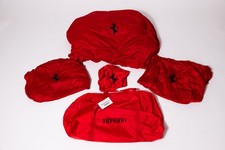
2015-17 Ferrari F12 TDF OEM Satin Indoor Car Cover F152 088139600 $1339.50
|
|
|
Shopping Cart  |

|
Recently Viewed |
|
Latest Items |
|
Facebook |
Secure Websites

|
