When you click on links to various merchants on this site and make a purchase, this can result in this site earning a commission. Affiliate programs and affiliations include, but are not limited to, the eBay Partner Network.
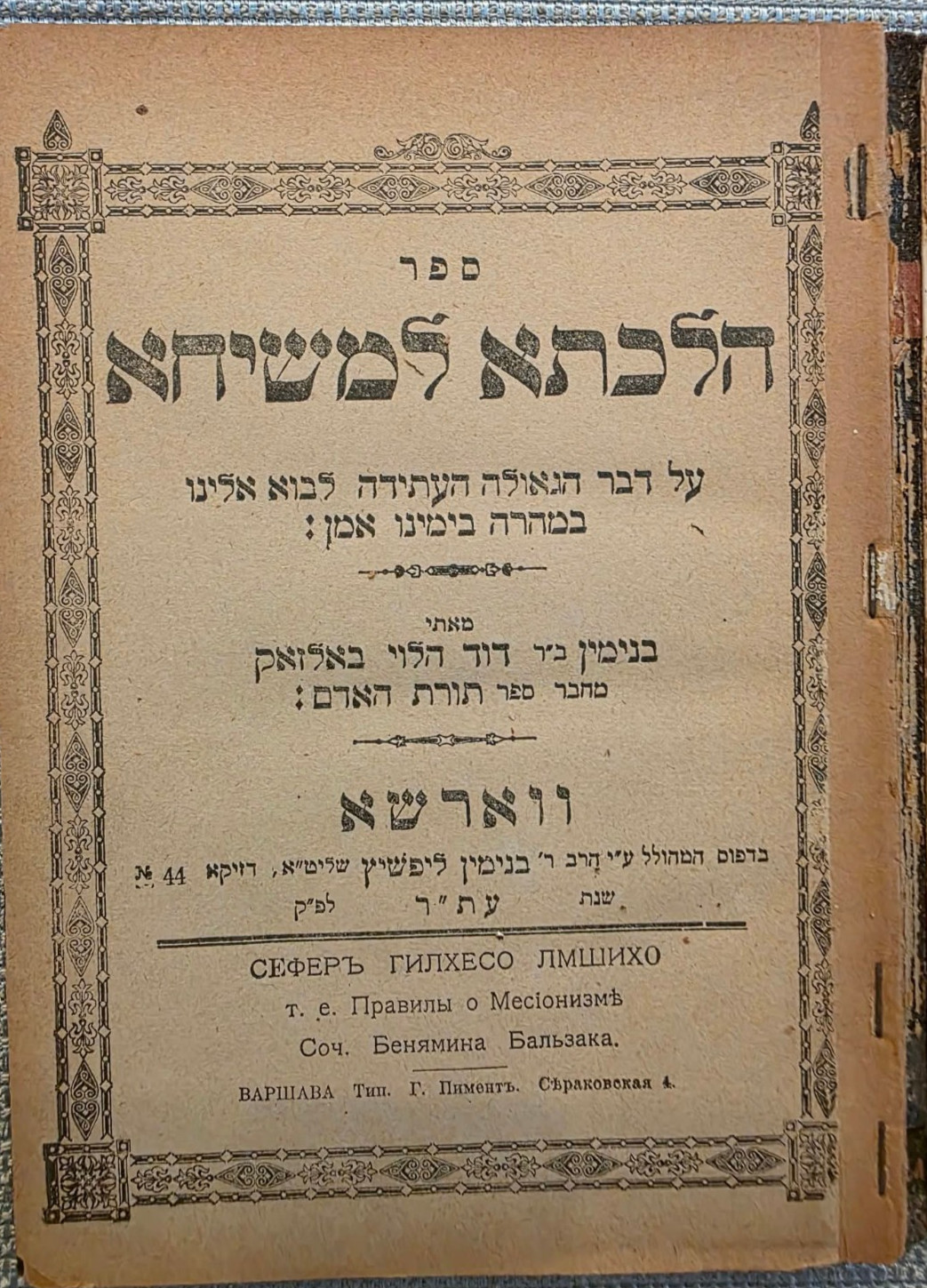
Hilcheta Li-Meshicha (הלכתא למשיחא), by Rabbi Benjamin ben David Ha-Levi Balzak, an Orthodox rabbinic scholar and author who was later a rabbi in Chicago. Warsaw: Benjamin Lipschitz Press, 1910 (תר\"ע). 70 pages.
An exceptionally interesting primary source for the history of Orthodox attitudes toward Zionism. Written almost four decades before the establishment of the State of Israel, Balzak sets out to demonstrate from Tanakh, Talmud and traditional rabbinic sources that Jews are religiously obligated to take practical action toward their national restoration in the Land of Israel rather than passively await miraculous redemption.
Balzak explicitly confronts the opposition of prominent Orthodox rabbis to the Zionist movement and argues that Zionism itself represents the practical beginning of the future Redemption. He describes participation in the movement as a “sacred obligation” incumbent upon the Jewish people.
Particularly noteworthy is Balzak\'s printed acknowledgment to the prominent Zionist leader Dr. Yechiel Tschlenow of Moscow, whom he thanks for contributing financially toward the publication of the book.
Balzak was an unusual international rabbinic author and polemicist whose career took him through Russia and Poland, England, Canada and the United States; he was subsequently identified as a rabbi in Chicago. His writings engaged Christianity, Jewish identity and the religious meaning of Zionism.
Both this work and Balzak\'s Torat Ha-Adam were printed by Benjamin Lipschitz in Warsaw in 1910, despite Balzak\'s later American rabbinic career—an interesting example of the continuing importance of Eastern European Hebrew printing to Jewish intellectual life in the early twentieth century.
COMPLETE: 70 pages.
Condition: Poor/fair, but complete. Original paper is heavily age-toned and extremely brittle, with chipping, tears and weakness particularly at the gutters and edges. Old binding with crude staple repairs and exposed/weak inner structure. Pages must be handled with considerable care. Please examine photographs closely. Sold as an important and scarce historical item rather than as a fine-condition copy.