When you click on links to various merchants on this site and make a purchase, this can result in this site earning a commission. Affiliate programs and affiliations include, but are not limited to, the eBay Partner Network.
9” x 12.75”
40 Pages
8.5” x 11” Boycott George Bush flyer stapled inside 2 Staples on Top
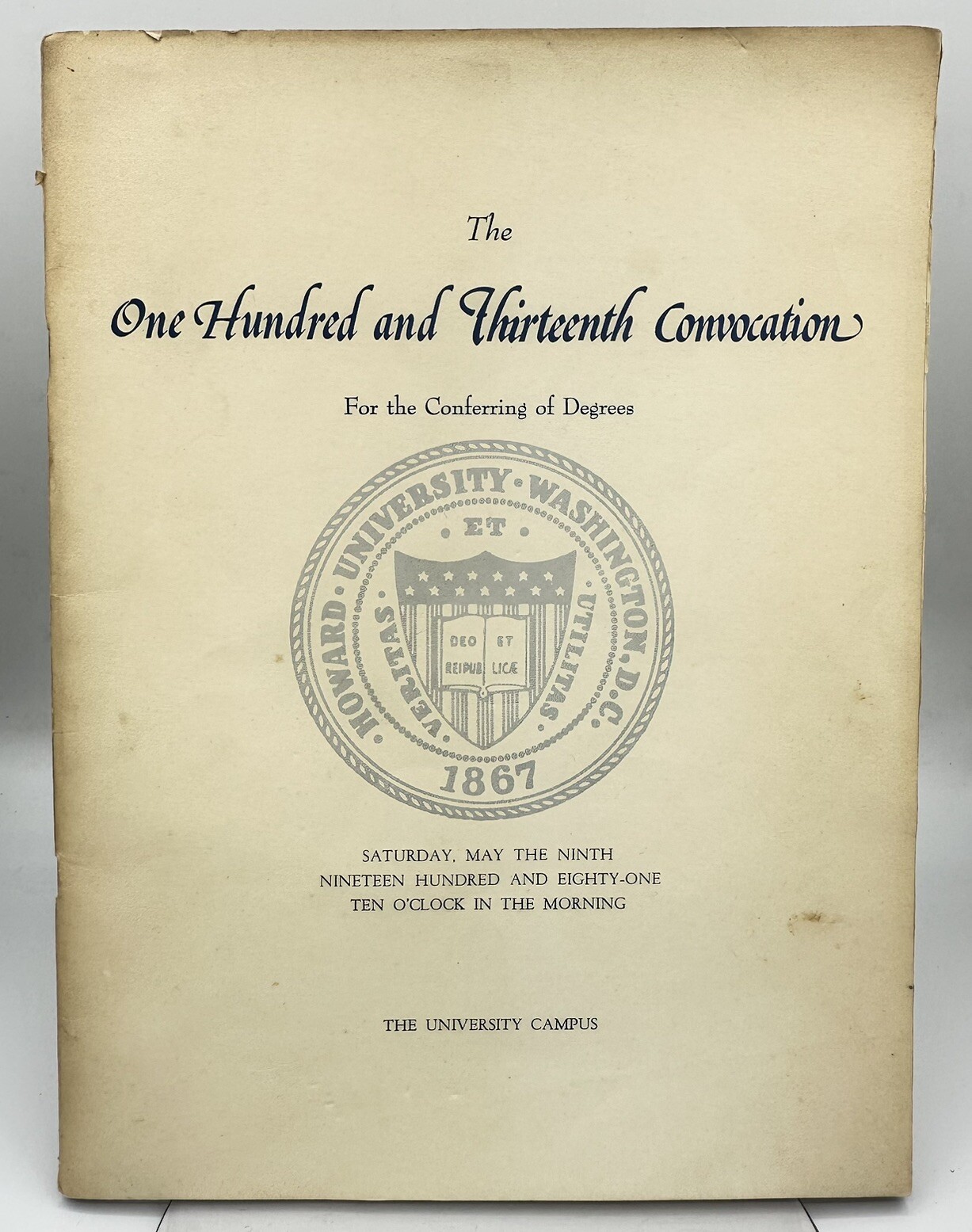
The product is a Howard University 1981 Commencement Graduation Program featuring a flyer for a boycott of George Bush. This original piece of historical memorabilia from the United States showcases the theme of Colleges & Universities, providing a glimpse into the graduation ceremony at Howard University in 1981. The program is a unique collectible item that offers a fascinating glimpse into the social and political climate of the time, with the added inclusion of a flyer related to a boycott against Bush adding an extra layer of significance to this piece.
Howard University
Howard University is a private, historically black, federally chartered research university in Washington, D.C., United States. It is classified among "R2: Doctoral Universities – High research activity" and accredited by the Middle States Commission on Higher Education.[8]
Howard University
Motto
Veritas et Utilitas
Motto in English
"Truth and Service"
Type
Private federally chartered historically black research 2, 1867; 157 years ago
Endowment
$865.3 million (2023)[1]
President
Ben Vinson III
Provost
Anthony Wutoh[2]
Students
12,941 (spring (spring (spring District of Columbia, United States
Campus
Large City,[6] 300 acres (1.2 km2)
Newspaper
The Hilltop
Colors
Blue
Red
Gray[7]
Nickname
Howard Bison and Lady Bison
Sporting affiliations
NCAA Division I FCS – MEACNEC
Mascot
Bison
Established in 1867, Howard is a nonsectarian institution located in the Shaw neighborhood.[9] It offers undergraduate, graduate, and professional degrees in more than 120 programs.
Founders Library is an iconic building on the Howard University campus that has been declared a National Historic Landmark.
The 256-acre (1.04 km2; 0.400 sq mi) campus, often referred to as "The Mecca", is in northwest Washington, D. C.[56] Major improvements, additions and changes occurred at the school in the aftermath of World War I. New buildings were built under the direction of architect Albert Cassell.[57][56]
Howard University has several historic landmarks on campus, such as Andrew Rankin Memorial Chapel, Frederick Douglass Memorial Hall, and the Founders Library.
The Howard University Gallery of Art was established by Howard's board of trustees in 1928. The gallery's permanent collection has grown to over 4,000 works of art and continues to serve as an academic resource for the Howard community.
Frederick Douglas Memorial Hall
Howard University has eight residence halls for students: Drew Hall (freshmen), College Hall North (freshwomen), The Harriet Tubman Quadrangle - "Quad" (freshwomen), Cook Hall (freshmen), Bethune Annex (co-ed, continuing students), Plaza Towers West (co-ed, continuing students), College Hall South (co-ed, continuing students), The Axis (co-ed, continuing students), Mazza Grandmarc (co-ed, continuing students), WISH-Woodley Park (co-ed, continuing students) and Plaza Towers East (co-ed, continuing students).
Howard University Hospital, opened in 1975 on the eastern end of campus, was built on the site of Griffith Stadium, in use from the 1890s to 1965 as home of the first, second and third incarnations of the MLB Senators, as well as the NFL's Washington Redskins, several college football teams (including Georgetown, GWU and Maryland) and part-time home of the Homestead Grays of the Negro National League.
Howard University is home to the commercial radio station WHUR-FM 96.3, also known as Howard University Radio. A student-run station, WHBC, operates on an HD Radio sub-channel of WHUR-FM. HUR Voices can be heard on SiriusXM Satellite Radio. Howard is also home to the public television station WHUT-TV, located on campus next to WHUR-FM. WHUR-FM became the birthplace of the quiet storm late-night radio format via its student intern Melvin Lindsey in 1976, named after a Smokey Robinson song and album, both titled "Quiet Storm" and "A Quiet Storm", respectively.