When you click on links to various merchants on this site and make a purchase, this can result in this site earning a commission. Affiliate programs and affiliations include, but are not limited to, the eBay Partner Network.
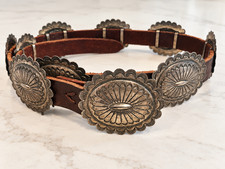
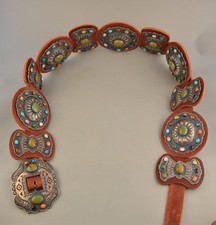
This Vintage stunning concho belt has been exquisitely crafted by Navajo silversmith Kirk Smith. This is a large belt is measures 41 inches long and weighs 1.49 lbs. The sterling silver conchos have raised repousse with handstamping and are set with colorful semiprecious stones. The belt is signed with Kirk\'s KS hallmark and marked sterling. This belt is in great vintage condition ..some of the large turquoise stones are a little loose from age but are secure in there settings ..Total length 41\"From buckle prong to first hole = 34\" / second hole = 35.5\"Oval Conchos = 2 3/4\" x 3\" (with leather 3 1/8\" x 3 1/2\")Butterfly Conchos = 2 3/4\" x 2\" (with leather 3\" x 2 3/8\")Buckle = 3 3/4\" x 3\"
Kirk Smith (1957–2012) was a highly acclaimed, master Navajo (Diné) silversmith renowned for his heavy, traditional sterling silver jewelry. He was best known for his \"old pawn\" style, utilizing deep stamp work, sand casting, and high-grade, premium gemstones like turquoise, red coral, and lapis lazuli. Because of his tragic passing in 2012, his authentic, hand-signed pieces have become highly collectible and valuable investments.
Throughout the 40 years that I have been in business, I have purchased jewelry from pawn shops throughout the Southwest that had collections of dead pawn. Most of these pawn shops and trading posts are now closed. The Native American would pawn his jewelry for immediate cash. The shop would hold it and charge interest until he could reclaim it. Dead pawn are the pieces that were never retrieved. Old Pawn Jewelry typically dates from the early 1900s to the 1970s. Most of the early pieces are not signed because it wasn\'t the Native American tradition to sign the pieces they crafted. Also, the turquoise in old pawn is turquoise that you can\'t get anymore because many of the mines have closed. And, the red and orange coral is rare because of the coral bleaching which is happening today.