When you click on links to various merchants on this site and make a purchase, this can result in this site earning a commission. Affiliate programs and affiliations include, but are not limited to, the eBay Partner Network.
At DiligentiaGraphsour focus is to source out the best, authentic items and give you expedient andjust service. Our goal is to deliver a five-star experience through promptshipping and communication. Thank you for viewing our sale and feel free toask any questions.
The items for saleare to honor the veterans who served our nation and to expose their storieswhich might otherwise be lesser known.
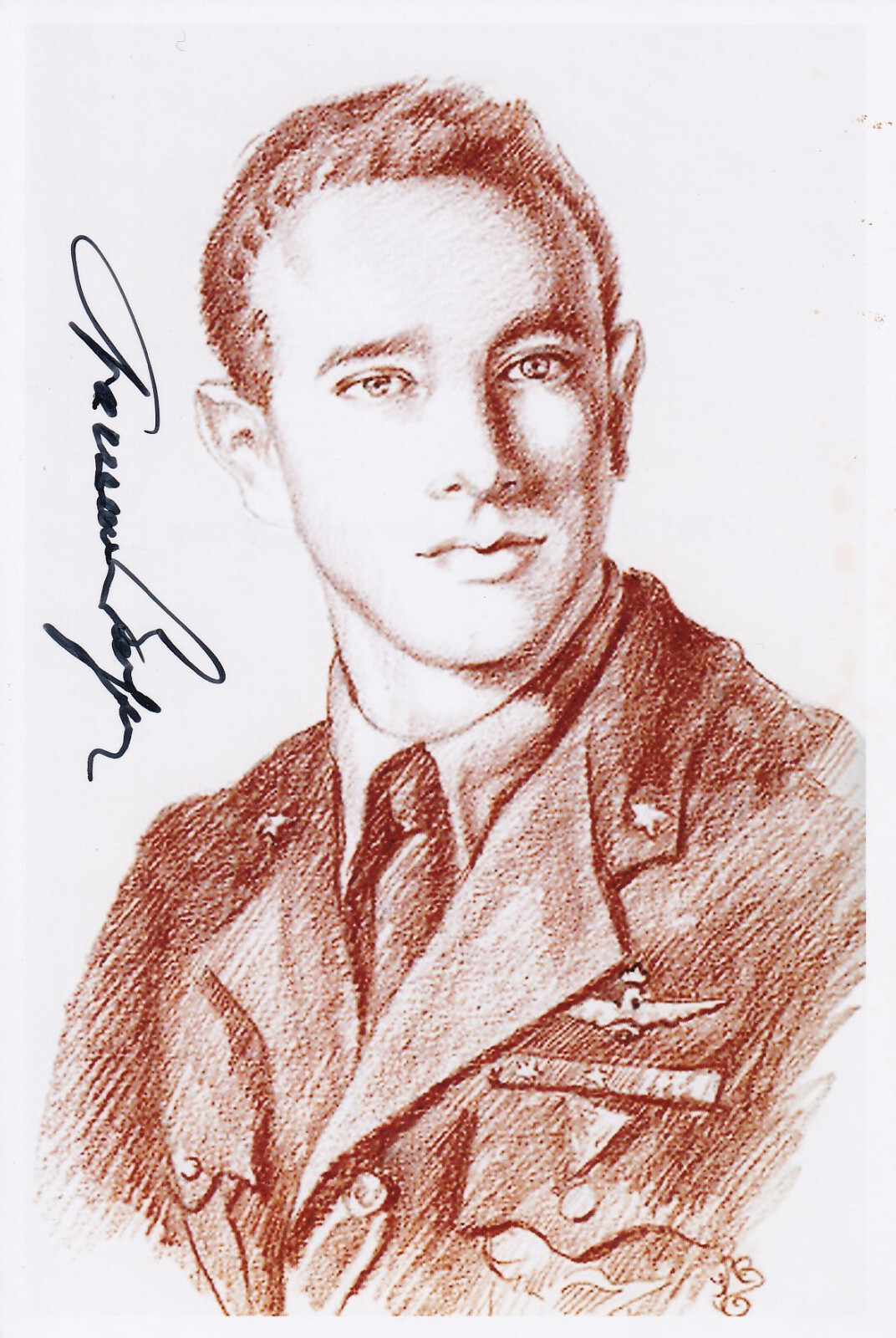
Hand signed 4x6 inch photo by World War II vet, Luigi Gorrini. Mr. Gorrini
was an Italian World War II fighter pilot in the RegiaAeronautica and in the Aeronautica Nazionale Repubblicana. During the conflict,he flew with the Corpo Aereo Italiano (CAI, Italian Air Corps) during theBattle of Britain, fought over Libya and Tunisia, and was involved in thedefence of the Italian mainland. Gorrini is believed to have shot down 19Allied planes (24 according to some sources), and damaged another 9, of severaltypes: Bristol Beaufighter, Bristol Blenheim, Curtiss P-40, Spitfire, P-38Lightning, P-47 Thunderbolt, B-17 Flying Fortress and B-24 Liberator. Hepiloted the biplane Fiat C.R.42 and monoplanes Macchi C.202 and C.205 Veltro.With the Veltro he shot down 14 Allied planes and damaged six more. At the timeof his death, he was the only surviving fighter pilot awarded the Medagliad\'Oro al Valor Militare (Gold Medal of Military Valor).
North Africa and Greece Bristol Beaufighter Mk 1, NorthAfrica - The first aircraft shot down by Gorrini was one of the first BristolBeaufighters that arrived in North Africa. A Fiat CR.42 in Regia Aeronauticaservice. Flying this nimble biplane, Gorrini scored his first victory on 16April 1941, over Derna, in Cyrenaica.
Gorrini came to North Africa as a member of 85a Squadrigliaof 18° Gruppo C.T.. He shot down his first aircraft on 16 April 1941, overDerna, in Cyrenaica, Libya. While flying a CR.42 during a solo protectionsortie, he intercepted two of the Bristol Beaufighters that had just arrived inthe Mediterranean Theatre. Gorrini opened fire immediately before the twoBritish aircraft reached the airstrip N 1 on Ftheja, where his 85ª Squadrigliawas based. He shot the leading aircraftfrom a distance of 700-800 meters, landing hits on the right wingtip. While thesecond Beaufighter was taking evasive action, Gorrini closed to a distance of250 meters hitting the first Bristol again. The British aircraft was by nowvery near to the Italian airstrip, so Gorrini strafed it a third time and theBeaufighter crashed just south of the airstrip. [4] He was credited with a killand a damaged and shot 1,100 rounds.
On 29 May, Gorrini intercepted two Blenheim bombers overBenghazi. He shot down one that fell just outside the city and shot all hisremaining ammunition at the other Blenheim that managed to escape. Repatriated with his unit, on 29 August he wason Caselle Torinese airfield to start the training on the new monoplanefighters, the Fiat G.50 and Macchi C.200. Gorrini and the rest of 18° Gruppo movedlately on Mirafiori base and then to Ciampino Sud airfield, where the trainingon the G.50 and the C.200 came to an end on 10 December when his Gruppo flewwith Macchi C.200s to Lecce and then to the new base of Araxos, in Greece.During the winter of 1941-42, he escorted convoys between Italy and Greece. On17 December, in the air space around Argostoli port, in Kefalonia island,Gorrini intercepted two Bristol Blenheims, painted in black. He attacked theleading aircraft, hitting it repeatedly and then strafed the second. The twoaircraft disappeared in the clouds and Gorrini was credited with a\"probable\" and a \"damaged\". Gorrini had no other chance toclash with the enemy and he flew back to Italy with his Gruppo, on 25 April1942. Back in Italy, Gorrini and his fellow pilots were trained to fly theC.200 as a fighter bomber until mid-July. On 23 July, the 18° joined the 23°Gruppo on Abu Haggag base, in North Africa. There, Gorrini flew protectionsorties for Axis ships and ground-attack missions. In October the 4° Stormo wasmoved back, it delivered his Macchi C. 202s to the 3°Stormo. \"At last,with the Macchi 202 we had a competitive plane.\" On 2 January 1943, thewhole 3° Stormo, now equipped with Macchi C.202s, took off to face twoformations of Douglas DB.7 Bostons and B-25 Mitchells, escorted by Spitfiresand P-40s. In the ensuing dogfight, Gorrini shot down an R.A.F. Curtiss P-40EKittyhawk, that fell west of Sirte. He then damaged a Spitfire that wasattacking another Macchi. Gorrini shot 880 bullets, but his aircraft had beenhit: there were 12 holes in his fuselage. Nine days later, the whole 18° Gruppowas escorting C.200 fighter-bombers in action on British airfields in Uadi (orWadi) Tamet area. Gorrini shot down a 92 RAF Squadron Spitfire and he damagedanother from the squadron of the British ace Flying Officer Neville Duke,shooting 688 12.7mm bullets. His Gruppo was often tasked to strafe theadvancing Allied columns or to escort German bombers. On the morning of 26February 1943, he took off from El Hamma, to escort, with other pilots of hisSquadriglia, Stukas attacking Allied armoured forces in Ksar Ghilane (an oasisof southern Tunisia located on the eastern limit of the Grand Erg Oriental),then he strafed the enemy troops. In the afternoon, on Kebili, with tenenteMelis and two other fellow pilots, he intercepted four Allied aircraft. Gorriniclaimed a Hawker Hurricane IID, armed with 40mm Vickers cannons. But this washis last air battle in Africa. His irritating eye injury was worsening. He wasgrounded and subsequently, at the end of February, hospitalised in Sfax. Hereturned to Italy in late March 1943.
Defence of Rome
When Gorrini recovered, he was posted as a flying instructorto 3° Gruppo C (Complementare), based at Venaria Reale airfield. Later, Gorriniserved as a ferry pilot to transfer captured French Dewoitine D.520 fightersfrom France to Italy, for Italian home defence. \"I have collected severaldozen Dewoitine from various French airfields and the Toulouse factory\",he recalled later. \"At the time, when we were still flying the MacchiC.200, it was a good, if not very good, machine. Compared to the Macchi 200, itwas superior only in one point - its armament of the Hispano-Suiza HS 404 20mmcannon.\" Gorrini, who had, by February 1943 achieved four confirmedvictories and one unconfirmed, was given, at the beginning of the summer of1943, one of the three Macchi C.205 Veltro assigned to the 3° Stormo as aspecial favour (the other two were allotted to the ace Tenente Franco BordoniBisleri and to Maresciallo Guido Fibbia). During the summer of 1943, in defenceof Italy, he claimed 11 enemy aircraft. On 19 July, during a single sortie westof Rome, Gorrini destroyed a four-engined Consolidated B-24 Liberator bomberand a Lockheed P-38 Lightning (another P-38 was damaged). The next day, heclaimed another P-38 destroyed and a P-38 damaged. On 25 July Benito Mussolinihad been overthrown, but this had no decisive effect on the morale of the RegiaAeronautica. Gorrini recalled: \"After 25 July, despite the arrest ofMussolini, the morale of my unit, 85a Squadriglia and my personal readiness foraction remained high. Despite all the reverses that Italy had suffered by thetime, our 3° Stormo was the only one still fully ready for combat: my sectionwas detailed to defend Rome. The larger part of the Regia Aeronautica wasuninterested in politics or parties, they were men infatuated with flying anddetermined to defend the land of their birth and to give their lives ifnecessary in the attempt to stop the bombing of Italian towns.\"
On 13 August, Gorrini claimed a B-24 off the coast at Ostia,in the Lazio region, but he was also shot down by defensive fire from thebomber, bailing out safely. He claimed a Spitfire on 26 August. The next day,the whole Stormo scrambled to intercept four-engine bombers which wereattacking Cerveteri, on the Latium coast in central Italy. Gorrini, stillflying a Veltro, shot down two Boeing B-17 Flying Fortresses and a Lockheed P-38Lightning in a single engagement (according to other sources, Gorrini claimedtwo B-24s). One wing of his C.205 was damaged after an overheating cannonmuzzle exploded. After running out of gasoline, he glided back to his base fora powerless landing. On 29 August, he claimed two P-38s destroyed and two moredamaged.
On 30 August, Gorrini claimed another B-17 Flying Fortressover Frascati and the same day he was mentioned on Bollettino di Guerra:\"Sergente Maggiore Luigi Gorrini da Alseno (Piacenza) of 3° Stormo Cacciahas distinguished himself during the aerial battles of the 27th and 29th,during which he has shot down two four-engined bombers and a twin-enginedfighter.\" On 31 August, 85a Squadriglia, with Gorrini in a C.205V, tookoff from Palidoro airfield (Rome) at 12:00, flying in the direction of Naplesto engage enemy bombers. At 8,500 meters the Squadriglia clashed with escortingSpitfires with 85a claiming three Spitfires destroyed and five damaged duringthis combat. Gorrini shot down one Spitfire (his 15th air victory) and damageda P-38, but his aircraft was badly hit by machine gun fire and he made a forcedlanding away from his airfield at 12:50. Gorrini was seriously wounded andhospitalised. He was out of the fighting when Italy surrendered to the Allieson 8 September 1943. During three years of combat service, Gorrini was involvedin 132 air battles, was credited with 15 confirmed air victories, was woundedtwice, crash-landed once and bailed out once, was mentioned in dispatchesseveral times, and was decorated two times.
Shipping is donewithin 24 hours of received payment. We ship our items in 6X9 envelopes, sentfirst class with tracking and well packed. We do our best to accommodatespecial shipping requests as needed.
We do accept returnswithin 14 days that has been communicated and approved. We have a 15% fee onitems that are restocked and do pay for return shipping. Refunds are given onceitems are returned in original condition.
On all of our solditems we donate a percentage of profits to the Wounded Warrior project and toWorld War II museum in New Orleans, LA.