When you click on links to various merchants on this site and make a purchase, this can result in this site earning a commission. Affiliate programs and affiliations include, but are not limited to, the eBay Partner Network.
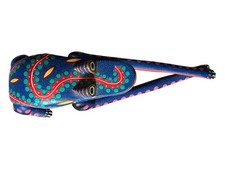
Pedro Ramirez Wooden Hand-Painted Stylized Frog 14\"L x 4.5\"W x 4.5\"H.
This is an authentic Oaxacan wood carving, a world-renowned style of Mexican folk art commonly referred to as an Alebrije.
* Item Type: Hand-carved and hand-painted zoomorphic folk art sculpture. It depicts a stylized frog with dramatically elongated legs.* Artist / Maker: Pedro Ramírez, a respected artisan from the pioneering generation of Oaxacan woodcarvers. The bottom of the piece features his distinct signature: \"Pedro Ramirez, Arrazola Xoxo, Oaxaca\".
* Origin: The village of San Antonio Arrazola, often abbreviated as \"Arrazola Xoxo\"), located in the municipality of Santa Cruz Xoxocotlán. Arrazola is celebrated as the absolute cradle and birthplace of wooden alebrijes.* Age: Likely vintage, originating between the 1980s and 1990s. This period corresponds to the global boom in Oaxacan wood carving popularity and aligns with Pedro Ramírez\'s primary body of work.
CONDITION: Excellent - Like New, no scratches scuffs, cracks, or other damage.
Visual Features & Materials
* Material: Hand-carved from a single piece of local copal wood (Bursera glabrifolia). Copal is the traditional material choice because it is naturally soft when green, enabling fluid lines and smooth carving.* Painting Style: The piece is painted with vibrant acrylics. It utilizes a bold cobalt blue base coat topped with a secondary layer of intricate dotting, multi-colored striping, wave motifs, and polka dots in contrasting hues of hot pink, mint green, red, and yellow.* Anatomy: Features protruding, stylized eyes, an exaggeratedly long mouth line, and uniquely extended front legs that cross over one another.Facts of Interest* The Origin Story: While the term alebrije originally applied to paper-mâché dream monsters invented by Pedro Linares in Mexico City during the 1930s, legendary Arrazola carver Manuel Jiménez adapted the concept to local wood carving in the mid-20th century. Pedro Ramírez worked alongside this lineage as one of the village\'s original recognized carvers.* Shape-Shifting Beliefs: In Oaxacan culture, these creatures are heavily tied to the concept of Nahuales—mythological spirit guides or shape-shifters that bridge the human and animal worlds.* Natural Movement: True to the style of early Arrazola master carvers, the natural curves, knots, and twists of the copal tree branches are intentionally left to dictate the whimsical, fluid movement of the final animal.
At 14 inches long, this is considered a large and substantial piece for Oaxacan folk art. Large scale authentic, signed alebrijes are extremely rare because finding flawless copal wood branches of that size is difficult, and the time required to carve it.