When you click on links to various merchants on this site and make a purchase, this can result in this site earning a commission. Affiliate programs and affiliations include, but are not limited to, the eBay Partner Network.
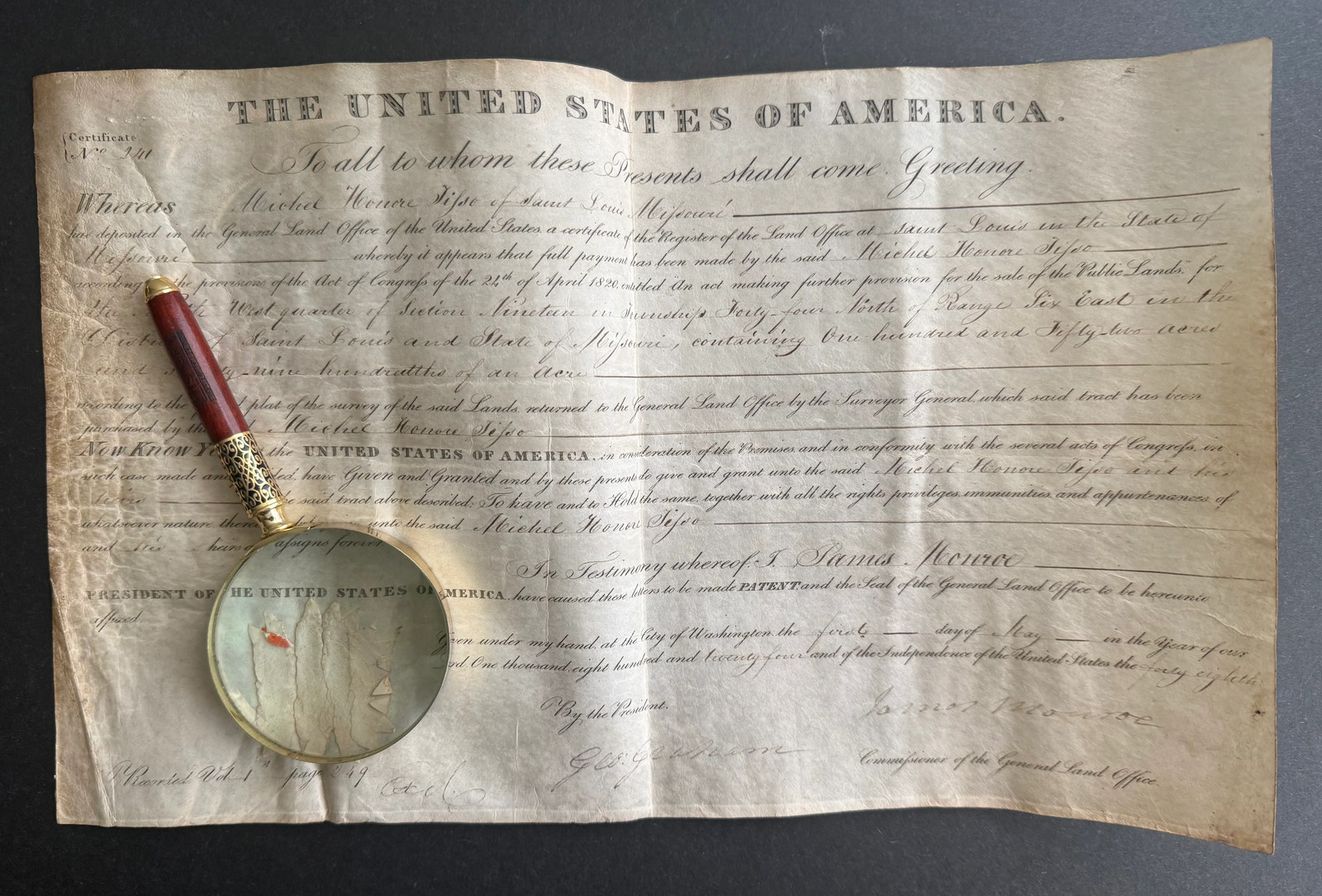
Issued at Washington on May 4, 1824, the document records that Michel Honoré Siffo had deposited a certificate from the federal land office at St. Louis showing full payment for the tract. The United States consequently granted him:
The northwest quarter of Section Nineteen, in Township Forty-four North, of Range Six East, in the district of lands offered for sale at St. Louis, Missouri, containing 152.09 acres.
The patent was issued pursuant to the important Land Act of April 24, 1820, which ended the federal credit system for public-land purchases, reduced the minimum price of government land and encouraged westward settlement through cash sales.
The document bears the faded but identifiable signature “James Monroe” as president and is countersigned George Graham as commissioner of the General Land Office. Graham was a Virginia soldier, lawyer and government official who served as acting secretary of war before becoming commissioner of the General Land Office in 1823.
James Monroe, the fifth president of the United States, was the last president of the Revolutionary generation. His administration witnessed the acquisition of Florida, the Missouri Compromise and the declaration of the Monroe Doctrine. This patent was signed during the final year of his presidency and documents the rapid settlement of newly admitted Missouri.
The document possesses considerable visual presence, headed in large engraved letters “THE UNITED STATES OF AMERICA” and completed throughout in elegant manuscript. It represents both an authentic artifact of early American westward expansion and a presidential document associated with one of the principal statesmen of the founding era.
Condition: Original folds, overall toning, wrinkling, scattered staining and handling wear, with small edge tears and heavier deterioration along the left side. The General Land Office seal is faded and partly deteriorated. President Monroe’s signature is faint but remains identifiable; George Graham’s signature is also present. Please examine the photographs carefully.