When you click on links to various merchants on this site and make a purchase, this can result in this site earning a commission. Affiliate programs and affiliations include, but are not limited to, the eBay Partner Network.
A Glowing Peacock-Teal Survivor from an Early American Pen Pioneer
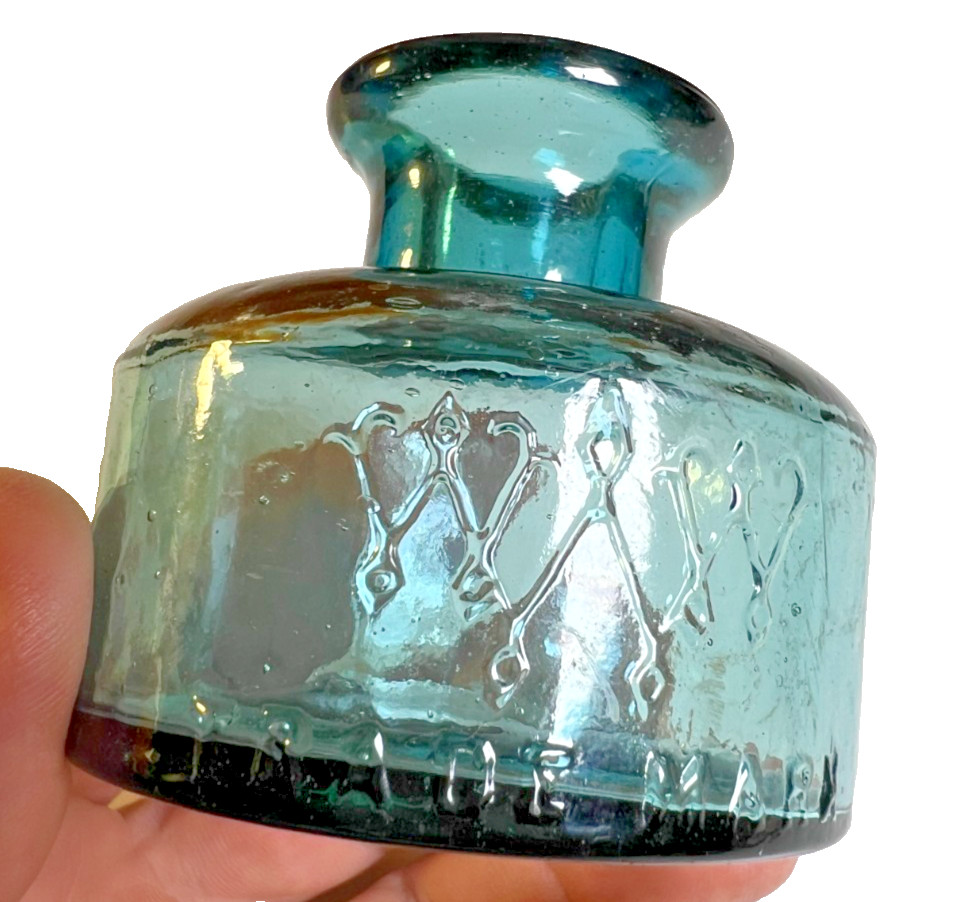
At barely over two inches tall, this remarkable little ink bottle contains an outsized amount of history, color and personality.
Blown in a spectacular peacock teal/light Prussian blue, the bottle almost seems illuminated from within. Its thick flared mouth and heavy heel concentrate the color into deep blue-green bands, while the thinner portions sparkle turquoise when held to the light.
The front carries the wonderfully elaborate intertwined:
WWW / TRADE MARK
This once-mysterious emblem has been identified through surviving labeled examples and specialized Rhode Island bottle research as the trademark used on ink supplied by Charles W. Livermore’s Stylographic Pen Company of Providence, Rhode Island.
Charles W. Livermore’s Stylographic Pen Company
Charles W. Livermore was more than a stationer putting his name on bottled ink. He was an inventive manufacturer and an important participant in the earliest successful development of the American reservoir pen.
The company manufactured stylographic pens, an early form of fountain pen that delivered ink through a hollow tubular point regulated by a fine internal wire. These pens were predecessors to the more familiar nibbed fountain pens that came to dominate the writing market.
Livermore received a Medal of Excellence from the American Institute in 1879 for his stylographic pens. By the early 1880s, his business was reportedly selling pens extensively in the United States and overseas, with agencies or branches serving New York, Boston, Chicago and London.
Despite those far-reaching sales operations, the company’s manufacturing center was in Providence.
Providence directories for 1886 and 1887 identify:
Charles W. Livermore
Stylographic Pen Company
44 Arnold Street
Providence, Rhode Island
The Providence factory was described in 1885 as a four-story brick building near the corner of Arnold and Brook Streets. Livermore died in Warwick, Rhode Island, in 1889, and the subsequent fate of his pen-making business is uncertain. Documented Livermore company history
Precise Date: Circa 1886–1888
The most defensible date for this bottle is:
Circa 1886–1888
A single working date of circa 1887 is appropriate for the listing.
Its mold-blown construction, smooth base, hand-tooled flared mouth, irregular surface and numerous tiny seed bubbles are entirely consistent with late-19th-century American commercial glassmaking.
sale specialists have cataloged surviving labeled examples of this design as “W W W / Trade Mark” ink bottles, broadly dating the form to 1870–1890. More focused Providence directory research permits the tighter circa-1887 attribution for bottles associated with Livermore’s documented Arnold Street operation.
The Correct Reading Is WWW
The ornate Victorian emblem can initially resemble two interlaced W’s, but examination of documented examples confirms that it represents:
WWW
Surviving labeled bottles establish the connection between this unusual trademark and the Stylographic Pen Company of Providence. A Rhode Island bottle specialist also identifies WWW bottles in several sizes and describes the smallest version as particularly elusive. Rhode Island bottle research
This example appears to be that desirable smallest-size variant.
What It Originally Contained
The bottle originally held writing ink intended for Livermore’s stylographic pens and other contemporary writing instruments.
Its squat, broad body made it exceptionally stable on a writing desk. The tall central neck and wide, flared mouth allowed the pen to be filled or dipped while helping the user control excess ink.
This was an important moment in writing technology. The traditional dip pen was still everywhere, but manufacturers such as Livermore were working to free writers from constantly returning their pens to an open inkwell. The stylographic pen carried its own internal ink supply, making it one of the practical ancestors of the modern fountain pen.
The ink bottle therefore represents both an everyday desk accessory and a surviving artifact from the early development of portable writing technology.
Extraordinary Peacock-Teal Glass
The bottle’s most immediately arresting feature is its color.
Depending upon the illumination, the glass displays shades of:
- Peacock teal
- Light Prussian blue
- Rich turquoise
- Deep blue-green
- Emerald-toned teal through the heaviest glass
The exceptionally thick mouth and heel create nearly jewel-like bands of saturated color. Numerous tiny seed bubbles, surface rippling and subtle irregularities provide the wonderful character expected from hand-finished American glass of the period.
Ordinary examples are encountered in aqua. This richly colored version possesses considerably greater display presence and collector appeal.
Measurements
Approximately:
2 1/4 inches wide × 2 1/8 inches tall
A wonderfully compact and highly displayable bottle.
ConditionExcellent Condition
- No chips
- No cracks
- No haze
- Bright, clean and shiny
- Strong, legible embossing
- Excellent original surface and glass character
- Numerous naturally occurring seed bubbles and manufacturing irregularities
The bottle has not been artificially altered to create its color. Please examine all photographs closely, as they show the mouth, base, embossing, color and condition from multiple angles.
A Rare Intersection of Bottles and Early Pen History
This bottle reaches well beyond the ordinary ink category.
It will appeal to collectors of:
- Early American ink bottles
- Rhode Island and Providence glass
- Antique fountain and stylographic pens
- Victorian writing equipment
- Colorful 19th-century bottles
- Early American trademarks
- Charles W. Livermore material
Its elusive WWW trademark, documented Providence attribution, connection to an early pen pioneer and extraordinary peacock-teal color combine to make it a particularly compelling little survivor.
It is difficult to imagine a more attractive two-inch witness to the moment when Americans began trying to carry their ink inside the pen instead of merely beside it.