When you click on links to various merchants on this site and make a purchase, this can result in this site earning a commission. Affiliate programs and affiliations include, but are not limited to, the eBay Partner Network.
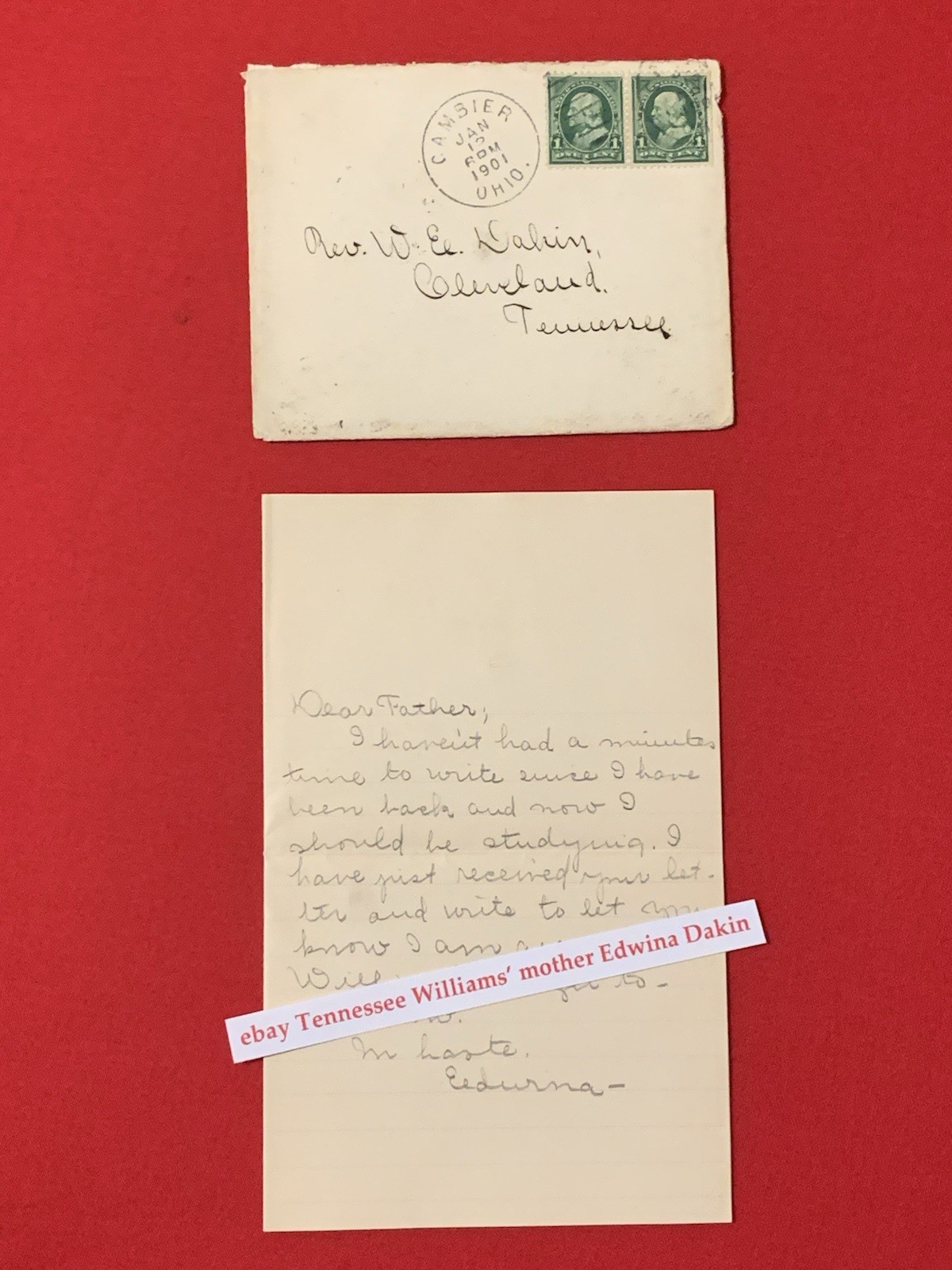
Mother of Tennessee WilliamsWrites Home from College! Own a piece of literary history now! 1 page, handwritten by 25 year-old EdwinaDakin to her parents! January 12, 1901.
Dimensions:4 3/8 x 7.00 inches foldedShipped Priority and Insured
Edwina Estelle Dakin, TennesseeWilliams’s mother, was born in Marysville, Ohio in 1874 toReverend Walter Edwin Dakin and Rose Dakin. Although the Dakin familyfrequently moved from Ohio to Tennessee to Mississippi, Edwina adapted to thesechanges with grace and enthusiasm. She attended Tennessee Female College inCleveland, a high school for young women, where she performed in several playssuch asBachelor’s Dream. She longed for a career as a professionalactress but stated in her memoir, “ladies in those days were not allowed suchcareers except in amateur form.” That being so, she performed only in amateurtheatricals and used her natural beauty and refined manners to cultivate a“Southern belle” image that attracted many admirers. According to Donald Spotoin his autobiography of Tennessee Williams,The Kindness of Strangers:
Her greatest performance was perhaps thatof the archetypal “Southern belle,” a role the Ohio-born Edwina played so wellthat it finally became her life; with a convert’s fervor, she more than adaptedto her Southern homes and habits—she virtually erased from her speech andmanner anything that was not appropriate to the Southern Victorian maiden. (6)
Edwina was the quintessential “Southern belle”; flirtatious yetprim, she enjoyed a busy social calendar of innocent dances, buggy rides, andparties with her many beaus. These young men asked her to go steady and a feweven proposed marriage, but she was uninterested in a serious relationship.Before the age of 21, the well-loved minister’s daughter had entertained dozensof gentlemen callers and made two debuts. She noted in her memoir,
My double debut occurred when each of twosisters asked me to “come out” with her. I met Vicksburg society first withClara Moore and again, the following year, when her sister Elise wrote, ‘I’dlike you to make a debut with me now.’ (175)
As an official member of debutante society, Edwina enjoyed thestatus of being known as an elegant, polite, and mature woman of marriageableage. However, it was her performance in a 1906 charity production of theGilbert and Sullivan operettaThe Mikadothat changed her lifedramatically. Cornelius Coffin “C.C” Williams witnessed her eye-catchingperformance in the musical number “Three Little Girls Are We,” whereupon heasked her on a date. During their courtship she developed typhoid fever andmalaria, and Cornelius sent a bouquet of red roses to her hospital bed everyday and called her every night. Their courtship lasted until June 2, 1907 whenthey married in St. Paul’s Episcopal Church in Columbus, Mississippi.
They honeymooned and began their lives as newlyweds in Gulfport,Mississippi where Cornelius worked for a telephone company. This was a happytime, recalled Edwina, “We enjoyed life there, sometimes going out to dance,sometimes playing cards, sometimes chaperoning young couples on moonlight boatparties to Ship Island.”
When the honeymoon period ended, Edwina found herself pregnantfor the first time. Disillusioned by marriage and unhappy with Cornelius, shereturned home to her parents in Columbus. On November 19, 1909, she gave birthto Rose Isabel Williams. During this time Cornelius was making occasionalvisits to his wife, but Edwina felt estranged from her husband. Nevertheless,she found herself pregnant again in 1910 and gave birth to Thomas LanierWilliams (Tennessee Williams) on March 26, 1911. Eight years later, afterCornelius uprooted the family and moved them to St. Louis, Edwina gave birth totheir last child, Walter Dakin (known as Dakin).
Thomas Lanier Williams III(March26, 1911 – February 25, 1983), known by his pen nameTennessee Williams,was an American playwright and screenwriter. Along with contemporariesEugeneO\'NeillandArthur Miller,he is considered among the three foremost playwrights of 20th-century Americandrama.
At age 33, after years of obscurity, Williams suddenly becamefamous with the success ofThe Glass Menagerie(1944) in New YorkCity. It was the first of a string of successes, includingA Streetcar Named Desire(1947),Cat on a Hot Tin Roof(1955),Sweet Bird of Youth(1959), andThe Night of the Iguana(1961).With his later work, Williams attempted a new style that did not appeal aswidely to audiences. His dramaA Streetcar Named Desireisoften numbered on short lists of the finest American plays of the 20th centuryalongside Eugene O\'Neill\'sLong Day\'s Journey into NightandArthur Miller\'sDeath of a Salesman.
Much of Williams\'s most acclaimed work has been adapted for thecinema. He also wrote short stories, poetry, essays, and a volume of memoirs.In 1979, four years before his death, Williams was inducted into theAmerican Theater Hall of Fame.
Thomas Lanier Williams III was born inColumbus, Mississippi, of English, Welsh,andHuguenotancestry,the second child of Edwina Dakin (August 9, 1884 – June 1, 1980) and CorneliusCoffin \"C. C.\" Williams (August 21, 1879 – March 27, 1957).[3]Hisfather was a traveling shoe salesman who became an alcoholic and was frequentlyaway from home. His mother, Edwina, was the daughter of Rose O. Dakin, a musicteacher, and the Reverend Walter Dakin, anEpiscopalpriest fromIllinois who was assigned to a parish inClarksdale, Mississippi, shortly afterWilliams\'s birth. Williams lived in his grandfather\'s Episcopal rectory withhis family for much of his early childhood and was close to his grandparents.Among his ancestors was musician and poetSidney Lanier.
He had two siblings, older sister Rose Isabel Williams(1909–1996)and younger brother Walter Dakin Williams(1919–2008).Asa young child, Williams nearly died from a case ofdiphtheriathatleft him frail and virtually confined to his house during a year ofrecuperation. At least partly due to his illness, he was considered a weakchild by his father. Cornelius Williams, a descendant ofEastTennesseepioneers, had a violent temper and was prone to usehis fists. He regarded what he thought was his son\'s effeminacy with disdain.Edwina, locked in an unhappy marriage, focused her attention almost entirely onher frail young son.Critics and historians agree that Williams drew fromhis own dysfunctional family in much of his writingand that his desire tobreak free from his puritan upbringing propelled him towards writing.
When Williams was eight years old, his father was promoted to ajob at the home office of theInternational Shoe CompanyinSt. Louis.His mother\'s continual search for a more appropriate home, as well as hisfather\'s heavy drinking and loudly turbulent behavior, caused them to movenumerous times around St. Louis. Williams attendedSoldan High School, asetting he referred to in his playThe Glass Menagerie.Laterhe studied atUniversity City High School.Atage 16, Williams won third prize for an essay published inSmart Set,titled \"Can a Good Wife Be a Good Sport?\" A year later, his shortstory \"The Vengeance of Nitocris\" waspublished (as by \"Thomas Lanier Williams\") in the August 1928 issueof the magazineWeird Tales.These early publicationsdid not lead to any significant recognition or appreciation of Williams\'stalent, and he would struggle for more than a decade to establish his writingcareer. Later, in 1928, Williams first visited Europe with his maternal grandfatherDakin.