When you click on links to various merchants on this site and make a purchase, this can result in this site earning a commission. Affiliate programs and affiliations include, but are not limited to, the eBay Partner Network.
Exhibiting an Exceptionally Rare Late Roman Riverside Winch & Ratchet Mechanism
A Museum-Tier 4th-Century AD Bloomery Wrought-Iron Lifting and Tension-Locking Machine from the W Field Locus - Industrial & Mechanical Master Reference Collection
Executive Summary & Overview
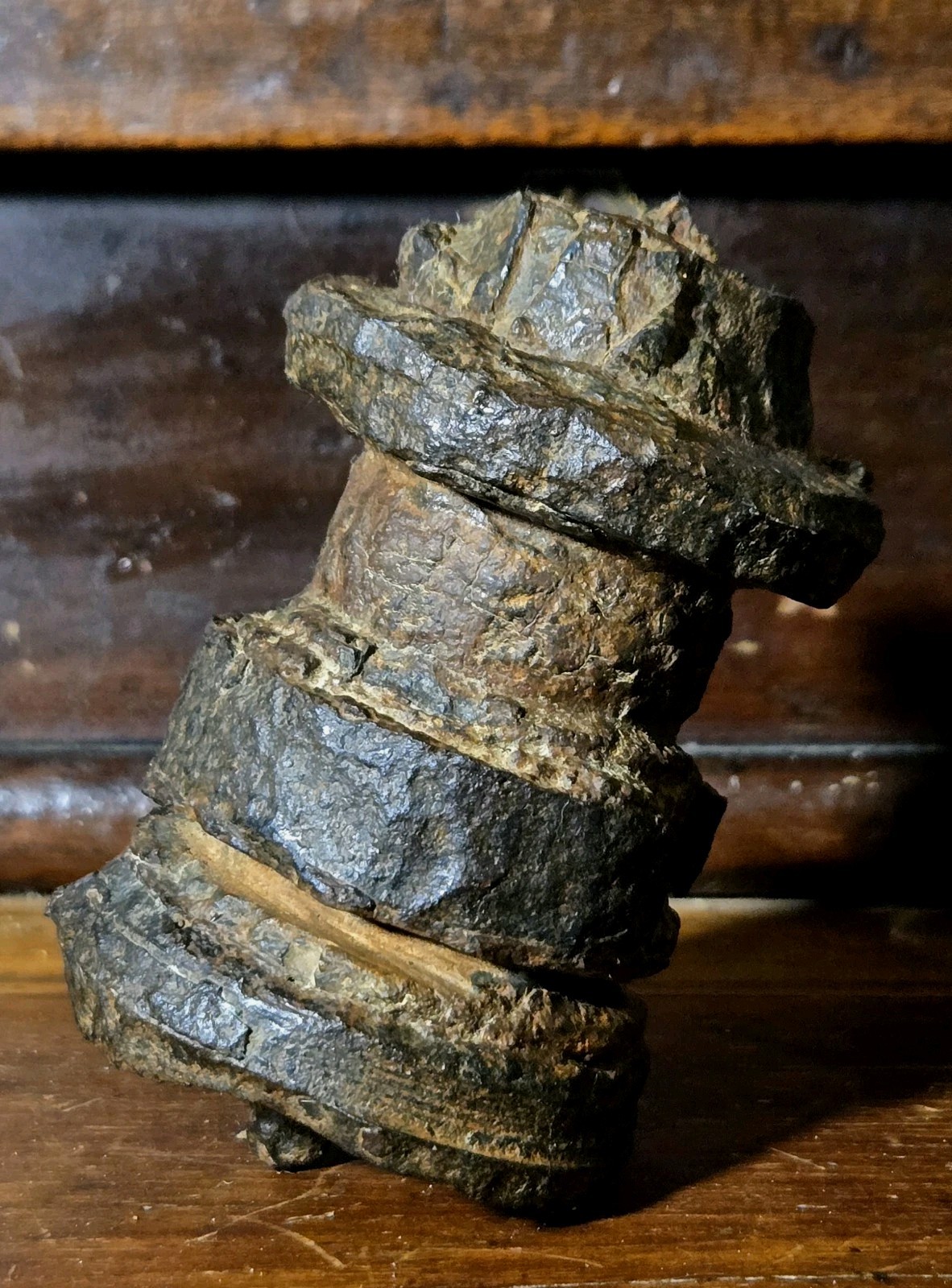
Offered for acquisition is an artifact of extraordinary technological rarity: an intact, heavily conserved 4th-century AD iron riverside winch and ratchet-action check mechanism, weighing 560 grams conserved (600 grams pre-conservation with its protective oxide bark), recovered from the W Field locus along the Northern Cambridgeshire Fen edge (associated with the Black Works industrial complex and Germanic federati auxiliary operations). To the best of current archaeological and institutional knowledge, no other functional parallel or surviving structural counterpart of this complexity exists within the recorded corpus of Roman Britain.
Please see image 2. "Comparative Analysis & Functional Interpretation: Side-by-side comparison showing the pre-conservation 'as found' encrusted state alongside a reconstructed cross-sectional interpretation of its internal spindle, guiding channels, and functional mechanics."
Rather than a generic industrial spacer or a later post-medieval mechanical component, this piece represents a sophisticated masterwork of late Roman engineering. Meticulously conserved to strip away heavy encrustation without altering the underlying metal, the artifact has naturally sectioned along its fitted concentric sleeves, exposing internal mechanical tooth-engagement channels, precision-cut screw threads, and hand-cut ratchet teeth. It stands as an absolute benchmark of antique mechanical ingenuity.
CONDITIONAL RESEARCH & DUE DILIGENCE PROTOCOL
Due to the unparalleled technological and material profile of this suite, general commercial inquiries are strictly excluded.
Accredited research institutions, recognized university departments, and qualified museum conservation bodies may request an extended, pre-acquisition Study-Period Bailment for exhaustive non-destructive analysis and metallurgical authentication.
- Prerequisites: Submission of formal institutional credentials, verified curatorial sponsorship, and execution of a standard secure-transit and insurance framework.
Authenticity & Material Provenance: Dispelling Later Post-Medieval or Machine-Made Attributions
To ensure absolute clarity for advanced collectors, researchers, and institutional curators, the material science and forging signatures of this piece definitively remove any possibility of a post-medieval, 18th-century, or modern machine-made origin:
- Bloomery Wrought-Iron Matrix & Slag Streaks: The exposed sectional layers reveal the fibrous, layered grain structure and longitudinal slag inclusions intrinsic to genuine bloomery wrought iron produced in antiquity. It completely lacks the homogeneous, carbon-dense grain of modern machine-rolled steel or the brittle, granular fracture of later cast iron.
- Hand-Chiseled Gearing vs. Machine Milling: Close-range forensic analysis confirms that the interlocking teeth and stepped casings do not possess the uniform, equidistant spacing or rotary milling marks of industrial machine-cutting or modern lathe gear-cutting. Every tooth and housing edge bears the unmistakable individual file and chisel signatures of a master smith hand-working hot iron.
- Primitive Threading & Bespoke Tolerances: The visible screw threads are hand-formed rather than standardized to modern industrial thread pitches, reflecting bespoke Roman mechanical fitting where components were individually keyed and locked for high-stress tension loads.
Physical Specifications & Technical Inventory
- Height (Elevation): 95.2 mm
- Maximum Diameter: 55 mm (with diameter varying dynamically through the overall stepped multi-tiered elevation)
- Conserved Mass: 560 grams (down from a pre-conservation mass of 665 grams inclusive of the protective oxide bark)
Mechanical Components:
- The Concentric Stepped Casing & Multi-Tiered Drum:
- Profile: A multi-layered cylindrical iron housing featuring nested sleeve construction that acts as a natural, non-destructive cross-section.
- Function: Designed to enclose and protect the central rotating axle-tree of a heavy lifting winch or wharf-side crane.
- The Hand-Cut Ratchet Teeth & Engagement Channels:
- Profile: Precisely chiseled interlocking iron teeth set into stepped exterior bands.
- Function: Acted as a positive-locking check mechanism (pawl-housing engagement), preventing the winch drum from slipping backward under heavy tension loads.
- The Precision-Cut Screw Threads:
- Profile: Helically cut thread lines preserved along the structural core.
- Function: Provided high-stress mechanical locking to secure tension-bearing elements of the lifting apparatus in place without relying solely on friction or pins.
Archaeological & Investment Significance
Surviving Roman mechanical machinery in iron is virtually non-existent due to the ravages of oxidation and recycling. The survival of this operational winch mechanism—protected by the anaerobic bog chemistry and bark-oxide crusts of the Cambridge Fen margin—provides an unparalleled example ideally suited for elite institutional acquisition, specialized technological collections, or advanced museum display.
Conservation & Stabilization Methodology
- Professional Conservation Note: The artifact has undergone meticulous mechanical stabilization to expose its internal mechanics while leaving the stable, protective oxide bark intact. The entire piece has been treated and sealed with micro-crystalline Renaissance Wax to ensure long-term preservation.
Bibliography & Further Academic Reference Material
- Bishop, M. C. Roman Military Equipment: From the Punik Wars to the Fall of Rome. Oxbow Books, 2002.
- Manning, W. H. Catalogue of the Romano-British Iron Tools, Fittings and Weapons in the British Museum. British Museum Press, 1985.
- Sim, David, and KingsleyPanelView. Roman Imperial Armour: The Production of Early Imperial Military Equipment. Oxbow Books, 2003. (Covers bloomery iron working tolerances and hand-chiseled mechanical fittings).
- Salway, Peter. Roman Britain. Oxford University Press, 1981. (Comprehensive overview of the Fen-edge economy, industrial complexes, and late Roman transport/wharf networks).
- Rees, Neil. Roman Horseshoes and Traction Hardware in Lowland Britain. Britannia Monograph Series, 2012.
Legal Compliance & Provenance Disclaimers:
- Land Status: Recovered with full landowner consent during a controlled surface scrape on private land in Northern Cambridgeshire.
General Reference material and further reading:
Where possible ancient artifacts may be referenced to similar material observed in the following publications within my collection:
- British Artefacts Vol.1, 2 and 3: Brett Hammond [Greenlight Publishing 2010]:
- Celtic & Roman Artefacts: Nigel Mills [Greenlight Publishing 2007]:
- SPQR: A History of Ancient Rome: Mary Beard [Profile Books 2015]:
- 50 Bronze Age Artefacts: Portable Antiquities Scheme: Dot Boughton [Amberley Publishing 2021]:
- Pottery in Britain 4000BC to AD 1900: Lloyd Laing [Greenlight Publishing 2003]:
- British Iron Age Coins In The British Museum: Richard Hobbs [British Museum 1996]:
- Swords of The Viking Age: Ian Peirce: [The Boydell Press 2003]:
- Proceedings of the Prehistoric Society Volume 85: [Cambridge University Press 2019].
- Mesolithic Europe: Geoff Bailey / Penny Spikins [Cambridge University Press 2008]
- Viking Art: James Graham-Campbell: [Thames & Hudson, London 2018]
- Roman Coins Vol. 1, 2 & 3: David R Sear: [Spink London 2000]:
- The Roman Cavalry: Karen R. Dixon: [B. . Batsford 1997]:
- Rome’s Saxon Shore: Coastal Defenses of Roman Britain AD 250 – 500: Nic Fields [Osprey Publishing 2006]:
- Amulets of Ancient Egypt: Carol Andrews: [University of Texas Press / British Museum Press 1994]:
The Uniforms of the Roman World: Military dress, weapons, artillery, ships, siege engines and fortifications: Kevin F. Killey: [Anness Publishing 2017]:
Where possible finger rings may be referenced to similar material observed in the following publications within my collection:
- Victorian and Albert Museum CATALOGUE OF FINGER RINGS 1930: C.C.Oman [Anglia Publishing. 1991 – Now out of print]:
- Finger Rings: Diana Scarisbrick / Martin Henig: [Ashmolean Museum Oxford. 2003]:
- Ancient Rings An Illustrated Collectors Guide: T. N. Polio: [McFarland & Co Inc. 2018:
- 1000 Rings: Inspiring Adornments of the Hand: Le Van, Marthe; Ebendorf, Robert [W: Lark Books 2004]:
Copyright AncientPasts 2026 | All rights reserve