When you click on links to various merchants on this site and make a purchase, this can result in this site earning a commission. Affiliate programs and affiliations include, but are not limited to, the eBay Partner Network.
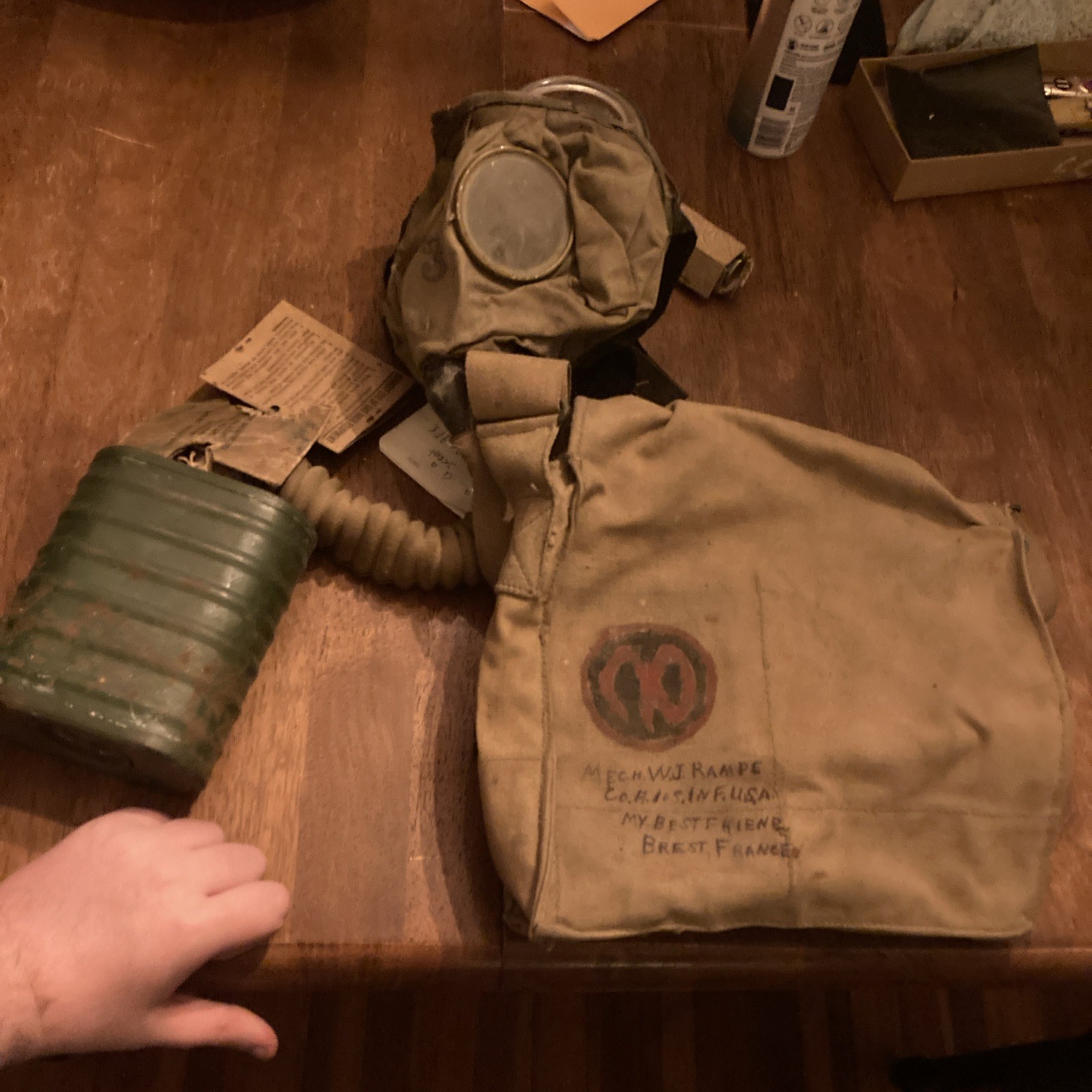
Up for sale is a museum-grade, exceptionally well-preserved, and historically complete World War I U.S. Army M1917 Small Box Respirator (SBR) Gas Mask Set. This remarkable piece of combat gear belonged to Mechanic William J. Rampe of Company A, 105th Infantry Regiment, 27th "New York" Division, who hand-personalized the carry bag with his service details during his deployment in France.
Finding an SBR set this complete—retaining its original facepiece, hose, canister, inner protective paper envelope, instruction card, and original record logbook—is extraordinarily rare for military collectors.
1. The Personalized Carry Bag (Haversack)
The canvas carry bag features beautiful, sharp hand-painted and handwritten personalization on the front face:
• Unit Insignia: A hand-painted 27th Infantry Division "NYD" monogram emblem inside a red circle, featuring the stars of the Orion constellation honoring Major General John F. O'Ryan.
• Soldier ID: Clearly hand-inked: “MECH. W. J. RAMPE / CO. A. 105 INF. U.S.A.”
• Frontline Sentiment: Inscribed with the classic Doughboy phrase “MY BEST FRIEND”—a common tribute to the piece of life-saving equipment that stood between the soldier and lethal chemical gas attacks.
• Location Marking: Marked “BREST, FRANCE”, denoting the primary naval port of debarkation and embarkation utilized by the 27th Division.
2. The M1917 Facepiece, Hose & Canister
• Facepiece: The rubberized fabric hood remains in strong condition, showing excellent structural integrity for its age. It features a bold factory size stamp "3" (Medium) between the lenses and a lower factory inspection code "T 240". The brass lens rims are intact.
• Hose & Canister: The original corrugated flexible breathing tube is intact and connects seamlessly to the green-painted ribbed Type "J" filter canister. The original factory pressure-test paper tag is still securely tied to the metal neck junction.
3. The Ultra-Rare Paper Ephemera & Repair Kit
Tucked safely inside the bag's interior pocket for over a century, the fragile paper accessories are miraculously preserved:
• Outer Paper Kit Envelope: Retains clear printed text detailing the contents, original factory string/twine on the edge used for adjusting the mask harness, and faint penciled-in lot or serial numbers.
• "Correct Use" Instruction Card: The double-sided yellow card outlining the 5-step emergency drill steps and preventative trench maintenance routines.
• Record Book & Repair Kit (Form A1): The logbook features a stamped issuance date of Dec 19, complete with the grid lines intended to track hours exposed to "Cloud Gas" or "Shell Gas." The right side still contains the original mesh adhesive plaster patches and the metal safety pin used to patch battlefield tears in the mask.
Historical Provenance:
Mechanic William J. Rampe's service is officially documented in the New York State Military Museum's World War I rosters for Company A, 105th Infantry. The 105th Infantry Regiment (known as the "Appleknockers") saw intense combat on the Western Front embedded with British forces, playing a pivotal role in shattering the German Hindenburg Line in September 1918.
Condition Notes:
• Overall Condition: This set is in excellent, untouched antique condition. Canvas shows normal frontline storage soiling and light staining, which adds beautiful character and undisputed authenticity. Rubberized components are fragile due to age, but remarkably supple compared to most surviving examples. Paper elements show minor edge fraying/tears but remain entirely legible and structurally intact. Please see photos for exact condition details.
• Lens Condition Note: The left eye lens shows significant dark discoloration. This is a natural, chemically organic reaction that is extremely common for 100-year-old M1917 gas masks. These lenses were manufactured as a "sandwich" of dual glass panes with a thin sheet of clear celluloid laminated in the middle to prevent shattering from battlefield shrapnel. Over the last century, trapped moisture and air have caused that internal celluloid layer to naturally decay and darken. The brass frame and the outer glass itself remain completely solid and secure.
⚠️ SAFETY NOTICE FOR BUYERS:
This item is sold strictly as a historical artifact for stationary display purposes only. World War I gas mask filters contain degraded chemical granules and particulate fibers (including asbestos). Do not attempt to wear, breathe through, or aggressively shake this mask, as doing so can release hazardous degraded particles.