When you click on links to various merchants on this site and make a purchase, this can result in this site earning a commission. Affiliate programs and affiliations include, but are not limited to, the eBay Partner Network.
WWII POLORON PRODUCTS, Inc.M1942 CANTEEN
RARECONTRACTOR!!!
PoloronProducts, Inc.
Firstyear of delivery!
P.P.Inc.
1943
EXC
Attentionadvanced Canteen and Field Equipment collectors!
(1)This M1942 Corrosion Resistant Steel (CRS) horizontal-seamCanteen is from a VERY RARE maker: the POLORONPRODUCTS, Inc. of New Rochelle, New York and Scranton,Pennsylvania! POLORON was beset withnumerous production problems, delays and was unable to fill the verysmall contract awarded by the War Department.
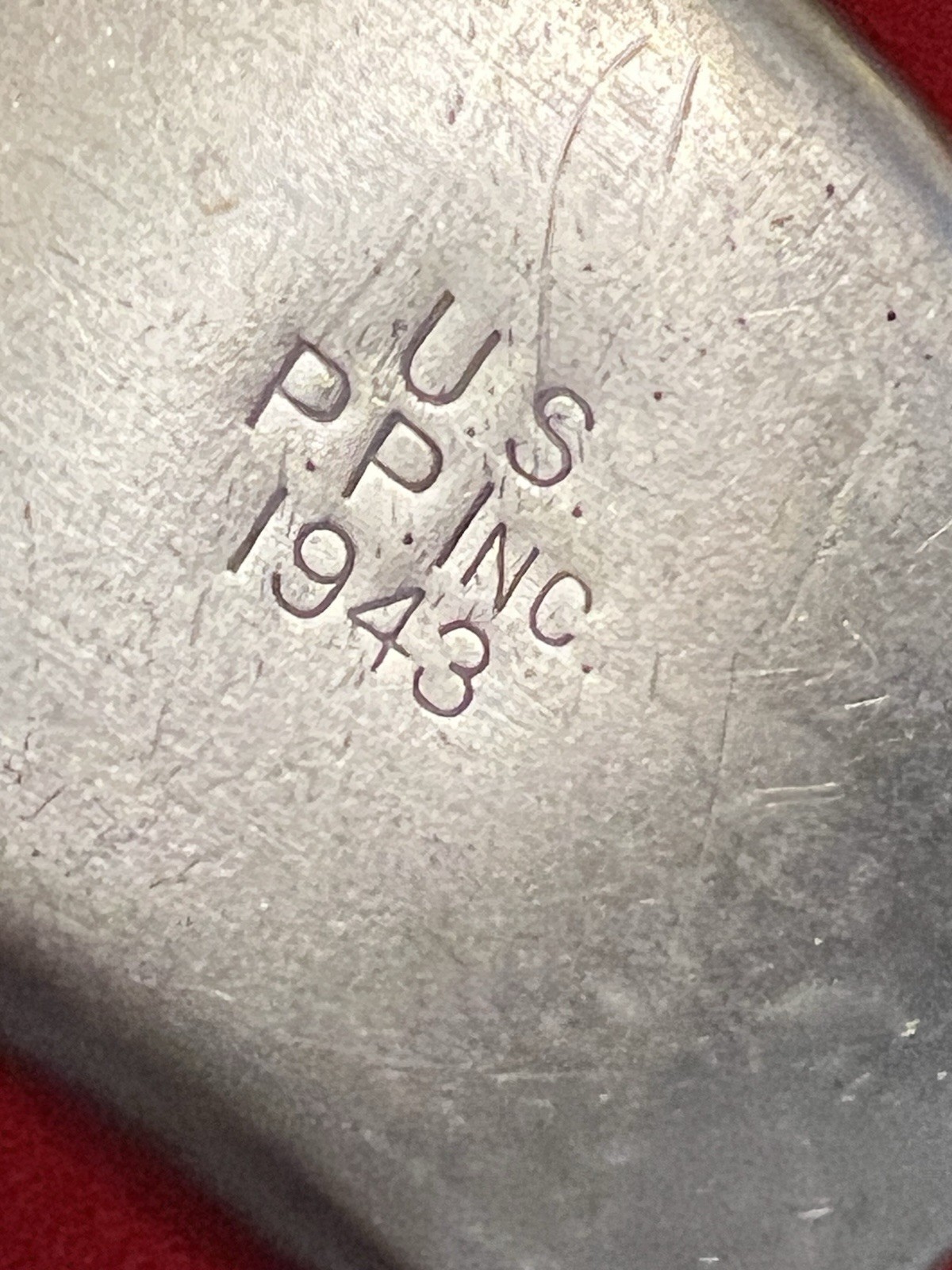
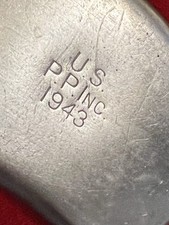
(2)This RARE example of a Poloron canteen wasamong the VERY first shipment of 25,050 delivered to theJeffersonville Quartermaster Depot three days after Christmas,December 28, 1943! The other 46,700 Poloroncanteen were made in 1944 and marked 1944. Thisexample is clearly stamped in san serif font on the bottom:
U.S.
P.P.Inc.
1943
(3) ThePOLORON PRODUCTS, Inc. canteens are SCARCER thanany of the other WWII-era manufactured canteens. Scarcer thanETHOCEL plasticcanteens. Scarcer than the enameled canteens, except,perhaps the “blue” enameled examples. Scarcer than even theRUTENBER contract M1942 canteens.
*****
CONDITION:
+ ZEROcracks, significant scratches to the vertical ridges, degradation ofthe Bakelite of the rugged M1942 Cap withthe recessed Chain Post.
+ ZEROcorrosion to the bare steel Cap Chain.
+ ZEROscratches, discoloration or significant dents to thehorizontal-seam body or neck of the Canteen. The only discerniblewear are several scattered 'dimples' from carefulservice or handling during depot storage and one shallow dent ½”long on the rear of the left shoulder of the canteen. There isZERO evidence of any contact from the male base studs of aLift-the-Dot Fastener, that typically identify an"issued/used" Canteen. This piece has seen only theslightest possible use.
+ TheCap screws on adequately. There is NO visible deformation ofthe threaded neck of the Canteen and there is NO visibleirregularities with the internal threads of the Cap.
*****
Backgroundand Court Case Brought by Poloron:
Thecase brought by Poloron Products, Inc. against thegovernment that worked its way through the courts following the warP.P. Inc. alleged that their small contract awarded bythe Jeffersonville Quartermaster Depot on March 17, 1943 for750,000 M1942 Canteens at a unit price of 85 cents was unfairlyterminated by the War Department.
Nota single delivery deadline was met.
P.P.Inc. had initially agreed in their offer to provide 2,671,000canteens, but then revised their offer to provide only 500,000 units at74 cents each. Only 71,750 Canteens were ever actually delivered onthe following dates in late 1943 and early 1944:
December 28, 1943.............. 25,050February 1, 1944............... 27,000March 8, 1944.................. 12,950April 1, 1944.................. [1]6,750 ______ Total delivered............. 71,750
Poloron Products Inc. was unsuccessful in their offer torecover to damages from the Office of the QuartermasterGeneral and their case was dismissed by the U.S. Court ofClaims.
POLORONPRODUCTS, Inc.
v.
UNITED STATES.
No. 48997.
United States Courtof Claims.
December 1, 1953.
*589 JosephusC. Trimble, Washington, D. C., Max L. Rosenstein, Newark, N. J., onthe brief, for plaintiff.
Edward L. Metzler,Washington, D. C., Warren E. Burger, Asst. Atty. Gen., for defendant.
Before JONES, ChiefJudge, and LITTLETON, WHITAKER, MADDEN and HOWELL, Judges.
LITTLETON, Judge.
Plaintiff, a New Yorkcorporation with its principal place of business at New Rochelle, NewYork, brings this suit to recover an alleged loss of $64,110.58 whichit contends resulted from the wrongful acts of the defendant inpartially terminating a contract under which plaintiff agreed tomanufacture for the Quartermaster Corps of the Army a quantity ofstainless steel canteens.[1] Pursuant to Rule 38(c), Rules ofCourt of Claims, 28 U.S.C.A. and a stipulation of the parties, theonly question now presented is on the issue of liability.
In answer toinvitations to offer issued by the Jeffersonville Quartermaster Depot,Jeffersonville, Indiana, for the procurement of 2,671,000 stainlesssteel canteens, the plaintiff firm on March 17, 1943, submitted anoffer to produce the entire quantity. Following negotiations withpersonnel of the Depot, plaintiff, on March 26, revised its offer toapply to 500,000 canteens, at 74 cents each, to be delivered atspecified intervals beginning on July 10, 1943. This revised offer wasaccepted by the Quartermaster Depot in a telegram of the same date. Adefinitive contract, dated March 30, 1943, was prepared by the Depotand forwarded to plaintiff, whose officers executed the "Contractor'sAcceptance" thereto on April 5, and returned it to the Depot forthe signature of the contracting officer.
Because the Office ofthe Quartermaster General in Washington did not approve of the awardof this contract to the plaintiff, the contracting officerat *590 JeffersonvilleQuartermaster Depot did not immediately execute the contract. Thisdisapproval or dissatisfaction was based on the fact that actualexperience in the manufacture of canteens from stainless steel hadinvolved more difficulties in fabrication than were originallyanticipated, and the Quartermaster personnel in Washington objectedto this award to a contractor without experience and tools whileother contractors with experience and adequate facilities were leftout or that awards were made for smaller orders. The Washingtonoffice warned the contracting officer of the serious possibility ofdelays by plaintiff in meeting delivery dates, and because of theurgent need for the canteens recommended that plaintiff's contract becanceled. This the contracting officer did not do, but after furtherinspections of plaintiff's plant and facilities, the parties amendedthe contract so as to reduce the quantity called for to 300,000. Thisrevision, Modification A, also increased the unit price to 85 centsand revised the delivery schedule to read as follows:
30,000 canteens on or before July 31, 1943. 30,000canteens on or before August 10, 1943. 30,000 canteens on or beforeAugust 20, 1943. 30,000 canteens on or before August 31, 1943. 30,000canteens on or before September 10, 1943. 30,000 canteens on orbefore September 20, 1943. 30,000 canteens on or before September 30,1943. 30,000 canteens on or before October 10, 1943. 30,000 canteenson or before October 20, 1943. 30,000 canteens on or before October31, 1943.
Plaintiff was unable tomeet any of the delivery dates for the canteens, as set out inModification A of the contract. The first delivery of July 31, 1943,was met only when plaintiff subcontracted with one of two experiencedfirms in the field who delivered the 30,000 canteens due on thatdate. In answer to its request for a time extension, the officer incharge of procurement at the Jeffersonville Quartermaster Depot wroteplaintiff on July 21, 1943, that the contract delivery schedule,
"* * * must be met; otherwise the undelivered balance at the endof each scheduled period will be terminated and purchased in the openmarket, and any excess cost charged to your account.
"These canteens for acceptance may be produced in your ownplant, or partially or wholly fabricated by a subcontractor.
"Your request for an extension of time cannot be granted, as youstated in your offer dated 17 March 1943, that you could deliver300,000 by 30 June 1943, and 475,000 by 31 July 1943, or a total of775,000 canteens. The Supplemental Agreement, dated 8 May 1943,modifying your contract of 30 March 1943, includes a deliveryschedule of 30,000 Canteens, stainless steel to be accepted by theGovernment Inspector between 20 and 31 July 1943. This is anextension of approximately seven weeks from the time indicated inyour offer to the time actual acceptances were required. * * *
"In the original offer space was provided for listing anyadditional equipment or facilities required to produce this item.Under this item no additional facilities were listed. On 12 May 1943,a Government Inspector visited your plant, at which time you statedall tools and dies would be ready by 15 June 1943, and at no time inthe course of submitting *591 youroffer, or in correspondence, did you indicate that new capitalequipment would be necessary; therefore, you have now hadapproximately ten weeks in which to complete the tools and dies andget into production."
Upon failure to meetthe August 10 delivery date, the contracting officer on August 16,1943, wrote plaintiff as follows, terminating its right to proceedwith the second delivery:
"Due to your failure to comply with the schedule of delivery, asprovided for in the subject contract, you are hereby notified thatpursuant to the provisions of the Delays-Damages Article, known asArticle 10 therein, your rights to proceed with the manufacture anddelivery of 30,000 Canteens, Stainless Steel, which quantity isdelinquent as of 10 August 1943, at a unit price of $.85 each and inthe total amount of $25,500.00 is hereby terminated effective as ofthis date."
Provisions of thecontract relating to damages for delay and disputes pertinent herewere as follows:
"10. Delays-Damages. If the Contractor refuses or fails toperform this contract within the time specified, or any extensionthereof, the Government may, by written notice, terminate the rightof the Contractor to proceed with deliveries or with such part orparts thereof as to which there has been delay, and may hold theContractor liable for any damage caused the Government by reason ofsuch termination. * * *
"11. Disputes. Except as otherwise specifically provided inthis contract, all disputes concerning questions of fact which mayarise under this contract, and which are not disposed of by mutualagreement, shall be decided by the Contracting Officer, who shallreduce his decision to writing and mail a copy thereof to theContractor. Within 30 days from said mailing the Contractor mayappeal to the Secretary of War, whose decision or that of hisdesignated representative, representatives or board shall be finaland conclusive upon the parties hereto. Pending decision of a disputehereunder the Contractor shall diligently proceed with theperformance of this contract."
Plaintiff, not beingpossessed of the facilities to make the necessary dies, was requiredto subcontract for the making of that equipment. After much inquiry,plaintiff on April 21, 1943, entered into a contract with the SimTool & Die Company of Brooklyn, New York, for a complete set ofdies to produce the lower half of the canteens deliverable on orbefore June 15, 1943.[2] However because of that company'sinability to produce satisfactory dies, plaintiff on August 8, 1943,re-ordered the dies from another tool and die maker who finallydelivered workable dies to plaintiff on November 18, 1943. It was notuntil that date that plaintiff was equipped to produce canteens underthe contract.[3]
Similar "noticesof terminations" were sent plaintiff upon plaintiff's failure tomeet its delivery schedule for canteens due on the following dates:
30,000 canteens onAugust 20, 1943. Notice dated August 23, 1943.
30,000 canteens onAugust 31, 1943. Notice dated September 3, 1943.
90,000 canteens onSeptember 10, 20, and 30, 1943. Notice dated October 4, 1943.
During August andSeptember of 1943, plaintiff by letters protested the terminationactions of the contracting officer. The contracting officer againrejected *592 plaintiff'srequests for time extensions, ruling that the sole cause ofplaintiff's delay was its failure to obtain satisfactory dies whichexcuse he held not to be excusable under the contract. These lettersread in part as follows:
"The information that you have listed in your letter of 24August 1943 for failing to comply with delivery schedule on subjectcontract has been carefully reviewed and studied. After dueconsideration and a careful review of delivery inspection reportssubmitted by the Government Inspector assigned to your Plant, it hasbeen decided that two of the references which you have given did notcause the delay in production. Even though the stainless steel hadbeen delivered to you in large quantities and the Canteen Caps weredelivered in accordance with schedule with your subcontractor,delivery could not have been made because you would not have thenecessary equipment set up, as well as the dies on hand to producestainless steel Canteens.
Consideration to reinstate the 60,000 Canteens terminated on subjectcontract cannot be given and you are again advised that there will befurther terminations if you become delinquent on the contract asscheduled.
* * * * * *
"The reasons you give for being delinquent on subject contractare not considered excusable and this office has again made aninvestigation of the causes for delay and found that the reason hasbeen your inability to secure suitable dies. Even though anabundance of material has been delivered to your plant, productioncould not have been started because your equipment was not ready toproduce." [Italics supplied.]
Plaintiff made noeffort to appeal any of these rulings to the head of the departmentwithin the 30 days required under Article 11 of the contract, but inOctober 1943, because of its inability to meet any of the deliverydates, plaintiff initiated negotiations with Quartermaster Corpspersonnel which resulted in a revision of the contract, reducing thetotal amount to be delivered and establishing a delivery schedule of25,000 for October, 35,000 for November, and 30,000 for December of1943.
Upon failure ofplaintiff to meet the October delivery, the contracting officer in anotice of termination similar to those mentioned above terminatedplaintiff's right to deliver that quota. While plaintiff continued indefault under this third revision, no further terminations were putinto effect, but instead the contract was again amended in an effortto enable plaintiff to complete delivery of the reduced contractquantity by March 1, 1944. Plaintiff's completed deliveries under thecontract for which it has received payment were as follows:
December 28, 1943.............. 25,050February 1, 1944............... 27,000March 8, 1944.................. 12,950April 1, 1944.................. [1]6,750 ______ Total delivered............. 71,750
Although plaintiff on several occasions, beginning in July 1944,directed protests to the War Department and General Accounting Officerequesting formal findings of fact by the contracting officer andarguing the excusability of its delays, it was not until November 13,1945, that an appeal was filed with the Secretary of War assertingthat the above mentioned partial terminations in 1943 and 1944 of thecontract were illegal.
Following hearings onMarch 21, 22, and 23, 1946, the appeal was dismissed by the WarDepartment Board of Contract Appeals acting as the duly authorizedrepresentative of the Secretary of War. The pertinent portions of theBoard's decision are set out in finding 37.
*593 Plaintiffthen instituted this action on the grounds that (1) it had never beenfurnished with sufficient findings of fact by the contracting officerupon which to base an appeal, (2) the delays entailed resulted fromthe acts of defendant, (3) those causes of delay chargeable toplaintiff were excusable under the contract, and (4) the conduct ofdefendant's representatives amounted to a fraud upon the plaintiff.
Defendant takes theposition that under the express terms of the contract the contractingofficer's notices of termination were sufficient, and that plaintiffis precluded from recovery because of its failure to perfect thenecessary appeal within 30 days as required by Article 11 of thecontract. Defendant further contends that apart from the failure oftimely appeals, the decision here must be for the Government on thegrounds that the decision of the War Department Board of ContractAppeals, which ruled adversely to plaintiff on the merits of itsclaims, is final and binding on this court. That decision, defendantpoints out, is fully supported by the evidence and no showing hasbeen made of wrongdoing on the part of defendant's representatives.
The Board of ContractAppeals granted plaintiff a full hearing on the merits of its claimsbecause it deemed a consideration on the merits necessary to adecision on the jurisdictional question presented, that is, whether atimely appeal had been made. The Board then, in addition todismissing the appeal for failure to perfect it within the requiredtime, made and incorporated as part of its decision, detailedfindings of fact which were adverse to plaintiff on all its claims.While the decision of the head of the department as to the facts isbinding on this court under United States v. Wunderlich, L. Ed. 113,its decision as to whether a timely appeal has been perfected withinthe meaning of the contract, being a question of law, is not one towhich the limitation of Wunderlich attaches. W. C. Shepherd v. UnitedStates, 1953,, 125 Ct. Cl. 724, 729; See W. E.Callahan Construction Co. v. United States, 91 Ct. Cl. 538,616.
Thus, we have in effecta twofold decision by the Board, part of which is binding here andpart which is not. We will first consider the issue of timely appeal.
Plaintiff in an effortto void any effect which the adverse Board ruling may have arguesthat since it was never presented with formal findings of fact by thecontracting officer there never was in existence a decision which wasappealable; thus, even to this time, the period time within which itwas required to appeal has never begun to run. In so contending,plaintiff refuses to accept the written "notices ofterminations" and the reasons given therefor by the contractingofficer, as being sufficient notice of the contracting officer'sdecisions. The essence of these notices was that the terminationswere made because of plaintiff's failure to meet the requireddelivery dates.
Defendant meets thiscontention with reliance on Kilgore v. United States, 121 Ct.Cl. 340, 371-372. However, that case as well as ClimaticRainwear Co., Inc., v. United States, 115 Ct. Cl. 520,559, relied on by plaintiff is inapplicable here since the Governmentin terminating contracts in both those cases acted under contractprovisions materially different from those present in the instantcase.[4]
The contracting officermade the terminations under Article 10, supra, and *594 theplaintiff's right to contest those terminations is to be found in the"Disputes" clause, Article 11, supra. This latterarticle requires only that the contracting officer "reduce hisdecision to writing and mail a copy thereof to the Contractor."
In addition to thenotices of termination received by plaintiff, the contracting officerduring August and September of 1943, in answer to protests byplaintiff, wrote on two occasions making it entirely clear why thepartial terminations were made and why plaintiff's alleged excusesfor the delays were being rejected. Even after receipt of theseletters plaintiff made no appeal. Instead, at its request, furthernegotiations were initiated with the Office of the QuartermasterGeneral in Washington and with personnel at the Jeffersonville Depot,which resulted in a revision of the contract. Finding 25.
Universal Power Corp.v. United States, 112 Ct. Cl. 97, cited by plaintiffas supporting its contentions is in point insofar as it involved thetermination of a contract under provisions identical with Articles 10and 11 here. However, we ruled in that case that the contractingofficer was in error not merely because he failed to furnish findingsof fact, but that he had failed to take any notice whatsoever ofprotests by the contractor, and as a result he neglected even so muchas to notify the contractor as to what, he, the contracting officerfound to be the causes of the delay in question. Here the plaintiffwas placed on adequate notice as to what the contracting officerbelieved to be the cause of the delays, and that such cause was notexcusable under the contract.
We hold, therefore,that the "notices of terminations" and the letters ofAugust and September 1943 constituted sufficient notice to theplaintiff of the contracting officer's decisions, under the contractprovisions applicable here, and because of the failure to appealthose decisions within the thirty days as required by Article 11,plaintiff is barred from recovery.
The consideration ofplaintiff's claims on the merits leads to the identical conclusion.As mentioned above, the findings of fact made by the Board ofContract Appeals are binding here. The findings of the Board aresupported by the evidence, and there is no evidence of the factorswhich would free those findings from the force which Wunderlich givesto them. Finding 38. Therefore, any discussion of plaintiff's case onits merits must begin with the recognition that the sole and primarycause of plaintiff's delay was the failure of its subcontractor tofurnish satisfactory dies which default was due to that company'sinability to produce the dies. However, the Board's conclusion thatthis was not an excusable delay under the contract is not bindingbecause it rests upon a construction of the contract.
Article 10, under whichthe partial termination actions were taken, provides in part asfollows:
"* * * The right of the Contractor to proceed with theperformance of this contract shall not be terminated * * * ifthe delay is due to unforeseeable causes beyond the control andwithout the fault or negligence of the Contractor * *."[Italics supplied.]
Plaintiff's position isthat the delay caused by the subcontractor's failure to produceadequate dies due to its inexperience was an unforeseeable causewithin the above article, and that the failure of the contractingofficer to grant time extensions for the resulting delay was a breachof contract on behalf of the Government.
Defendant meets thiscontention with the opposite argument, asserting thatthe *595 inability of thesubcontractor to perform was not excusable. This is particularly so,defendant urges, when it is remembered that the process for makingstainless steel canteens was comparatively new, and what progress hadbeen made had been done so only with difficulty.
Plaintiff reliesprimarily on two cases, H. B. Nelson Construction Co. v. UnitedStates, 87 Ct. Cl. 375, and Climatic Rainwear Co.,Inc., v. United States, supra, as supporting its position.In the Nelson case delay resulted when some of the contractor'smaterials were delivered in a damaged condition due to the negligenceof the railroad in transporting them. That delay was held to havebeen an unforeseeable one not chargeable to the contractor sinceprompt and satisfactory service on the part of the railroads was tobe expected, and the contractor in binding himself to specifiedcompletion dates was entitled to rely on it. In the Climatic Rainwearcase, plaintiff manufactured raincoats for the War Department, anddelay resulted when a number of the finished coats were rejectedbecause of leakage at the seams. The samples had originally beenapproved as satisfactory, but after delivery had begun on a largescale, this defect was discovered. It was remedied by the use ofdifferent strapping material at the seams but only after extensivetests by all parties concerned. Citing the Nelson case, we held thatthe failure of the strapping material to be watertight after it hadbeen previously tested and found to be acceptable by the Governmentwas an unforeseeable cause beyond the control and without fault bythe contractor. Neither case can be controlling here sincedifficulties in manufacturing stainless steel canteens was to beexpected, and plaintiff was expressly and clearly put on notice ofsuch difficulties when it bound itself to deliver on the dates calledfor in the contract. The difficulty which ensued can hardly be saidto have been unforeseeable when it is recalled that the plaintiffobligated itself to embark upon work new to it, with no dies withwhich to fabricate the canteens and possessed of no facilities toproduce those dies, thus necessitating its looking elsewhere for thatbasic equipment. See Lebanon Woolen Mills, Inc., v. UnitedStates, 99 Ct. Cl. 318, 328.
Nor does theinexperience of the subcontractor operate to excuse plaintiff'sdelays. Under a contract such as we have here, lack of "know-how"is no excuse for failure of performance. Carnegie Steel Co. v. UnitedStates.
There remains one pointmore, and that deals with the plaintiff's contention which runsthroughout its brief to the effect that there existed from the verybeginning, on the part of the Quartermaster personnel, a concertedeffort to remove this contract from the plaintiff. This, plaintiffasserts, was tantamount to fraud on the part of defendant'srepresentatives. It is not disputed that the Office of theQuartermaster General in Washington was displeased with the award ofthis contract. But the facts support their position. The Depot atJeffersonville had evidently been prompted to let this contract toplaintiff because of the activities of the Smaller War PlantsCorporation in Washington, whose efforts were directed at obtainingwar contracts for the smaller plants, and at the same time providefor greater diversification of war contracts. The process offabricating canteens from stainless steel was a comparatively newprocess and, at the time of this award to plaintiff, only two firmshad been able to solve adequately all difficulties encountered.Finding 5. The Quartermaster officers in Washington realizing timewas of the essence in securing delivery of the canteens believed thatthe experienced firms should receive the bulk of the canteencontracts. As it developed, their fears in connection withplaintiff's contract proved to be well grounded. Plaintiff's officerswere warned from the very beginning that failure to meet deliverydates would result in termination action. Finding 5. Plaintiff wasafforded the opportunity to withdraw from its offer but declined. Thus,the Government determined that it would adhere strictly to thedelivery *596 daterequirements which its officers did, but not to the extent ofdefrauding plaintiff of its right to proceed under the contract. Wefind no substantial evidence supporting plaintiff's assertions to theeffect that the contracting officer acted under the compulsion ofhigher authority in terminating portions of the contract rather thanon the merits of the situation. The absence of any such intent on thepart of Quartermaster personnel is evidenced by the several revisionswhich they permitted to be made in the contract in order thatplaintiff could, even in the face of its inexcusable difficulties,deliver portions of the contract quantity. We think the Governmentwas fair to plaintiff in every way.
In conclusion, we holdthat plaintiff is not entitled to recover because it failed toperfect a timely appeal as required by the contract, and even apartfrom that bar, plaintiff is precluded on the facts since it must beheld that the delays incurred were chargeable to it, thus entitlingthe defendant to terminate the contract as it did. Plaintiff'spetition is dismissed. It is so ordered.
JONES, Chief Judge, andMADDEN and WHITAKER, Judges, concur.
*****
Poloron Products, Inc.
Poloron began business in New Rochelle, New York in1937. Poloron produced not only blow-molded plastic figures but manyitems made from metal, such as picnic jugs, coolers, and Christmastree stands. Their innovative line of blow-molded items includedSantas, Nativities in various sizes, angels, toy soldiers, candles,lanterns, and more. Poloron also produced a wide array of smallerplastic decorations to adorn Christmas trees and tabletop displays.
The sculptural detail, impeccable paint applications,and use of thick, high-quality plastic produced long-lasting piecesof beauty and durability. Many of their blow-molded figures can stillbe found in good to excellent condition.
A hallmark of Poloron was their liberal use of goldmetallic painted details on many of their pieces – most notablytheir choir people songbooks and cassock trim, candles, angel wings,and even Santa’s beard. In daylight, the gold paint produces arich, luxuriant look, but when illuminated at night, Santa’s beardappears to have a heavy shadow because the light from within is notquite able to penetrate the metallic paint.
Following Beco’s 3D sleigh set, Poloron introducedan improved, fully illuminated, version of its own. A beautiful redsleigh, a waving Santa, and sleek brown deer. The figures arelifelike, with great attention paid to the details. Poloron improvedon the elegant sleigh again in 1971 when it introduced a newvariation – a lovely white sleigh. In 1972, this sleigh could bepurchased carrying a whimsical Santa with his bag of toys. The samedeer were used for all three variants with blow-molded bodies,injection-molded hard plastic antlers, and came fully equipped withreins that were studded with jingle bells....
Considered by some to be the “Holy Grail” of blowmolds, in 1969 Poloron produced a magnificent motorized “AnimatedSwinging Santa Claus” holding a Noel lantern. This beautiful piecestands 60” tall and swings side to side at the waist. The plasticused was heavy and durable; the paint was of the highest quality.This same Santa was later produced when the aluminum molds wereacquired by Plastic Toy & Novelty Co (PTN) and marketed under theHoliday Innovations brand and again, in a non-animated version, whenthe aluminum molds were acquired by Empire when Holiday Innovationswent out of business.
Poloron Products, the innovative company that createdincredible Christmas memories, ceased production in 1981.