When you click on links to various merchants on this site and make a purchase, this can result in this site earning a commission. Affiliate programs and affiliations include, but are not limited to, the eBay Partner Network.
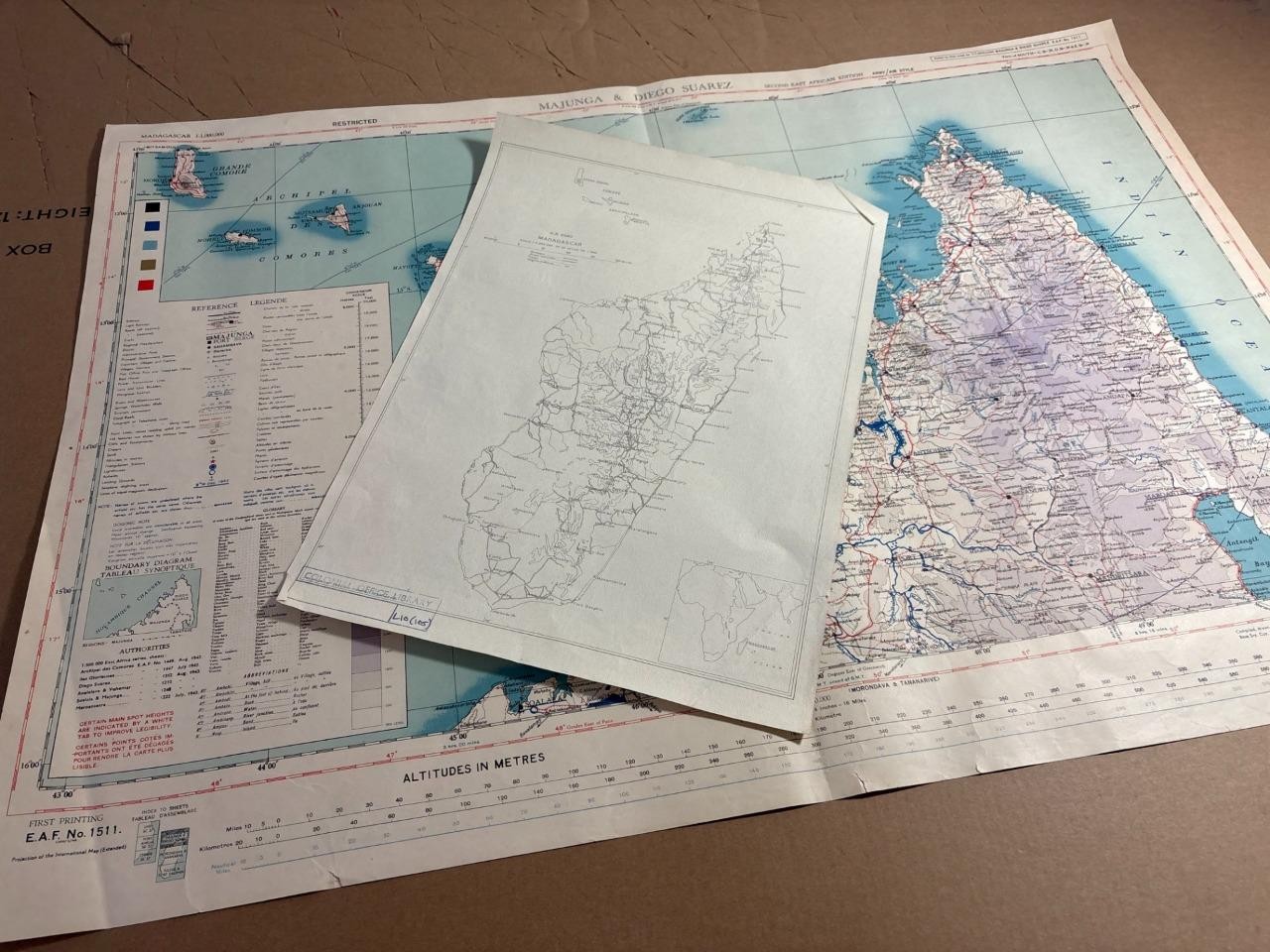
1944 North Madagascar Majunga Diego Suarez Brit Military & small map of IslandThe Battle of Madagascar (5 May – 6 November 1942) was an Allied campaign to capture the Vichy French−controlled island Madagascar during World War II. The seizure of the island by the British was to deny Madagascar's ports to the Imperial Japanese Navy and to prevent the loss or impairment of the Allied shipping routes to India, Australia and Southeast Asia. It began with Operation Ironclad, the seizure of the port of Diego-Suarez (now Antsiranana) near the northern tip of the island, on 5 May 1942.[7][8]A campaign to secure the rest of the island, Operations Stream, Line and Jane, was opened on 10 September. The Allies broke into the interior, linking up with forces on the coast and secured the island by the end of October. Fighting ceased and an armistice was granted on 6 November.[9] This was the first big operation by the Allies combining sea, land and air forces. The island was placed under Free French control.[10][11]With Madagascar in their hands, the Allies established military and naval installations across the island. The island was crucial for the rest of the war. Its deep water ports were vital for control of the passageway to India and the Persian corridor, and were now beyond the grasp of the Axis.[38] This was the first large-scale operation of World War II by the Allies combining sea, land, and air forces. In the makeshift Allied planning of the war's early years, the invasion of Madagascar held a prominent strategic place.[10]Historian John Grehan has claimed that the British capture of Madagascar, before it could fall into Japanese hands, was so crucial to the war effort that it led to Japan's eventual downfall and defeat.[46]Free French General Paul Legentilhomme was appointed High Commissioner for Madagascar in December 1942[47] only to replace British administration. Like many colonies, Madagascar sought its independence from the French Empire following the war. In 1947, the island experienced the Malagasy Uprising, a costly revolution that was crushed in 1948. It was not until 26 June 1960, about twelve years later, that the Malagasy Republic successfully proclaimed its independence from France.Campaign service in Madagascar did not qualify for the British and Commonwealth Africa Star. It was instead covered by the 1939–1945 Star.[48]December 1942. Four RAF Westland Lysander aircraft fly over Madagascar, after the campaign. Z) 1944 North Madagascar Majunga Diego Suarez Brit Military & small map ofIsland Z) 1944 North Madagascar Majunga Diego Suarez Brit Military & small map ofIsland
Click image to enlarge
Description 1944 North Madagascar Majunga Diego Suarez Brit Military & small map of Island
The Battle of Madagascar (5 May – 6 November 1942) was an Allied campaign to capture the Vichy French−controlled island Madagascar during World War II. The seizure of the island by the British was to deny Madagascar's ports to the Imperial Japanese Navy and to prevent the loss or impairment of the Allied shipping routes to India, Australia and Southeast Asia. It began with Operation Ironclad, the seizure of the port of Diego-Suarez (now Antsiranana) near the northern tip of the island, on 5 May 1942.[7][8]
Captured French troops marching away from their HQ after the British had captured Diego-Suarez on 7 May
A campaign to secure the rest of the island, Operations Stream, Line and Jane, was opened on 10 September. The Allies broke into the interior, linking up with forces on the coast and secured the island by the end of October. Fighting ceased and an armistice was granted on 6 November.[9] This was the first big operation by the Allies combining sea, land and air forces. The island was placed under Free French control.[10][11]
With Madagascar in their hands, the Allies established military and naval installations across the island. The island was crucial for the rest of the war. Its deep water ports were vital for control of the passageway to India and the Persian corridor, and were now beyond the grasp of the Axis.[38] This was the first large-scale operation of World War II by the Allies combining sea, land, and air forces. In the makeshift Allied planning of the war's early years, the invasion of Madagascar held a prominent strategic place.[10]
December 1942. Four RAF Westland Lysander aircraft fly over Madagascar, after the campaign.
Historian John Grehan has claimed that the British capture of Madagascar, before it could fall into Japanese hands, was so crucial to the war effort that it led to Japan's eventual downfall and defeat.[46]
Free French General Paul Legentilhomme was appointed High Commissioner for Madagascar in December 1942[47] only to replace British administration. Like many colonies, Madagascar sought its independence from the French Empire following the war. In 1947, the island experienced the Malagasy Uprising, a costly revolution that was crushed in 1948. It was not until 26 June 1960, about twelve years later, that the Malagasy Republic successfully proclaimed its independence from France.
Campaign service in Madagascar did not qualify for the British and Commonwealth Africa Star. It was instead covered by the 1939–1945 Star.[48] Payment Mangaed via Shipping Royal Mail Tracked 48hr Terms of Sale Private seller About Us Private seller Contact Us via Get images that
make Supersized seem small.Showcase your items with Auctiva's
Listing Templates!
THE simple solution for sellers.
Track Page Views With
Auctiva's Counter