When you click on links to various merchants on this site and make a purchase, this can result in this site earning a commission. Affiliate programs and affiliations include, but are not limited to, the eBay Partner Network.
English Creamware Chinoiserie Teapot, c.1770–1775 — David Rhodes / Robinson-Rhodes School, Possibly Wedgwood
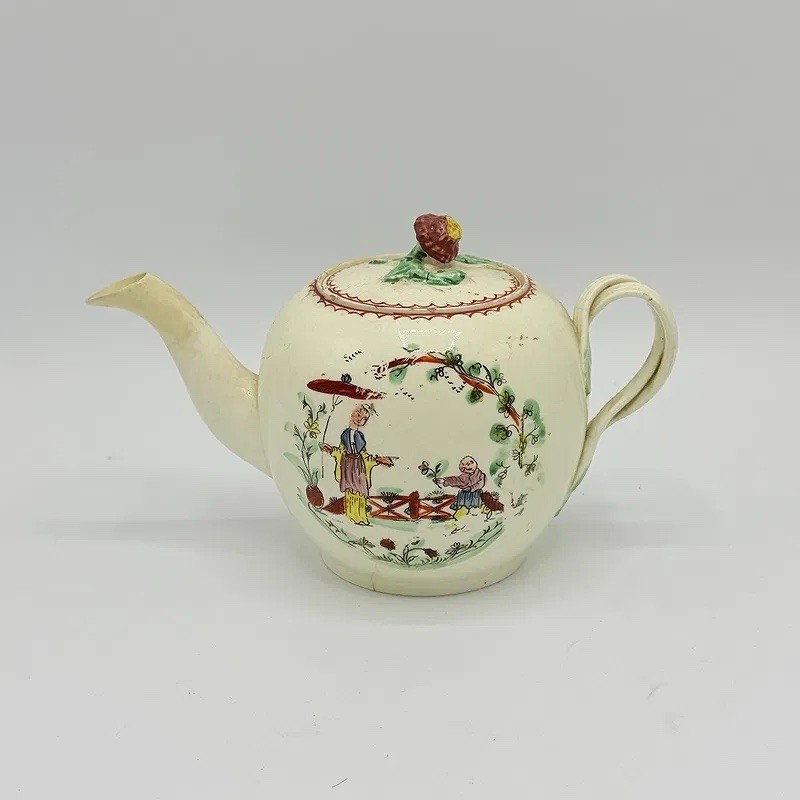
An unusually attractive 18th-century English creamware teapot and cover, dating to approximately 1770–1775, decorated in hand-painted polychrome enamels with a lively chinoiserie garden scene.
The globular body is painted with Chinese figures beneath a parasol, surrounded by flowering plants, an angular iron-red garden fence, foliage and landscape details. The palette includes iron red, green, yellow, blue, puce/purple and black, with the loose, expressive outlining and freely applied enamels associated with English creamware decoration of the period.
The teapot measures approximately 5 inches high to the top of the finial and 8 inches from handle to spout. It has a distinctive double-entwined reeded handle with green foliate terminals, a molded flower-form finial with puce petals, yellow center and green leaves, and an internal seven-hole spout strainer.
The decoration is closely related to work associated with David Rhodes and the Robinson & Rhodes decorating tradition. Rhodes is known to have enamelled creamware produced by several English manufacturers, including Wedgwood, and surviving museum examples show comparable chinoiserie figures, garden fences, palettes and molded fittings.
The form and dimensions of this teapot also compare favorably with contemporary Wedgwood creamware teapots, including examples subsequently enamelled in the Rhodes workshop. However, this example is unmarked, and therefore a Wedgwood attribution cannot presently be confirmed. It is offered as English creamware, circa 1770–1775, decorated in the David Rhodes / Robinson-Rhodes tradition, possibly on a Wedgwood body.
The cover appears consistent with the teapot in body, glaze, decoration and age and is believed to be original.
Condition: The teapot displays age-related crazing, staining, enamel wear and several hairlines/cracks consistent with a creamware vessel approximately 250 years old.
- Picture #2 shows heat related damage on the enamel.
- There is a visible line/fissure on the underside of the base, possibly a firing-related flaw or old hairline. It appears stable; please review photographs for condition.
- Some chips along top rim or body and cover rim
The piece is being sold as a historic decorative object and should not be used for serving.
A particularly appealing example of early English creamware, combining a classic Georgian form with vivid chinoiserie decoration associated with one of the best-known English enamelling traditions of the 18th century.