When you click on links to various merchants on this site and make a purchase, this can result in this site earning a commission. Affiliate programs and affiliations include, but are not limited to, the eBay Partner Network.
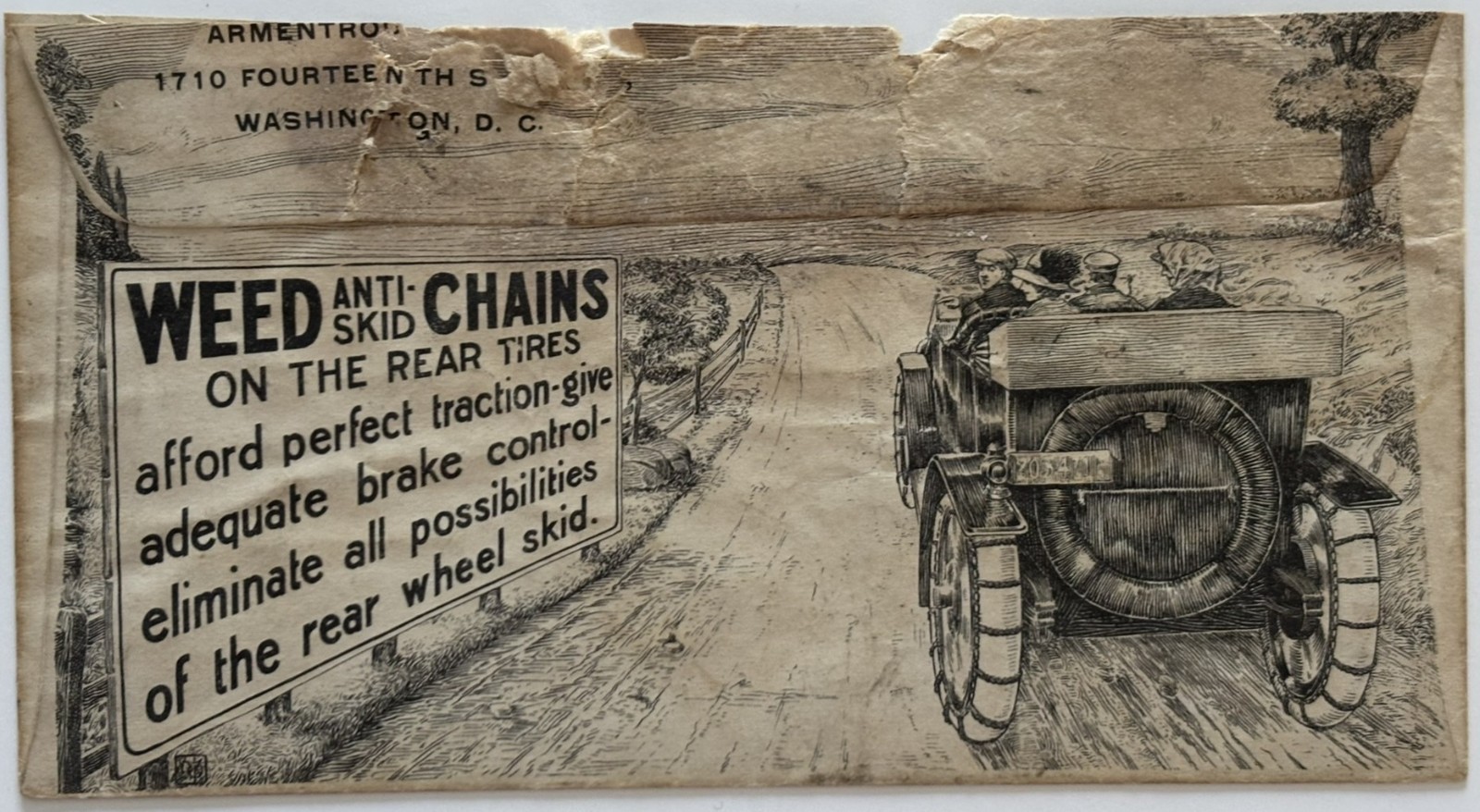
A striking c. 1913 illustratedadvertising cover for Weed Anti-Skid Chains, mailed from Washington, D.C.and printed on both sides with detailed line drawings of an early open touringautomobile fitted with tire chains.
The address side shows theautomobile approaching the viewer beneath the warning:
“WEED ANTI-SKID CHAINS ON THEFRONT TIRES insure absolute steering control and prevent the dreaded frontwheel skid.”
The reverse shows the car drivingaway, promoting chains on the rear wheels to “afford perfect traction—giveadequate brake control—eliminate all possibilities of the rear wheel skid.”
Together, the two illustrationsform a remarkably effective piece of early automotive safety advertising,showing how Weed marketed chains not only for traction and braking at the rear,but also for steering control at the front. Weed’s patented tire-chain systemdated to the first decade of the automobile era, making this an early exampleof advertising created to address the very real problem of skidding on therough, muddy and snow-covered roads encountered by early motorists.
The cover bears a Washington,D.C. June 26 postmark, with its original 2-cent Washington stamp stillaffixed. The damaged return imprint gives the address 1710 FourteenthStreet, Washington, D.C.; surviving lettering reads “ARMENTRO…,” and periodresearch identifies the dealer as apparently Armentrout’s.
Although the year in thisparticular postmark is no longer visible, another documented advertising coverusing the same Weed front-and-rear automobile design bears an April 30, 1913postmark, providing a strong basis for dating this example to approximately thesame early-1910s period.
WHAT’S INCLUDED
One original mailed Weed Anti-SkidChains illustrated advertising envelope/cover, c. 1913, with original 2-centWashington postage stamp and Washington, D.C. cancellation.
WHY IT STANDS OUT
The strongest feature is the double-sidedadvertising artwork. The two automobile views work together almost like aminiature advertising campaign: the front-wheel illustration promotes steeringcontrol, while the rear-wheel illustration emphasizes traction and braking.
Unlike a loose magazineadvertisement, this piece was actually mailed and preserves its postal use,dealer imprint, original stamp and commercial context. It crosses severalcollecting fields, including early automobile history, automotive accessoryadvertising, road-safety ephemera, Washington, D.C. local history, postalhistory and antique motoring imagery.
Inventory # LT096