When you click on links to various merchants on this site and make a purchase, this can result in this site earning a commission. Affiliate programs and affiliations include, but are not limited to, the eBay Partner Network.
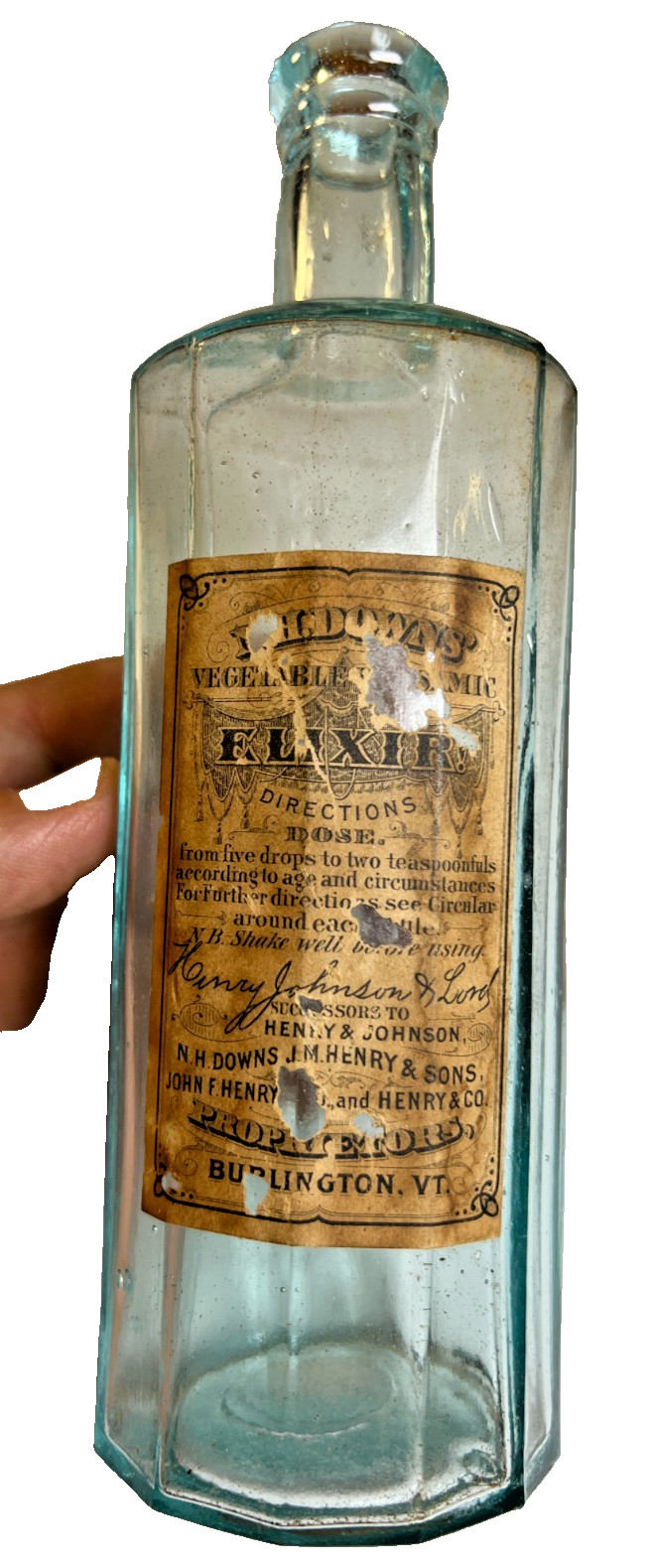
Offered is a scarce circa 1880–1885 Rev. N.H. Downs’ Vegetable Balsamic Elixir bottle, produced by Henry, Johnson & Lord of Burlington, Vermont. Measuring approximately 7 5/8 inches tall, this striking twelve-sided medicine bottle is blown in a rich dark teal-aqua glass with abundant tiny seed bubbles, irregularities and character throughout.
The tall neck terminates in a wonderfully crude hand-applied double-collar top. The base is smooth rather than pontiled, entirely appropriate for an early-1880s bottle of this type. Small, fine remnants of its original cork remain loose inside—an evocative bit of its working history.
Most importantly, the bottle retains its ornate original printed paper label. The label reads in part:
“N.H. Downs’ Vegetable Balsamic Elixir”
“Henry, Johnson & Lord”
“Successors to Henry & Johnson”
“Proprietors, Burlington, VT.”
It also preserves the original dosage directions, ranging from five drops to two teaspoonfuls, with instructions to shake the preparation before use. The paper shows age toning, areas of surface loss and scattered abrasions, but a substantial portion survives and the product name, decorative typography, directions, proprietor and Burlington identification remain readily recognizable.
The Medicine
Reverend N.H. Downs’ Vegetable Balsamic Elixir was introduced during the nineteenth century as a proprietary cough and respiratory remedy. Period advertising recommended it for complaints ranging from ordinary coughs and colds to bronchitis, influenza, pleurisy and even “consumption,” the period name commonly associated with tuberculosis.
The medicine had already been marketed by 1842, and an 1864 advertisement called it an established Vermont cough remedy that had been used for 33 years. Later formulations are documented as containing opium and alcohol, ingredients that could quiet a cough and make a suffering customer feel considerably better—although the bottle’s reassuring “vegetable” language did not exactly tell the whole story. A circa-1910 labeled example records one grain of opium per fluid ounce and 2½ percent alcohol.
Henry, Johnson & Lord
The Burlington concern traced its roots to a business established in Waterbury, Vermont, in 1855. Following a reorganization, Henry & Johnson retained the proprietary-medicine branch, and the addition of Loren B. Lord in 1879 created Henry, Johnson & Lord.
By the early 1880s, the firm operated from 119–123 College Street in Burlington, distributing Downs’ Elixir and numerous other medicines through druggists and lavishly illustrated advertising almanacs.
Burlington in the Early 1880s
When this bottle was filled, Burlington was a prosperous Lake Champlain port, railroad center and major lumber town. Steamboats, freight wagons and trains brought goods and travelers into the city, while factories and commercial buildings crowded the waterfront and College Street district. Patent medicines were household staples in an era when professional medical care remained expensive, inconsistent and often distant—especially for rural Vermont families.
Condition
Excellent glass condition with no chips, no cracks and no scratches. The bottle displays beautifully, with rich teal coloration, plentiful seed bubbles and a notably crude applied top. The original label has age toning, surface wear and several areas of paper loss, all clearly shown, but remains firmly legible and visually impressive. Fine brown remnants of the original cork remain inside the bottle.
Dimensions: Approximately 7 5/8 inches tall.