When you click on links to various merchants on this site and make a purchase, this can result in this site earning a commission. Affiliate programs and affiliations include, but are not limited to, the eBay Partner Network.
Before hair care meant plastic bottles and ingredient lists, it meant glass, confidence, and a little chemistry gamble. This antique bottle of Barry’s Tricopherous for the Skin & Hair is a striking survivor from 19th-century New York—hand-blown, boldly embossed, and finished while the glass was still visibly alive. With its tall, graceful neck and applied lip that still shows a molten drip frozen in time, this bottle perfectly captures the moment when grooming, medicine, and early advertising collided.
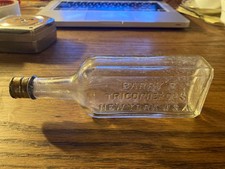
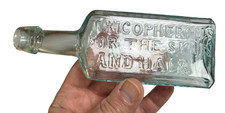
This is an original 19th-century hand-blown bottle embossed on multiple panels:
BARRY’S
TRICOPHEROUS
FOR THE SKIN
AND HAIR
NEW YORK
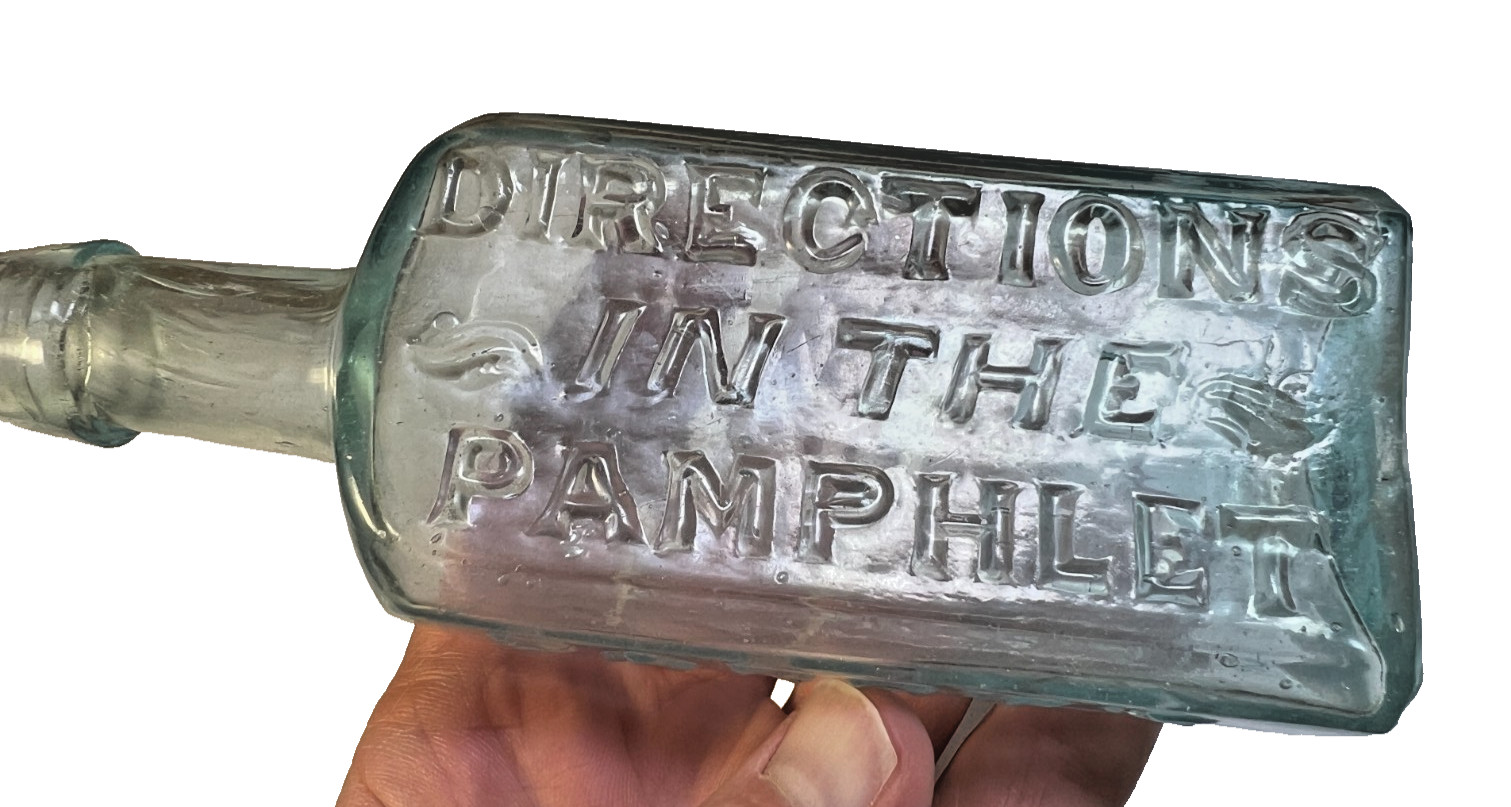
Rear panel embossing reads:
“Directions ~In The~ Pamphlet” — a wonderful period detail that confirms this product was sold with printed instructions, reinforcing its role as both cosmetic and quasi-medicinal.
Physical Details
Height: 5 7/8 inches
Glass color: Light aqua
Mold type: Hinge mold
Lip: Applied, with visible hot-glass flow and oozing drip
Base: Pontil-era finish; not an open pontil, with the pontil mark worked smooth over a diagonal hinge mold line
Neck: Beautiful elongated vertical stretch lines from hand finishing
Embossing: Exceptionally strong and crisp on all panels - especially the back panel
The bottle exhibits a uniform matte haze throughout the glass, caused by early unstable glass chemistry. This is a factory-related characteristic, not burial damage—there are no iron stains, dirt shadows, scratches, or acid etching.
That even, matte, “frosted-from-within” haze is classic in-the-glass chemical clouding, not surface wear. The big giveaways:
Uniform haze over the entire bottle
No iron staining, soil ghosts, or root marks
No scratching or directional wear
Doesn’t feel etched or gritty to the touch
Crisp embossing still intact
That rules out burial, sand abrasion, and later acid cleaning.
The real culprit: unstable glass chemistry
This bottle was made with a chemically unbalanced glass batch, very common in mid–late 19th century American bottles (especially medicine and hair products like this one).
Here’s what likely happened:
Too much alkali (soda or potash)
Not enough lime to stabilize it
Possibly recycled cullet thrown into the melt
Slightly inconsistent furnace temperature
Result:
The glass slowly reacted with moisture in the air over decades, causing microscopic leaching of alkali to the surface from within the glass matrix. Light scatters instead of passing cleanly through → haze.
Think of it as the bottle aging internally, like a Victorian with bad knees.
Why it looks “too perfect” to be damage
This is devitrification / internal weathering, not corrosion:
It does not polish out
It does not feel rough
It does not respond to vinegar, acids, or solvents
It often affects entire production runs, not just one bottle
You’ll sometimes see the same haze on bottles that have clearly never been buried, including attic finds and old pharmacy stock.
Collector impact (...good news)
Among bottle collectors:
This is considered honest factory-related aging
It does not kill desirability
It often confirms early manufacture
It can even help distinguish hand-blown examples from later machine bottles
In other words: it’s a birth defect, not an injury.
About Barry’s Tricopherous
Barry’s Tricopherous was one of the most famous hair preparations of the mid-to-late 19th century, widely advertised and heavily promoted as a solution for:
The name Tricopherous comes from Greek roots meaning “hair-bearing,” which sounds impressively scientific—exactly the point. This product was marketed to men and women alike and sold through barbershops, druggists, and general stores across the country.
City & State
New York, New York
Barry’s products were closely associated with New York, a major hub for patent medicines, cosmetics, printing, and national distribution during the period.
What Was Inside
Barry’s Tricopherous typically contained a mixture such as:
Alcohol (as a preservative and stimulant)
Botanical extracts and oils
Fragrance agents
Occasionally glycerin or herbal compounds
While marketed as a grooming aid, it lived firmly in the gray zone between cosmetic and medicine, a hallmark of the era.
Date Range
Circa 1860s–1870s
This date range is supported by:
Applied lip construction
Pontil-era base treatment
Hinge mold usage
Multi-panel embossing style
Pamphlet-based instructions (pre-label dominance)
Life During the Time Period
When this bottle was made:
Barbers were semi-medical professionals
Hair loss was blamed on “poor circulation” or “impure blood”
Indoor plumbing was rare
Germ theory was still being debated
The Civil War had just reshaped American industry
Photography, railroads, and mass advertising were transforming daily life
A bottle like this would have sat on a dresser or barber’s shelf, promising modern confidence in a rapidly modernizing world.
Condition Summary
No cracks or chips observed
Strong, legible embossing
Honest factory haze consistent with age
Structurally solid and display-worthy