When you click on links to various merchants on this site and make a purchase, this can result in this site earning a commission. Affiliate programs and affiliations include, but are not limited to, the eBay Partner Network.
This impressive piece was purchased from knifemaker Craig Steketee in 2006. It has been displayed ever since. Never used.
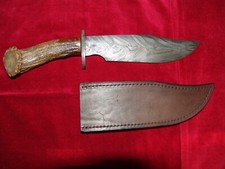
This 13 1/4\" Custom Damascus Fighting Bowie has an exhibit grade sambar stag handle with buffalo horn and red and nickel silver spacers. The double guard and pommel are both Damascus. The 360-layer pool and eye pattern blade is 8 1/8\" long from tip to the guard, with the top edge measuring 3 5/8\".
The custom sheath is made of genuine leather.
Stek Knives Damascus was forged in the shop, from scratch, every week.Stamped \"Stek\" on one side and \"2006\" on the other.
Comes with a signed Certificate of Authenticity.
About Craig Steketee:
I began designing and crafting custom knives full time as \"STEK KNIVES\" in 1991. I am a member of \"Professional Knifemaker\'s Association\" (PKA) and \"The American Bladesmith Society\" (ABS). I received a Bachelor of Fine Arts from Ft Wayne Art Institute in 1974 and a Master of Fine Arts from Western Michigan University in 1976, majoring in sculpture and printmaking. I taught art at the university level from 1977 through 1991. My sculptures, paintings and prints have been exhibited at numerous art galleries and museums throughout the country. I first began forging and casting steel while in graduate school. My knives have been illustrated in the Knives Publication (by Ken Warner), the Knife Magazine, Blade Magazine, Fighting and Tactical Knives. My shop is located in Billings, Missouri which is just 20 miles southwest of Springfield and one hour northwest of Branson.
STEK KNIVES are produced almost exclusively from Damascus steel. Damascus steel is the result of multi layers of steel forge welded together to create a variety of patterns. The 2 main types of steel used for my blades are 10995 and 1065 mixed with nickel. A mixture of 60 layers are alternately stacked, forged and hand welded together to make a billet. Four to 8 billets are then stacked together to make a completed billet of 240, 360, or 480 layers. Because of the different layers of steel, a Damascus blade has an excellent cutting edge similar to a serrated knife.