When you click on links to various merchants on this site and make a purchase, this can result in this site earning a commission. Affiliate programs and affiliations include, but are not limited to, the eBay Partner Network.
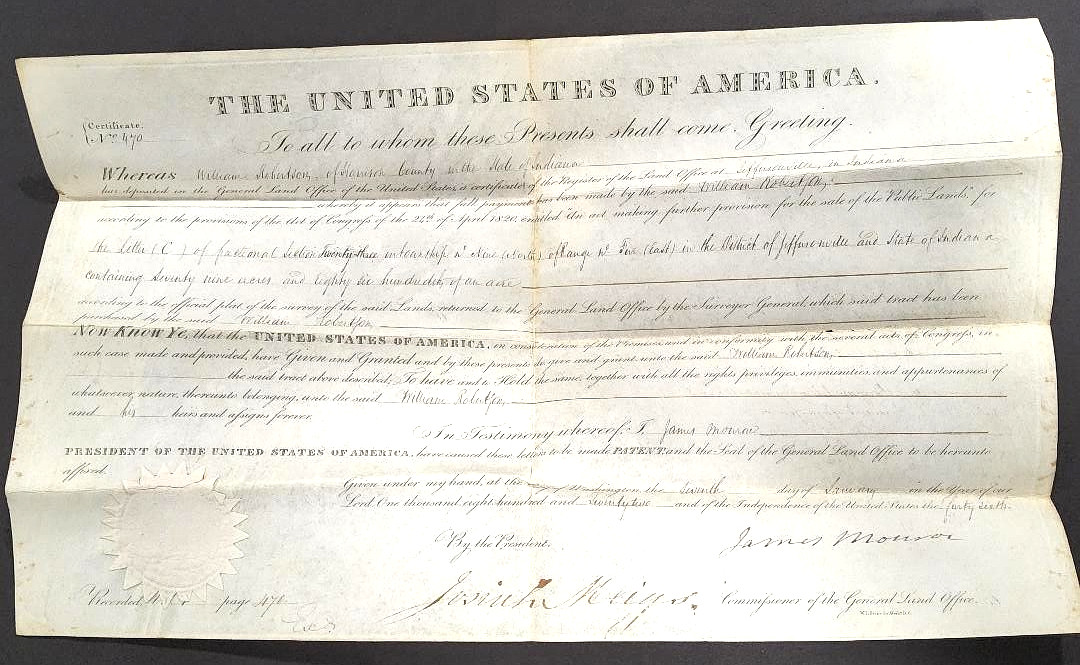
TheLand Act of 1820enacted April 24, 1820, is theUnited States federal lawthat ended the ability to purchase the United States'public domain landson a credit or installment system over four years, as previously established. The new law became effective July 1, 1820 and required full payment at the time of purchase and registration. But to encourage more sales and make them more affordable, Congress also reduced both the minimum price (from $2.00 to $1.25 (equivalent to $29 in 2025[1]) per acre ($495 to $309/km2)) and the minimum size of a standard tract (from 160 to 80 acres (647,000 to 324,000 m2)). The minimum full payment now amounted to $100, rather than $320.[2]At the time, these lands were located on thefrontierwithin theCongress Landsof Ohio and elsewhere in theNorthwest TerritoryandMissouri Territory, in what was then "The West"
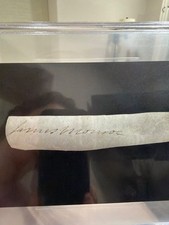
James Monroe[a](April 28, 1758– July 4, 1831) was an AmericanFounding Fatherwho served as the fifthpresident of the United Statesfrom 1817 to 1825. He was the last Founding Father to serve as president as well as the last president of theVirginia dynasty. Monroe was a member of theDemocratic-Republican Party, andhis presidencycoincided with theEra of Good Feelings, concluding theFirst Party Systemera of American politics. He issued theMonroe Doctrine, a policy of limiting European colonialism in the Americas. Monroe had previously served as Governor ofVirginia, a member of theUnited States Senate, U.S. ambassador to France and Britain, the seventh secretary of state, and the eighth secretary of war.
In 1789, Josiah Meigs leftNew Haven, Connecticut, forSt. George, Bermuda, where he practiced law and was involved in defending the owners of U.S. vessels that had been captured byBritishprivateers.[2]In 1794 he returned to the United States and took the chair of mathematics and natural philosophy at Yale. As aRepublican, he was in conflict with theFederalistswho ran Yale.[3]He taught there until 1801 when he was chosen as the first acting president of theUniversity of GeorgiainAthens. His salary at Georgia was fixed at $1500 annually, and he was given $400 in moving expenses for his family.
At Georgia, Meigs implemented the university's firstphysicscurriculum in 1801. He resigned as president on August 9, 1810, after clashing with the university's board of trustees; however, he continued on in the position of Professor of Mathematics, Natural Philosophy and Chemistry for one more year.
After his academic career at the University of Georgia, Meigs was appointedSurveyor Generalby PresidentJames Madisonin 1812, and relocated toCincinnati.[4]Meigs, however, was astronomer more than surveyor and took instruction from his predecessor, Jared Mansfield, by correspondence and from his clerks in the Washington, D.C. office.[5]He then accepted an appointment as Commissioner of theUnited States General Land OfficeinWashington, D.C., in 1814. During his tenure at theUnited States General Land Office, serving underJames Monroe, he instituted the nation's first system of dailymeteorologicalobservations at the land offices throughout the country, which evolved into theNational Weather Service.